

TL;DR
Every piano chord symbol has two parts: a root (the letter, maybe with a sharp or flat) and a quality (everything after it — m, 7, maj7, sus4, dim). The root tells you where to put your thumb; the quality tells you how far apart the other fingers go, measured in semitones. Learn four distances — 3, 4, 7 and 10 semitones — and you can build most chords in pop, rock and folk without a chart. Until then, the free piano chords chart does the decoding for you: pick a root and a type, and it highlights the keys, names the notes, lists the semitone gaps and plays the chord. Each common chord also has its own page, such as C major or G7, with every inversion drawn out.
In this guide
- What a chord symbol tells you
- The four distances that build most chords
- Step by step with the chord chart
- Reading a chord page and its inversions
- A decoding table for the common symbols
- Practice routine for the first week
- Common mistakes
- FAQ
What a chord symbol tells you
A lead sheet, a chord chart above lyrics, or a guitar tab site will give you something like this:
C          G          Am         F
When the night has come and the land is dark
Those four letters are the entire accompaniment. Each one is a chord symbol, and each symbol answers two questions:
- Which note is the root? The capital letter, plus
#(sharp, one key to the right) orb(flat, one key to the left).Cis C.Bbis the black key just left of B.F#is the black key just right of F. - What kind of chord is built on it? Nothing after the letter means a major triad. A lowercase
mmeans minor. A number adds a note (7,9,6). Words and abbreviations change a note (sus4,dim,aug,maj7).
That is it. There is no separate "hand shape" to memorise for every symbol; there is one rule for each quality, applied from whichever root you are given. The same rule that turns C into C–E–G turns D into D–F#–A. That is why a chart with 12 roots and 16 chord types — 192 chords — is really only 16 things to learn.
The four distances that build most chords
On a piano, a semitone is the gap from one key to the very next key, black or white. Count them and chords stop being mysterious:
- 4 semitones up from the root = a major third. This is what makes a chord major and bright.
- 3 semitones up = a minor third. Swap the 4 for a 3 and the same chord turns minor and darker.
- 7 semitones up = a perfect fifth. Almost every chord has it; it is the stable "frame".
- 10 semitones up = a minor seventh. Add it on top and you get the tense, bluesy sound of a
7chord.
So:
- Major = root, +4, +7. C major: C, E, G.
- Minor = root, +3, +7. A minor: A, C, E.
- Dominant seventh (
7) = root, +4, +7, +10. G7: G, B, D, F. - Major seventh (
maj7) = root, +4, +7, +11. Cmaj7: C, E, G, B. - Minor seventh (
m7) = root, +3, +7, +10. Am7: A, C, E, G.
The chart prints these numbers under every chord as "Semitones above the root", so you can check your own counting against it rather than trusting a picture.
Step by step with the chord chart
The piano chords chart is free, needs no account, and runs in the browser — nothing to install. Here is the whole workflow using Am, the third chord of that example progression.
- Open the chart. You will see two rows of buttons: Root (C, Db, D, Eb, E, F, F#, G, Ab, A, Bb, B) and Chord type (major, m, dim, aug, sus2, sus4, 6, m6, 7, maj7, m7, m7b5, dim7, 9, m9, add9).
- Pick the root. Press A.
- Pick the quality. The symbol says
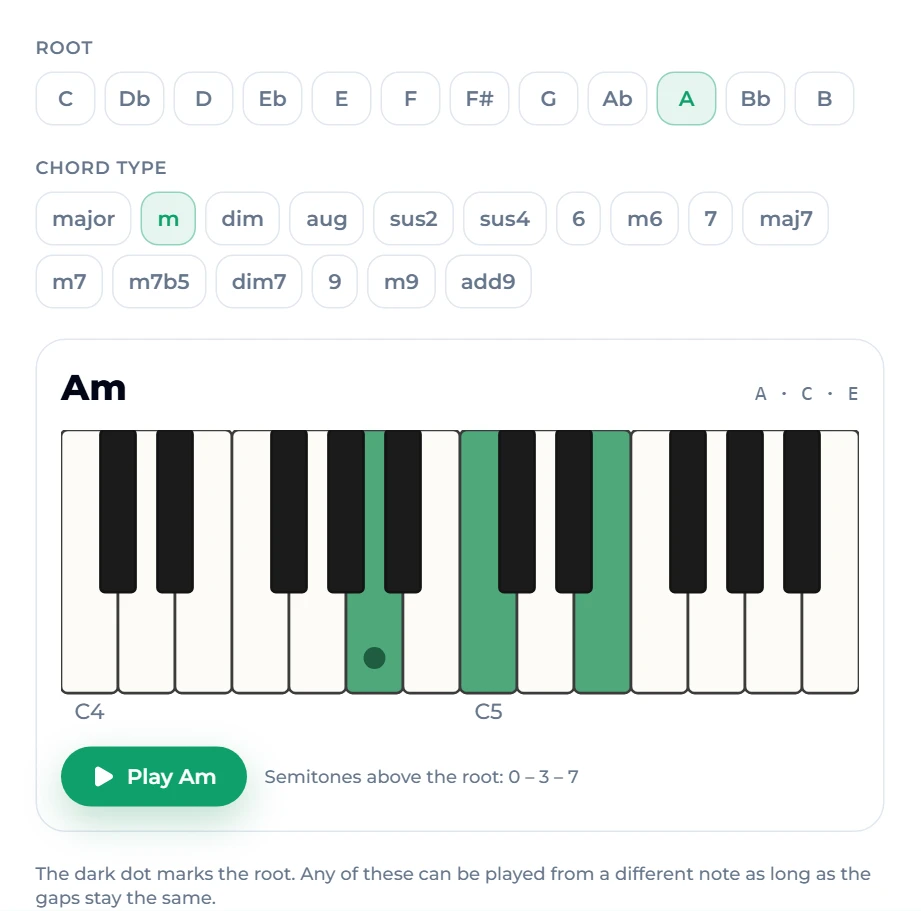
Am, so press m. - Read the card. It now says Am, lists the notes as A · C · E, highlights those three keys across a two-octave keyboard starting at C4 (middle C), and marks the root with a dark dot. Underneath: Semitones above the root: 0 – 3 – 7.
- Press Play Am. The chord sounds, so you can check your ear against the diagram — useful when you have played something that "looks right" and sounds wrong.
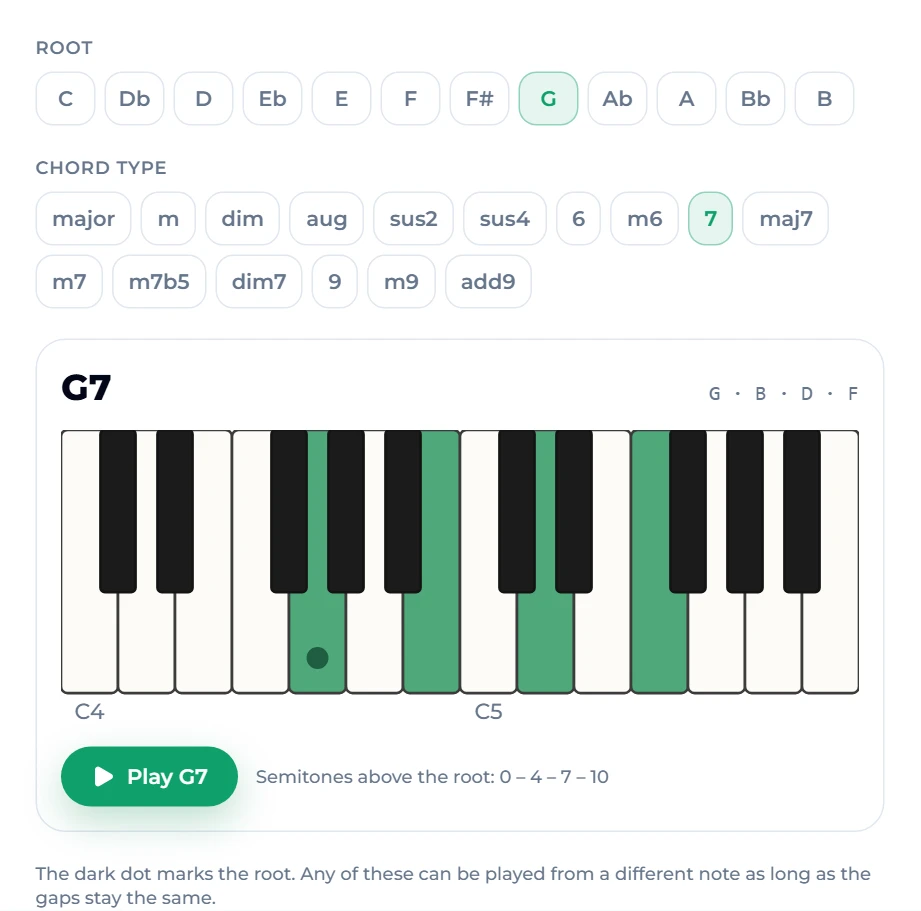
Now do the same for a four-note chord. Press G, then 7. The card switches to G7 · G · B · D · F, four keys lit, 0 – 4 – 7 – 10. Compare it with plain G (0 – 4 – 7) and you can see exactly what the 7 does: one extra key, ten semitones above the root. The chart's hint says the rest: any of these shapes can be played from a different starting note as long as the gaps stay the same — which is the whole trick of reading chords.
Reading a chord page and its inversions
The chart shows chords in root position — root at the bottom — because that is the clearest way to see what a chord is made of. Real accompaniment rarely stays there. If you play C, G, Am and F all in root position, your hand jumps up and down the keyboard on every change. Pianists avoid that with inversions: the same notes, stacked with a different one at the bottom.
That is what the individual chord pages are for. Every common chord has one: C major, A minor, F major, G7, D minor, E minor and the rest — twelve roots by ten types, each at /piano-chords/<root>-<type>. On the G7 page you get:
- The chord itself with its notes (G · B · D · F), its intervals and one line on how it behaves — "unstable on purpose, and it wants to resolve a fourth up".
- Every inversion drawn separately. Root position (bass G), inversion 1 (B · D · F · G, bass B), inversion 2 (D · F · G · B, bass D) and inversion 3 (F · G · B · D, bass F). Each diagram plays when you press it.
- Keys that contain it, with the Roman numeral it takes there. G7 lives in C major as the V chord.
- A progression that actually uses it, spelled out in chords you can play.
- Links sideways: other chords on the same root (G, Gm, G6, G9…), and the same chord type on other roots (C7, D7, E7…).
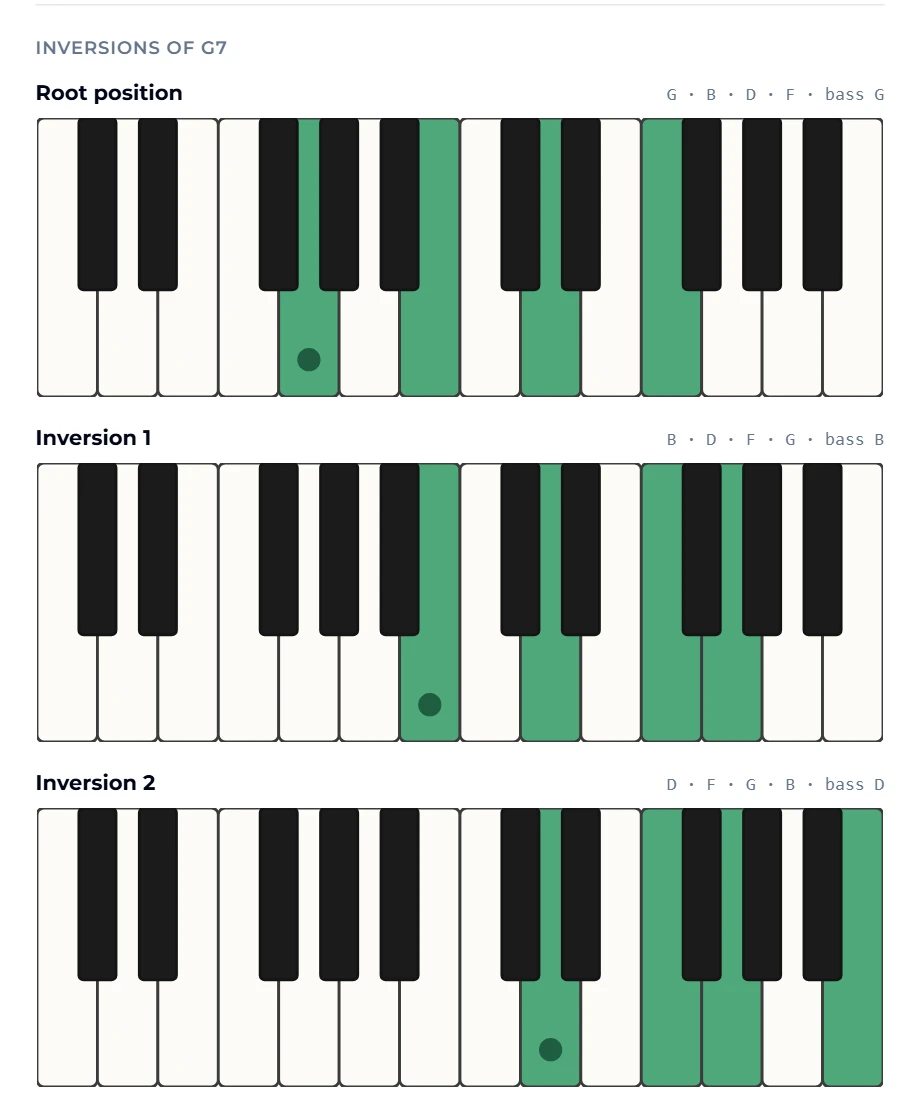
Here is why inversions matter in practice. Going from C (C–E–G) to G7, the closest G7 is the second inversion (D–F–G–B): your hand barely moves — C drops a semitone to B, E slides up to F, G stays, and the D goes under. Two fingers move one key each. That smoothness is what separates an accompaniment that sounds "played" from one that sounds "clicked in".
A decoding table for the common symbols
Use this as a cheat sheet. Every row is a rule you can apply from any root; the example is built on C so you can check it on the chart.
| Symbol | Name | Semitones above root | Example on C |
|---|---|---|---|
| C | major | 0 – 4 – 7 | C E G |
| Cm | minor | 0 – 3 – 7 | C Eb G |
| Cdim | diminished | 0 – 3 – 6 | C Eb Gb |
| Caug | augmented | 0 – 4 – 8 | C E G# |
| Csus2 | suspended 2nd | 0 – 2 – 7 | C D G |
| Csus4 | suspended 4th | 0 – 5 – 7 | C F G |
| C6 | major sixth | 0 – 4 – 7 – 9 | C E G A |
| C7 | dominant seventh | 0 – 4 – 7 – 10 | C E G Bb |
| Cmaj7 | major seventh | 0 – 4 – 7 – 11 | C E G B |
| Cm7 | minor seventh | 0 – 3 – 7 – 10 | C Eb G Bb |
| Cm7b5 | half-diminished | 0 – 3 – 6 – 10 | C Eb Gb Bb |
| Cdim7 | diminished seventh | 0 – 3 – 6 – 9 | C Eb Gb A |
| C9 | dominant ninth | 0 – 4 – 7 – 10 – 14 | C E G Bb D |
| Cadd9 | added ninth | 0 – 4 – 7 – 14 | C E G D |
Two symbols trip people up more than the rest:
C7versusCmaj7. The7alone means the flattened seventh (Bb), the tense one.maj7means the natural seventh (B), a soft, jazzy colour. They are one semitone apart and sound nothing alike.- Slash chords like
C/E. The part before the slash is the chord; the part after is the bass note.C/Eis a C major chord with E in the bass — in other words, the first inversion. Once you know inversions, slash chords are just inversions written down.
Practice routine for the first week
Ten minutes a day is enough to stop needing the chart for the common chords.
- Days 1–2: the four-chord song. C, G, Am, F. Find each on the chart, play it, then play all four in a loop with the right hand while counting four beats per chord. This progression is under an enormous number of pop songs.
- Day 3: minor from major. For C, D, E, F, G and A, play the major chord, then lower the middle note one key to make it minor. Check each against the chart.
- Day 4: sevenths. Add the 10-semitone note on top of G, C and D to get G7, C7 and D7. Then try Cmaj7 and hear how different it is.
- Day 5: inversions. Open the C major page and play the three positions. Then loop C → G7 using the closest shapes described above.
- Days 6–7: a real song. Take any song's chord sheet and decode each symbol yourself first, using the chart only to check.
If you want to know why C, G, Am and F belong together — and which other chords you can swap in — the next step is the circle of fifths. Our guide on how to use the circle of fifths picks up exactly where this one stops, and the interactive circle of fifths shows the seven chords of any key. When a song sits too high to sing, transpose music moves every chord symbol in a chord sheet up or down for you.
Common mistakes
- Reading
mas "major". Lowercasem(ormin) is minor. Major is either nothing ormaj, andmajonly appears in front of a 7 or 9. - Counting white keys instead of semitones. From E to F is one semitone with no black key in between; the same is true from B to C. Count every key, black or white.
- Forgetting the black key in D, E and A major. D major is D–F#–A, E major is E–G#–B, A major is A–C#–E. If your D major sounds sad, you have played D minor.
- Treating the diagram position as the only right one. The chart shows root position so you can see the structure. Any arrangement of the same notes is the same chord; the chord page's inversions are there to prove it.
FAQ
What is the easiest way to read piano chords as a beginner?
Learn the rule, not the picture: root plus 4 and 7 semitones is major, root plus 3 and 7 is minor. Then check yourself on the piano chords chart, which names the notes and plays the chord so you can hear whether you got it right.
Which piano chords should I learn first?
C, G, Am and F cover a huge share of pop songs and all sit comfortably near middle C. Add D, Em and A next, then the seventh chords G7, C7 and D7. The chord pages for each — for example E minor — show which keys they belong to, which is a faster way to learn them in useful groups.
What does the number after a chord mean?
It adds a note counted in scale steps from the root. 7 adds the flattened seventh, 9 adds the ninth (on top of the seventh), 6 adds the sixth. add9 adds the ninth without the seventh. The chart lists the exact semitone gaps for every one.
What is a chord inversion?
The same notes with a different one at the bottom. C major in root position is C–E–G; first inversion is E–G–C; second is G–C–E. Inversions let your hand move smoothly between chords. Every chord page draws each inversion and plays it.
Why is C# major written with an E# instead of F?
Because chord notes are named by their scale step, not by the key you press. The third of any C chord is some kind of E, so a raised one is E#. It is the same key as F on the piano; the name tells you its job in the chord.
Do I need to sign up to use the chord chart?
No. The chart, the 120 individual chord pages, the circle of fifths and the transposer are free and run in your browser without an account.
Final take
Reading piano chords is not memorising 192 shapes; it is recognising a root, reading a quality, and counting semitones. Spend a week decoding symbols yourself and checking them on the chord chart, use the individual chord pages to learn inversions so your hands stop jumping, and move on to the circle of fifths when you want to know which chords belong together. And when you have a progression you like and want to hear it as a finished song with a full arrangement and vocals, write it into the lyrics or style of a track in the AI music generator and let it build the rest.