

TL;DR
The circle of fifths is the twelve major keys arranged so that neighbours share almost all their notes. That one property makes it a tool for three everyday jobs. Key signatures: count steps clockwise from C for sharps, anticlockwise for flats. Chords that fit: in any key, the chords on the two neighbouring wedges are the IV and V, and the three minors tucked inside are the ii, iii and vi — six of the seven chords a song in that key usually uses. Where to go next: a neighbour is the smoothest key change. The free interactive circle of fifths shows all of this for whichever key you press — sharps or flats, relative minor, the seven chords, and the scale on a keyboard, with sound — and the chord progression generator turns it into four chords you can play and copy.
In this guide
- What the circle actually shows
- Step by step with the interactive circle
- Use 1 Read any key signature
- Use 2 Find the chords that belong together
- Use 3 Turn it into a progression
- Use 4 Change key without a bump
- Common mistakes
- FAQ
What the circle actually shows
Start at C at the top. Move one wedge clockwise and you land on G, the note a perfect fifth (seven semitones) above C. Move again and you reach D, a fifth above G. Keep going — A, E, B, F# — and after twelve steps you are back at C. That is the "circle of fifths": the twelve keys ordered by fifths instead of alphabetically.
Why that order? Because each step clockwise changes exactly one note of the scale. C major has no sharps. G major is identical except F becomes F#. D major keeps that F# and adds C#. So two keys next to each other on the circle are near-twins, and keys on opposite sides (C and F#) share almost nothing.
The inner ring holds the relative minors: the minor key that uses exactly the same notes as the major key on the same wedge. A minor sits inside C, E minor inside G, B minor inside D. Same notes, different home note.
At the bottom of the circle the two spelling systems meet. F# major (six sharps) and Gb major (six flats) are the same keys on a piano written two ways; the same goes for Db and C#. The interactive circle labels each wedge with the spelling musicians meet most often — F# on the sharp side, Db, Ab, Eb, Bb and F on the flat side.
Step by step with the interactive circle
The circle of fifths tool is free, needs no sign-up and runs in your browser. Here is a real run using D major.
- Open the page. You see twelve major keys around the outside and their relative minors on the inner ring, with C selected.
- Press the D wedge. It lights up, and the readout underneath switches to D major · Bm.
- Read the key signature line. It says 2 sharps: F# C# — the notes you play sharp everywhere in the key.
- Read the chords row. Seven chords, each with its Roman numeral: I D · ii Em · iii F#m · IV G · V A · vi Bm · vii° C#dim. Press any chip to hear that chord.
- Play the scale. A keyboard below shows the D major scale with D marked as home, and the play button runs it up the octave so the key becomes a sound, not just a diagram.
- Read the neighbours line. It names G and A as D's nearest neighbours — one accidental away each.
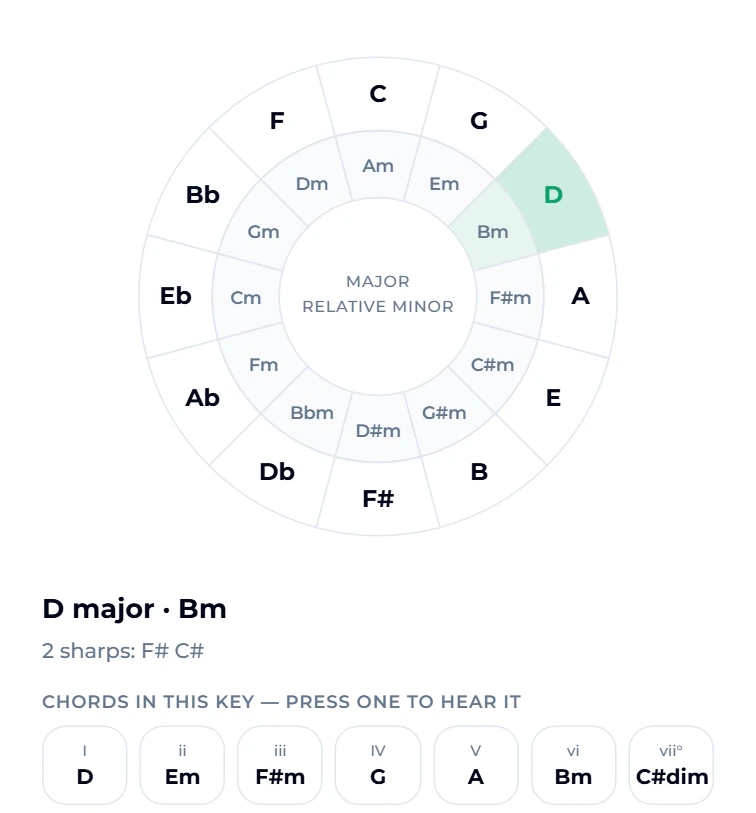
Now look at the circle again. The two wedges beside D are G and A — exactly the IV and V in the chords row. The minors inside D and its neighbours are Bm, Em and F#m — the vi, ii and iii. Six of the seven chords are sitting in one slice of the circle. That is the most useful thing it will ever tell you.
Use 1 Read any key signature
You never need to memorise twelve key signatures; you need two orders.
- Sharps come in the order F C G D A E B. Count wedges clockwise from C. G is one step: one sharp, F#. D is two: F# and C#. A is three: F#, C#, G#. E is four, B is five, F# is six.
- Flats come in the order B E A D G C F — the sharps backwards. Count anticlockwise from C. F is one: Bb. Bb is two: Bb, Eb. Eb is three, Ab four, Db five.
A handy check: in a sharp key, the last sharp is one semitone below the key's name (D major's last sharp is C#). In a key with two or more flats, the second-to-last flat is the key's name (Eb major's flats are Bb, Eb, Ab).
The tool prints the answer for every wedge ("3 flats: Bb Eb Ab" for Eb), so use it to check yourself until the counting is automatic.
Use 2 Find the chords that belong together
Every major key has seven chords built from its own scale, and they always come in the same pattern of qualities:
| Degree | I | ii | iii | IV | V | vi | vii° |
|---|---|---|---|---|---|---|---|
| Quality | major | minor | minor | major | major | minor | diminished |
| In C | C | Dm | Em | F | G | Am | Bdim |
| In G | G | Am | Bm | C | D | Em | F#dim |
| In D | D | Em | F#m | G | A | Bm | C#dim |
Upper-case numerals are major chords, lower-case are minor, and ° marks the diminished one. On the circle, the pattern has a shape: the home key and its two neighbours are the three major chords (I, IV, V); the three minors on the inner ring under them are vi, ii and iii. Only the diminished vii° sits elsewhere, and most pop songs skip it anyway.
This is why a songwriter with a guitar and no theory still finds chords that "work": they are reaching for neighbours. If you want to see exactly which keys to press for any of these, the piano chords chart builds each one — our guide on how to read piano chords covers that step.
Use 3 Turn it into a progression
Knowing the seven chords is half the job; the other half is ordering them. The chord progression generator does that part.
- Pick the key from the drop-down (C through B, all twelve).
- Pick the mode — Major or Minor.
- Read the four chord cards. With G and Major, our run gave G · D · Em · C — the I – V – vi – IV progression behind a remarkable number of pop songs.
- Press Play. It plays the four chords as plain triads, two beats each at 90 BPM, so you hear the movement rather than a piano sound.
- Press Shuffle until one sounds like the song in your head. Each key has eight shapes to draw from in each mode.
- Press Copy chords. The names land on your clipboard (for example
G – D – Em – C), ready to paste above your lyrics.
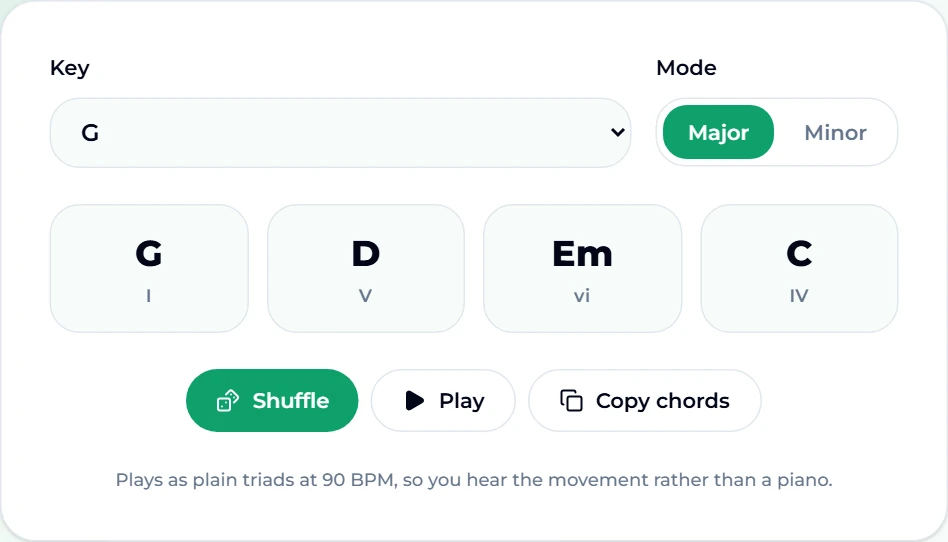
Switch to Minor and pick A, and one of the shapes is Am · F · C · G — i – VI – III – VII, the brooding cousin of the four-chord pop progression. Notice those are the same four chords as C major's vi – IV – I – V, just starting from Am. That is the relative-minor relationship from the inner ring, heard instead of read.
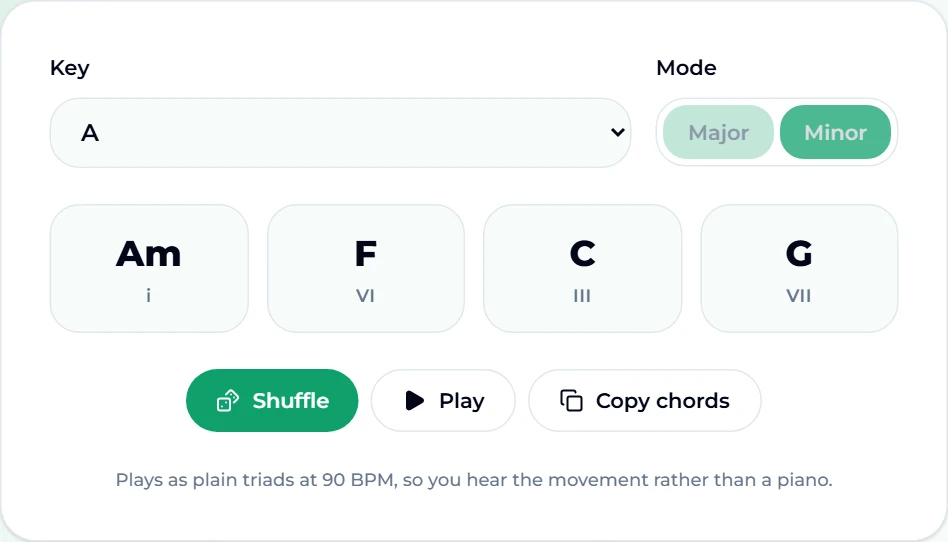
Each card shows the numeral under the chord name in the same convention: capitals for major, lower case for minor.
Some shapes worth knowing, all of which the generator hands out:
- I – V – vi – IV (G D Em C): the anthem shape.
- vi – IV – I – V (Em C G D): the same chords starting on the minor; more wistful.
- I – IV – V – I (G C D G): folk, country, early rock and roll.
- ii – V – I (Am D G): the jazz cadence, and the strongest "arriving home" sound there is.
Use 4 Change key without a bump
A key change sounds natural when the new key shares most notes with the old one, and the circle tells you which keys those are: the neighbours. From C, moving to G or F changes one note. Moving to the relative minor (Am) changes none. Moving across the circle to F# changes six, which is why that jump sounds dramatic.
Practical recipes:
- A lift for the last chorus: go up a step (C to D, G to A). That is two wedges clockwise — a deliberate, noticeable change. Pop songs have done it for decades.
- A bridge that feels different but connected: go to the IV key (one wedge anticlockwise) or the relative minor.
- Pivot chords: find a chord both keys share. C major and G major both contain Em, Am, C and G, so passing through one of those makes the change almost invisible.
If the song simply sits in the wrong range for your voice, you do not need a modulation — you need to move everything. Transpose music shifts every chord symbol in a chord sheet by the number of semitones you choose, and keeps the lyrics lined up underneath.
Common mistakes
- Reading the circle as "the order of notes". Neighbours are a fifth apart, not a step apart. For stepwise order, use the keyboard under the readout.
- Counting the relative minor from the wrong place. It starts on the sixth note of the major scale, three semitones below the major key's name: C → A, G → E, D → B.
- Expecting the minor-key chords to match major-key numerals. In A minor, the chords are i (Am), ii° (Bdim), III (C), iv (Dm), v (Em), VI (F), VII (G). Same notes as C major, different home, different numbers.
- Forgetting enharmonics. Db and C# are the same key. If a chord chart uses one and your key signature the other, you have not made a mistake; you have met the bottom of the circle.
- Only reading, never listening. Press the chords. Your ear learns "IV feels like leaving, V feels like wanting to come back" faster than your eyes learn the diagram. The chord progression ear training drill tests exactly that.
FAQ
What is the circle of fifths used for?
Three jobs: reading key signatures (count wedges from C), finding the chords that fit a key (the key, its two neighbours and the three minors inside them), and choosing a smooth key change (a neighbour). The interactive version shows all three for any key you press.
How do I find the relative minor of a key?
It sits on the inner ring of the same wedge. Mathematically, it is the sixth note of the major scale — three semitones below the major key's name. C major's relative minor is A minor, G's is E minor, F's is D minor.
Why is it called the circle of fifths?
Each clockwise step moves up a perfect fifth — seven semitones — and after twelve steps you return to where you started. Going anticlockwise moves in fourths, which is why some teachers call that direction the circle of fourths.
Which chords go together in a key?
In a major key: I, ii, iii, IV, V, vi and vii°. On the circle, that is the home key and its two neighbours (major chords I, IV, V) plus the three minors inside them (vi, ii, iii). The tool lists all seven by name for any key you select.
Can I use the progressions from the generator in my own songs?
Yes. Chord progressions are common property; nobody owns I – V – vi – IV. What you write on top — melody, lyrics, arrangement — is yours.
Is the circle of fifths tool free?
Yes. The circle, the chord progression generator, the piano chords chart and the transposer all run in your browser without an account.
Final take
Treat the circle of fifths as a map, not a poster. Press a key on the interactive circle, and you get its sharps or flats, its relative minor and its seven chords in one glance; notice that six of those chords live in one slice of the circle, and you will never pick a chord at random again. Then let the chord progression generator give you an order to play them in, shuffle until it sounds right, and copy it. If you also need a key to start from, the random key generator picks one for you. When you have a progression and a lyric and want to hear it as a full song, describe the feel and paste your lyrics into the AI music generator — a good progression gives it a strong starting point.