
TL;DR
Perfect pitch (absolute pitch) is the ability to name a note — "that's an F#" — with no reference note to compare it to. It is rare: the usual estimate is about one person in ten thousand, higher among people who started music very young. To test it fairly, open the free perfect pitch test, play a single note, pick one of twelve note names, and do at least 20 questions — first in one octave, then across three. Do not play or hum any reference note before or during the test. Scoring 9 out of 10 or better across the wide range, quickly and without working it out, suggests genuine absolute pitch. Scoring around 1 in 12 is chance. Almost everything in between is relative pitch working hard — which is the more useful skill anyway, and the one you can train with ear training.
In this guide
- Perfect pitch vs relative pitch
- How to take the test fairly
- Step by step
- What your score means
- The traps that inflate a score
- Can adults learn perfect pitch
- Using a reference tone
- FAQ
Perfect pitch vs relative pitch
There are two ways to know what note you are hearing.
- Absolute pitch is recognising a note the way you recognise a colour. Someone with it hears a car horn and says "that's roughly a B-flat" with no piano nearby. It is mostly acquired in early childhood, is more common among speakers of tonal languages such as Mandarin and Cantonese, and is rare in adults who did not grow up with music.
- Relative pitch is recognising the distance between notes. Give a musician with good relative pitch one reference — "this is an A" — and they can name everything that follows, by interval. Nearly all professional musicians rely on this.
A fair perfect pitch test therefore has one job: take away every possible reference, so relative pitch has nothing to work from.
How to take the test fairly
Before you start:
- Do not listen to music for twenty minutes or so beforehand. A song still in your head gives you a reference.
- Do not play, sing or hum any note before a question. That includes tuning your guitar "just to check".
- Use headphones or speakers at a comfortable, fixed volume. Some people associate loudness with pitch; keep it constant.
- Answer quickly. People with absolute pitch name a note almost instantly. If you find yourself singing up a scale from an imagined C, that is relative pitch — note it, and be honest in how you read the score.
- Do enough questions. Five questions can be lucky. Twenty in one octave and twenty across three give you a real picture.
Step by step
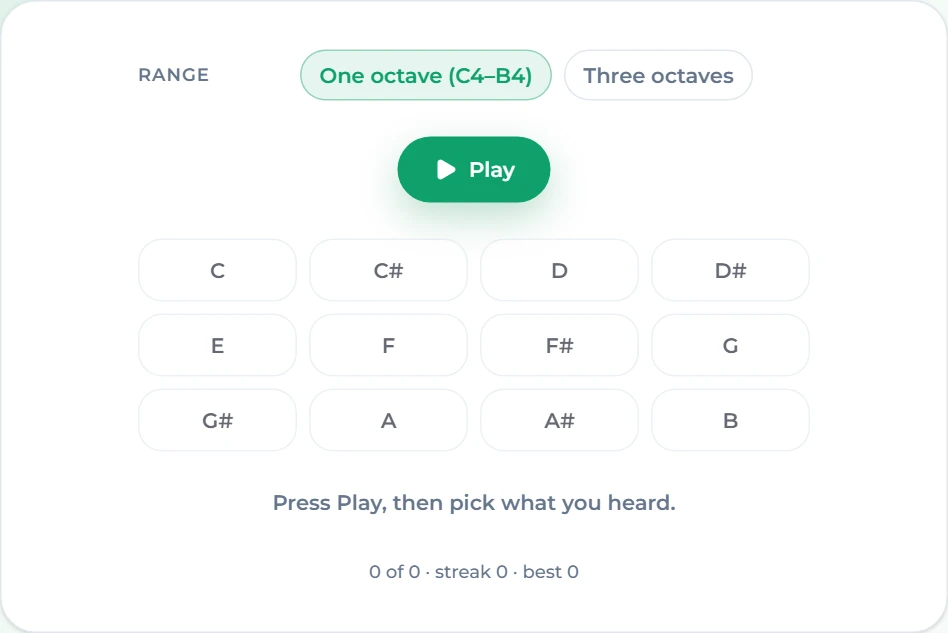
The perfect pitch test is free, needs no account, and generates its questions in your browser, so no answer is ever in the page for you to peek at.
- Choose a Range. Start with One octave (C4–B4), the octave above middle C. Once that feels steady, switch to Three octaves, where the note may come from anywhere between C3 and B5.
- Press Play. A single note sounds for just over a second. You can press Play again — the same note, so replaying is allowed.
- Pick one of the twelve buttons, C to B. Sharps are used for the black keys (C#, D#, F#, G#, A#). The octave does not matter — a C is a C in any octave.
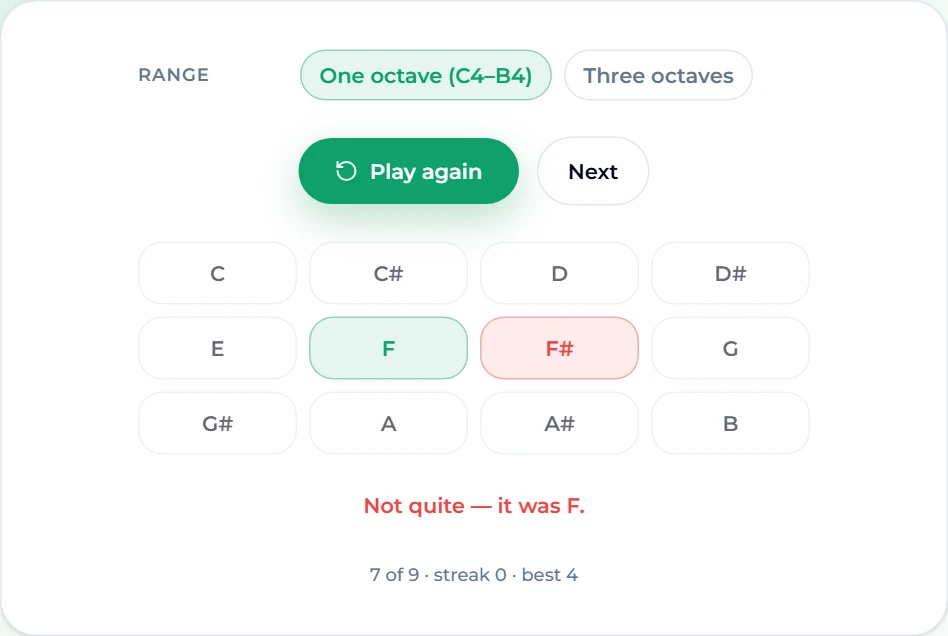
- Read the feedback. A correct answer lights green; a wrong pick turns red and the page tells you the right note.
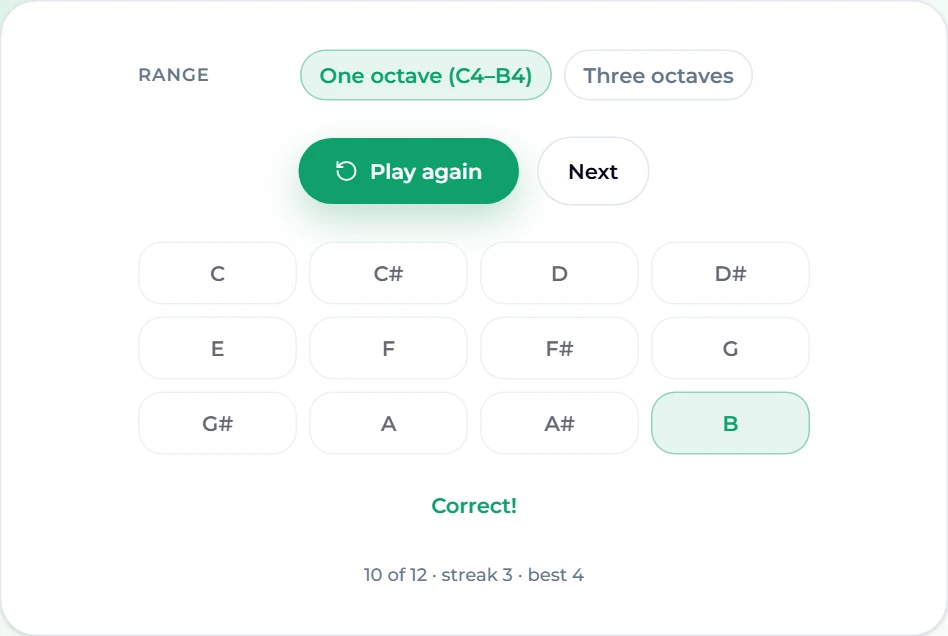
- Press Next and keep going. The line at the bottom keeps your score, your current streak and your best streak.
This is the one-octave setting before the first question:
And here is a miss, nine questions in: the note was F, the answer given was F#. Notice the kind of error — one semitone off. That is typical of someone with a strong sense of pitch who is not quite locked on, and it is very different from random wrong answers:
After twelve questions the same run stood at 10 of 12, both misses a semitone away:
What your score means
With twelve possible answers, random guessing scores about 8% — one in twelve. Here is a rough guide for a 20-question round with no reference:
| Score | Likely explanation |
|---|---|
| 1–3 of 20 | Chance. Completely normal — this is where most people land. |
| 4–9 of 20 | Some pitch memory, often for one or two familiar notes (the open strings of your instrument, a song you know in its original key). |
| 10–16 of 20 | A strong pitch memory. Look at your misses: if they are mostly one semitone off, you have a good "pitch neighbourhood" but not precise labels. |
| 17–20 of 20, fast, also in three octaves | Consistent with absolute pitch. |
Two things to check before celebrating a high score:
- Did it survive the wide range? Getting one octave right can come from memorising how those twelve particular notes sound. Absolute pitch is about the pitch class in any octave, which is exactly what the Three octaves setting tests.
- Were your misses near or far? Semitone slips suggest a real but fuzzy pitch sense. Answers scattered all over the keyboard suggest guessing, even if a streak happened.
The traps that inflate a score
- Using the previous question as a reference. This is the big one. If you know the last note was an A, and the next one sounds "a bit higher", relative pitch fills in the rest. To reduce it, wait a few seconds between questions, or hum something unrelated in between.
- Instrument memory. Guitarists often "know" E and A because they hear their open strings daily; pianists know middle C. That is pitch memory for a few anchors, not full absolute pitch — though it is a genuinely useful skill.
- Too few questions. Three correct in a row happens by chance about once in 1,700 runs — rare, but with thousands of people taking tests online, somebody will get it and wonder.
- Playing a note first "to calibrate". Any reference turns the test into an interval test.
Can adults learn perfect pitch
True absolute pitch — instant, effortless naming of any note across the range — is very rarely acquired in adulthood. Research on training adults has produced improvements, but they tend to be partial and to fade without constant practice.
What adults can realistically build:
- One or two anchor notes. Many musicians learn to recall an A or a C reliably — by singing it first thing in the morning and checking it, day after day. With an anchor in memory, relative pitch does the rest.
- Strong relative pitch. This is what actually makes you better at playing by ear, transcribing and singing in tune. Start with interval ear training and the rest of the ear training drills; our guide on how to train your ear has a ten-minute daily routine.
- Pitch awareness in your voice. The pitch detector names the note you sing and how many cents off it is. Try singing your anchor note from memory, then check it.
The perfect pitch test is a good way to measure progress on anchors: if your right answers cluster around the note you have been practising, it is working.
Using a reference tone
If you are practising an anchor note, you need an exact reference to check against. The frequency generator plays a steady tone at any frequency from 20 Hz to 20 kHz and shows the nearest note name. It opens at 440 Hz — A4, the standard tuning pitch:
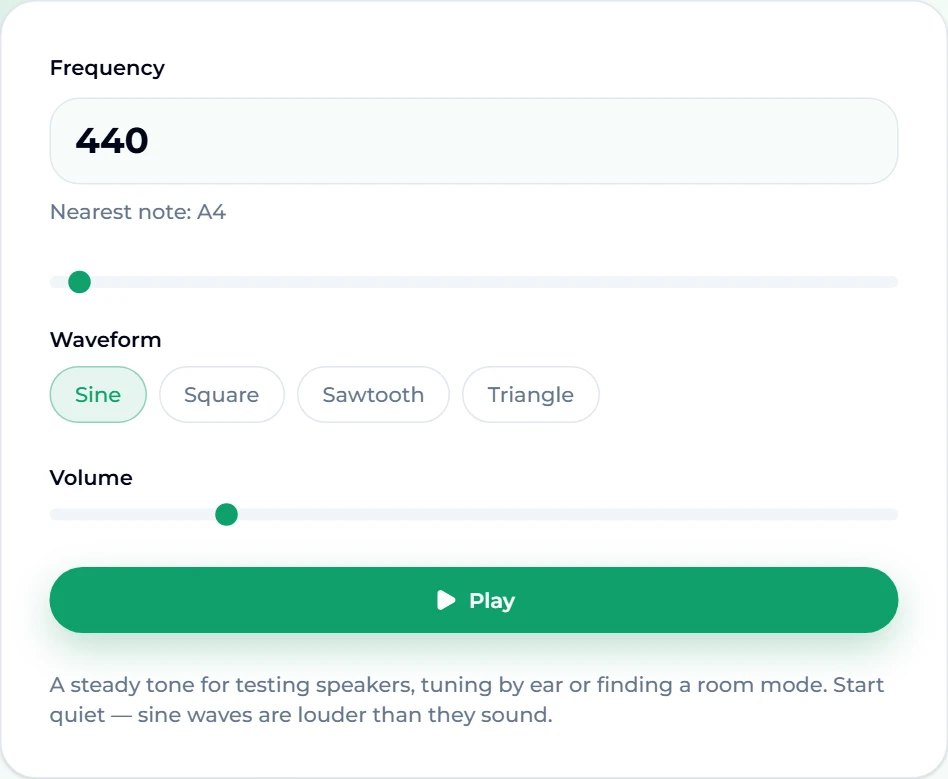
A practice loop that works: before looking, sing what you think A4 is; then play 440 Hz on a sine wave at low volume and compare. Some useful reference frequencies:
| Note | Frequency |
|---|---|
| C4 (middle C) | 261.63 Hz |
| E4 | 329.63 Hz |
| G4 | 392.00 Hz |
| A4 | 440.00 Hz |
| C5 | 523.25 Hz |
Never use the reference during the perfect pitch test itself — that turns it back into a relative pitch test.
FAQ
How rare is perfect pitch?
Commonly estimated at about one in ten thousand people in the general population. It is much more common among musicians who began training before about age six, and among native speakers of tonal languages.
Is perfect pitch better than relative pitch?
Not for most musical work. Relative pitch is what you use to play by ear, harmonise and transpose. Absolute pitch can even be a nuisance when a song is played in a different key or an orchestra tunes slightly off 440 Hz.
Why does the test only ask for note names, not octaves?
Absolute pitch is about the pitch class — recognising C as C whether it is high or low. The Three octaves setting tests exactly that: the same twelve answers, with the note drawn from three different octaves.
What does it mean if I keep choosing a note one semitone off?
You probably have a good sense of where notes sit but not precise labels. That is common and trainable in the sense of anchor notes; it is not the same as absolute pitch.
Is the test free, and is anything recorded?
It is free, needs no account, and makes all its sounds on your device. It does not use the microphone at all — you answer by clicking — and nothing is uploaded.
Can a child be tested?
Yes, and young children who have started music lessons are the most likely to show absolute pitch. Keep it playful, use the one-octave range, and do not read too much into one session.
Final take
A fair perfect pitch test takes five minutes and one rule: no reference notes, ever. Run twenty questions in one octave and twenty across three on the perfect pitch test, look at how far off your misses were, and read the score honestly. If you have it, you will know. If you do not — like almost everyone — the time is better spent on relative pitch with the ear training drills, and on building an anchor note or two with the frequency generator as your reference.