
TL;DR
Ear training is practice at naming what you hear: how far apart two notes are (intervals), whether a chord is major or minor (chord quality), which familiar pattern a set of chords follows (progressions), which scale a melody uses, and whether you are on the beat. It is the skill behind playing by ear, transcribing songs, improvising and singing in tune. You get it the way you get any skill: short, frequent rounds with instant feedback. The free ear training drills on Suno AI Music give you exactly that — play, answer, see if you were right, keep a score and a streak — with no account and nothing to install. Do ten minutes a day, start with intervals at the beginner level, and move up only when you are right nine times out of ten.
In this guide
- What ear training actually trains
- The order to learn things in
- Step 1 Intervals
- Step 2 Chords and progressions
- Step 3 Scales
- Step 4 Rhythm
- A 10 minute daily routine
- Habits that make it stick
- FAQ
What ear training actually trains
Most musicians do not have perfect pitch, and they do not need it. What they use is relative pitch: hearing a note in relation to another one. If you know the first note of a melody is a G, relative pitch tells you the next one is a fourth above — a C. Chords work the same way: you hear the relationship between their notes, not their absolute frequencies.
Relative pitch is very trainable at any age. It improves noticeably within two or three weeks of short daily practice, because the ear is being asked a small number of questions over and over, and each answer comes with immediate correction. That is the whole method — and it is why drills beat passive listening.
The order to learn things in
Each skill builds on the one before it, so the order matters:
- Intervals — the atoms. Every chord and melody is made of them.
- Chord qualities — a chord is two or three intervals stacked; hearing major vs minor is hearing a major vs minor third.
- Progressions — chords in sequence, heard relative to the home chord.
- Scales — the set of notes a melody draws from, and the "flavour" that gives it.
- Rhythm — runs in parallel with all of the above; do a round any day.
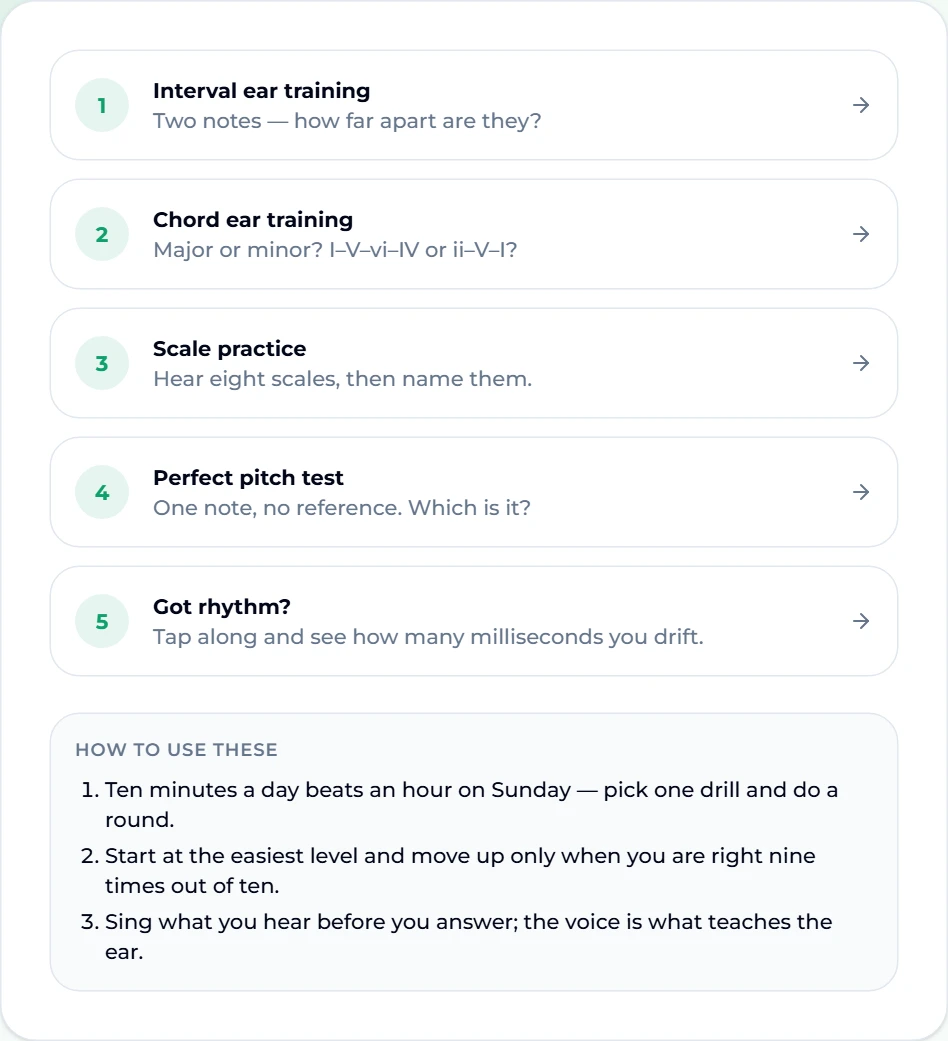
The ear training hub lays the drills out in exactly this order:
Step 1 Intervals
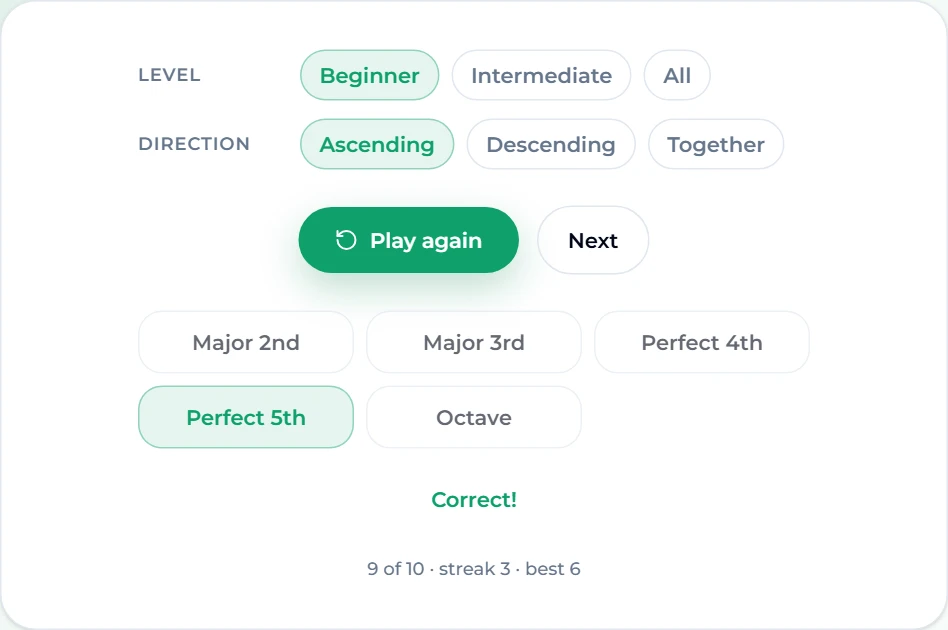
Open interval ear training. Two notes play; you pick the distance between them.
- Set Level to Beginner and Direction to Ascending. Beginner uses the five easiest intervals: major 2nd, major 3rd, perfect 4th, perfect 5th and octave.
- Press Play. Listen to both notes. Press Play again as often as you like — replaying is not cheating, it is practice.
- Sing the two notes quietly before you answer. Your voice is what teaches your ear.
- Pick an answer. The right one lights up; a wrong pick turns red and the page tells you what it was.
- Press Next. The score line keeps count: right answers out of total, your current streak and your best streak.
The first note moves around between C3 and G4, so you cannot memorise a pitch — you have to hear the distance. Here is a ten-question round with one miss (a fifth mistaken for a fourth, the most common beginner confusion):
Anchor each interval to a song. This is the single most effective trick:
| Interval | Semitones | Ascending, sounds like the start of |
|---|---|---|
| Major 2nd | 2 | "Happy Birthday" (on "birth-day") |
| Major 3rd | 4 | "When the Saints Go Marching In" |
| Perfect 4th | 5 | "Here Comes the Bride" |
| Perfect 5th | 7 | "Twinkle Twinkle Little Star" |
| Major 6th | 9 | "My Bonnie Lies Over the Ocean" |
| Octave | 12 | "Somewhere Over the Rainbow" |
Use the song to get started, then try to drop it — the goal is to hear the interval itself. When Beginner reaches nine out of ten, switch Level to Intermediate (adds minor 2nd, minor 3rd, both sixths and both sevenths), then to All (adds the tritone). After that, change Direction to Descending and then Together — melodies go down as often as up, and in harmony the notes sound at once.
Step 2 Chords and progressions
Open chord ear training. It has two modes.
Chord quality. One chord plays; you name it. The Triads level asks major, minor, diminished or augmented. Sevenths adds dominant 7th, major 7th and minor 7th. All adds sus4. Rules of thumb:
- Major sounds bright and settled; minor darker. The difference is one note — the middle one, a major or a minor third above the root.
- Diminished sounds tense and unstable; augmented sounds unresolved, like a question.
- Dominant 7th wants to move somewhere; major 7th is soft and dreamy; minor 7th is mellow.
Progression. Three or four chords play in a random major key, and you pick which of six common progressions it was: I–IV–V–I, I–V–vi–IV, ii–V–I, I–vi–IV–V, vi–IV–I–V and I–IV–vi–V. These six sit under an enormous number of songs — I–V–vi–IV alone is the backbone of hundreds of pop hits.
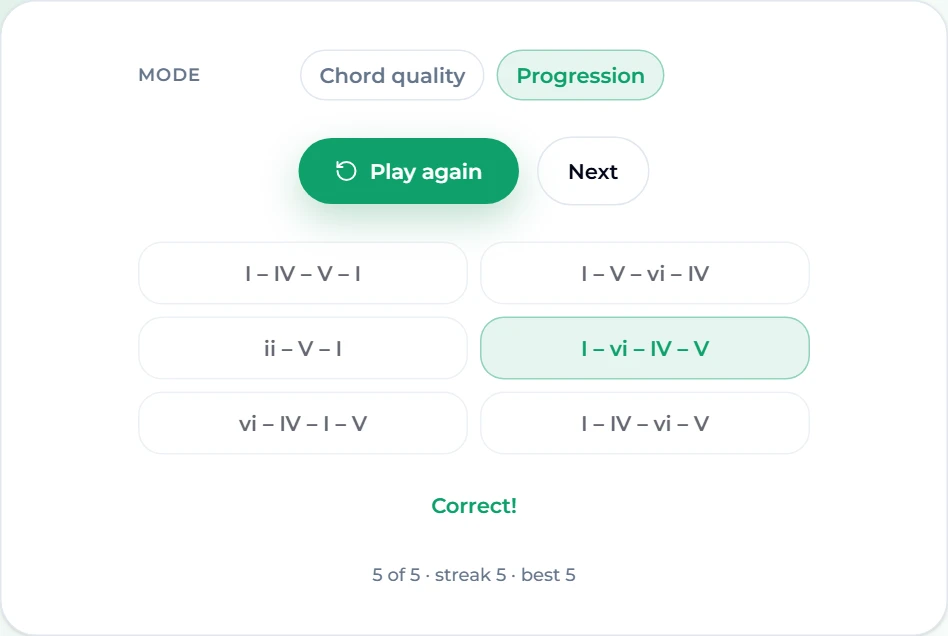
How to tell them apart: count the chords first (ii–V–I is the only three-chord one), then listen for where the home chord lands — first, last, or both — and whether the second chord is major or minor. vi–IV–I–V is the only one that starts on a minor chord.
Step 3 Scales
Open scale practice. It has two tabs, and the first is the one people skip.
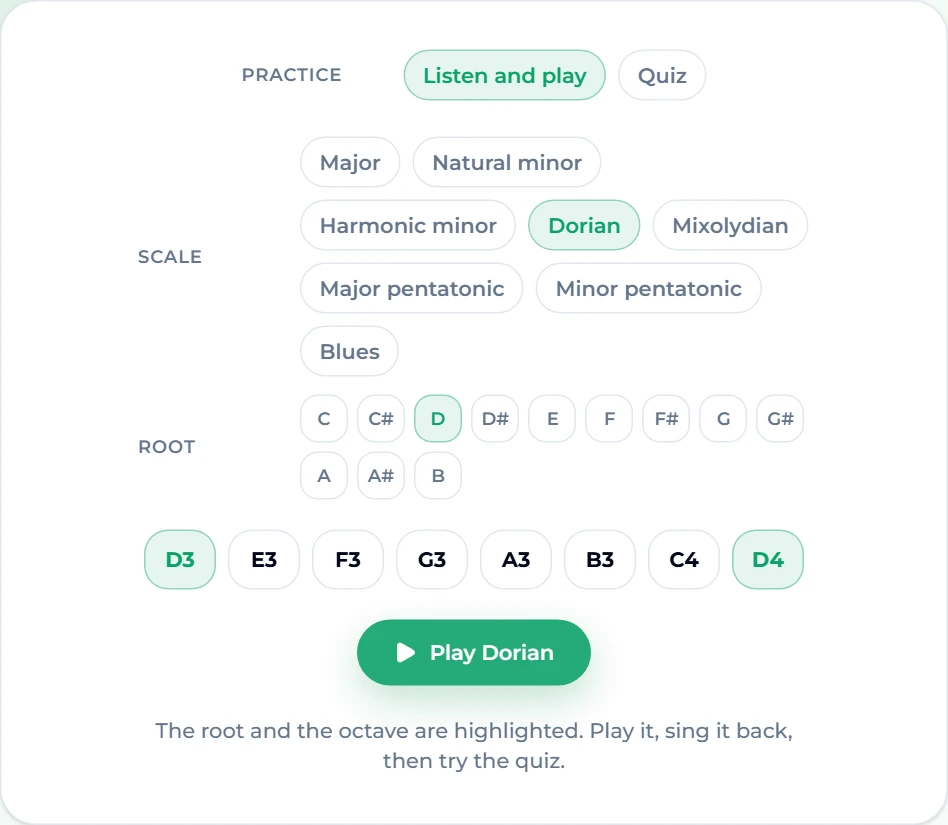
Listen and play. Pick one of eight scales — major, natural minor, harmonic minor, Dorian, Mixolydian, major pentatonic, minor pentatonic, blues — and a root. The notes appear with the root and octave highlighted; press Play and sing it back. Here is D Dorian, D3 to D4:
Quiz. A scale plays from a random note and you name it. To tell them apart:
- Count the notes. Five means a pentatonic, six means blues, eight (with the octave) means one of the seven-note scales.
- Listen to the third. Major or minor sets the family.
- Then listen to the sixth and seventh. Mixolydian is major with a flat seventh — the "rock" major. Dorian is minor with a bright raised sixth — "Scarborough Fair", "Oye Como Va". Harmonic minor has a raised seventh that jumps a step and a half from the sixth, the sound people call "Middle Eastern".
Study a scale in Listen mode until you can hum it from memory; the quiz gets far easier.
Step 4 Rhythm
Got rhythm? measures your timing in milliseconds. Pick a tempo from 60 to 140 BPM and press Start: four clicks count you in, then you tap along with eight more — with a finger on the circle or the space bar. When it finishes, you see each tap's error (+ late, − early), the average and a score. Taps within 30 ms are highlighted.
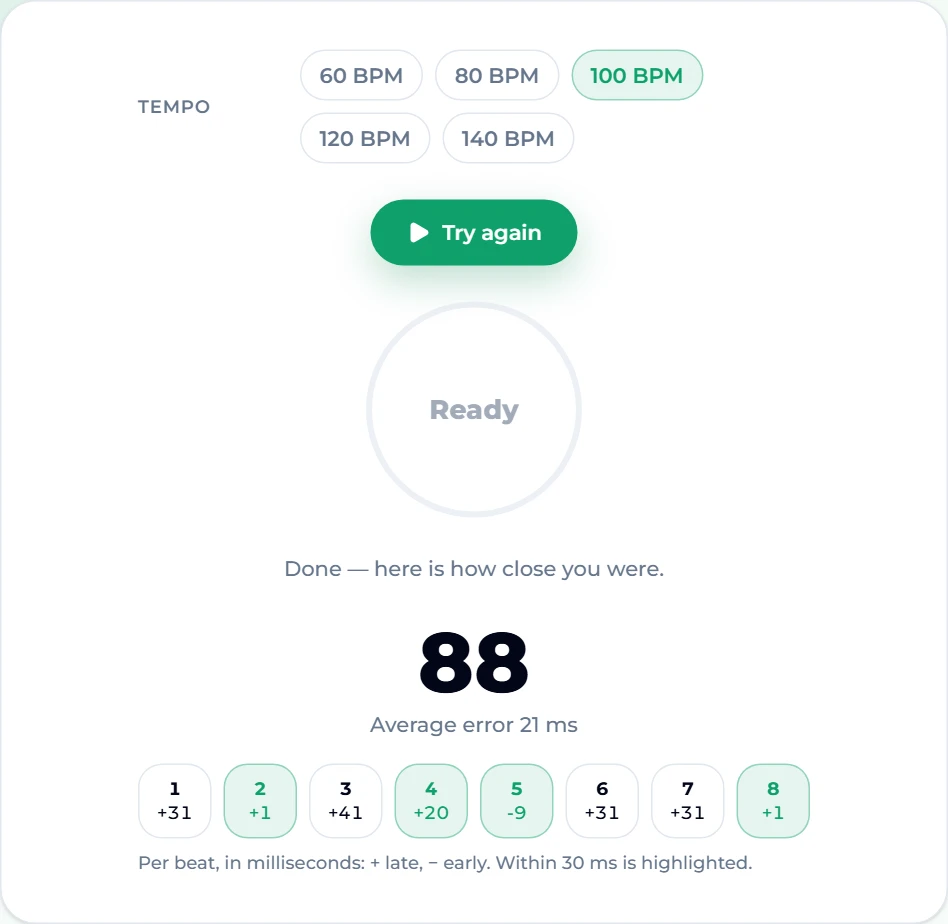
The score starts at 100, loses 6 points for every 10 ms of average error and 12 for every missed beat. In the round above, the taps leaned late — seven of eight on the late side — which is the most common pattern and the most useful thing to learn from the result. An average under 30 ms is tight; under 50 ms is solid; over 80 ms is audible as rushing or dragging. Slow tempos are harder than fast ones, because there is more room to drift between clicks. For daily timing practice, play along with a metronome and come back here to measure.
A 10 minute daily routine
| Minutes | Drill | Setting |
|---|---|---|
| 0–4 | Intervals | Your current level; sing before answering |
| 4–7 | Chords | Quality at your level, then two progressions |
| 7–9 | Scales | One scale in Listen mode, then five quiz questions |
| 9–10 | Rhythm | One round at 80 BPM |
Rotate the emphasis through the week — an interval-heavy day, a chord-heavy day — and keep a note of your best streak per drill. Move up a level when you hit nine out of ten on two days running, not before.
Habits that make it stick
- Consistency beats length. Ten minutes every day does more than an hour on Sunday; the ear consolidates between sessions.
- Sing everything. Humming the answer before you click connects the sound to your voice, which is how you will use it in real music.
- Use real songs. After a drill, put on a song and try to name one interval in the melody or the progression under the chorus. If you want material you have not heard before, generate a few instrumentals in the AI music studio and work out their chords by ear.
- Don't guess to protect a streak. A wrong answer with a correction teaches you more than a lucky right one.
- Test absolute pitch separately, if you are curious. The perfect pitch test asks you to name notes with no reference at all — our guide on how to test for perfect pitch explains what the score means and why relative pitch matters more.
FAQ
How long does ear training take to work?
Most people notice intervals getting easier within two or three weeks of short daily rounds. Chords and scales take longer because there are more options to tell apart. Consistency matters more than session length.
Can adults learn to play by ear?
Yes. Relative pitch — hearing intervals and chord relationships — is learnable at any age, and it is what playing by ear depends on. Perfect pitch is different and rarely acquired by adults, but you do not need it.
Should I practise ascending, descending or harmonic intervals first?
Ascending first, because most beginners find it easiest. Then descending, then harmonic (both notes at once). Each direction sounds different to the ear, so each needs its own practice.
Why does the same interval sound different each time?
The first note changes every question, between C3 and G4, so you learn the distance rather than a fixed pitch. That is deliberate.
Do the drills work without headphones?
Yes, but headphones or decent speakers help with the chord drills, where low notes can get lost on a laptop speaker. The rhythm drill works best with wired headphones; wireless ones add a small, consistent delay.
Is anything uploaded or saved?
No. The sounds are synthesised on your device, the questions are generated there, and your score lives on the page until you leave it.
Final take
Ear training is not a talent test; it is a short list of sounds learned by repetition with feedback. Start with interval ear training at the beginner level, add chords, scales and rhythm as you go, sing every answer, and give it ten minutes a day. In a month you will hear the fifth in "Twinkle Twinkle", the vi chord in the chorus of your favourite song, and exactly how late you tend to play — which is when music starts to feel less like guessing.