

TL;DR
"Can I sing?" is really two questions: can you hold a note steadily, and can you match a note you hear. Both can be measured with a microphone, and neither needs a vocal coach to start. On Suno AI Music, Rate my voice listens to twelve seconds of anything you sing and reports the range you covered, how steady your pitch was in cents, and how much of the take carried a pitch — combined into a score out of 100. The singing test plays five notes, you sing each one back, and it scores how close you landed. Both are free, need no account, and run in your browser without recording anything. A steadiness under 15 cents or a singing-test average above 85 means you sing in tune; most untrained voices score between 60 and 85, and that gap closes quickly with practice.
In this guide
- What a microphone can honestly measure
- Test 1 Rate my voice
- Test 2 The singing test
- What a good score looks like
- How to get a fair result
- What to practise if you scored low
- FAQ
What a microphone can honestly measure
A lot of "singing tests" online ask you to sing a song and then hand you a verdict like "You have the voice of an angel". There is no way a web page knows that. What it can know, reliably, is pitch — the frequency of the note you are producing, dozens of times a second. From pitch you can get three honest numbers:
- Accuracy: how close your note is to a target, measured in cents (a hundredth of a semitone).
- Steadiness: how much your pitch wanders while you hold notes.
- Range: the lowest and highest notes you produced.
Tone, breath support, diction, emotion and whether a song suits you are not in those numbers. They matter enormously — but they are for your ears, a friend's or a teacher's. The two tests below stick to what can be measured and say so.
Test 1 Rate my voice
Rate my voice is the open-ended one: nothing to match, you just sing.
- Open the page and press "Record twelve seconds". Allow microphone access when the browser asks.
- Sing anything — a line of a song you know, a scale, or one long note. The big number counts down the seconds left; the button now reads "Stop and score" if you want to finish early.
- Keep going until the countdown ends. Short gaps for breath are fine; the tool counts them against "voiced time", not against your pitch.
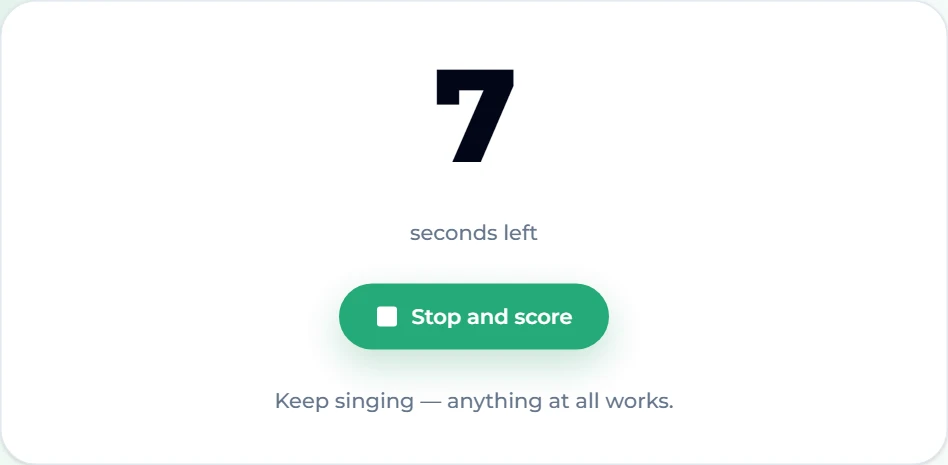
When the twelve seconds are up you get the report. This is a real take — a simple phrase between G3 and E4 with a breath every four notes:
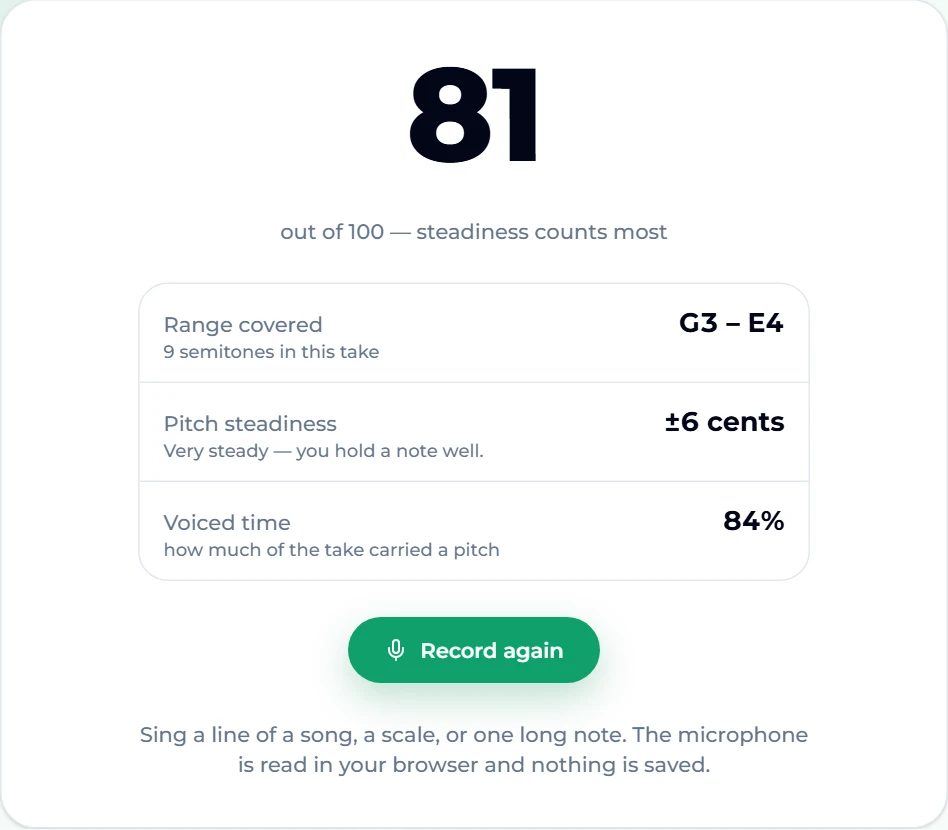
How the score is built — it is a readout, not an audition, and the weights are on the page for a reason:
- Pitch steadiness is the biggest share, up to 55 points. It is the median distance of your notes from the nearest semitone. Under 15 cents is "very steady"; 15–30 is normal for an untrained voice on a moving line; over 30 usually means a wide vibrato, sliding into notes, or notes outside your comfortable range.
- Range covered is worth up to 25 points. It trims the top and bottom 5% of readings so that one slipped note does not stretch your range by an octave. A short phrase covers less than your full range — that is expected. For your real extremes, use the vocal range test.
- Voiced time is worth up to 20 points: the share of the take that carried a pitch at all. Breathy, whispered or spoken passages lower it.
So the 81 above is mostly steadiness (±6 cents is excellent), a modest range from a nine-semitone phrase, and 84% voiced time because of the breaths. Sing a wider melody and the same voice scores higher.
Test 2 The singing test
The singing test checks the other skill: hearing a note and producing it.
- Press "Play the note". A clean tone plays for about a second and a half. The big letters show which note it is — the first round is C4, middle C.
- Press "Start singing" and sing it back on an "ah". Hold it for at least three seconds.
- Press "Stop". Your score for the round appears, with a one-line verdict.
- Repeat for all five rounds — C4, E4, D4, G4 and F4, a range most voices can reach.
Two details make it fair:
- Octaves count as correct. If the tone plays a C4 and you sing a C3, you are right. Most men sing these notes an octave down, and the test would otherwise measure range instead of accuracy. Sing where it is comfortable.
- Your best three seconds count. The score is a rolling median of your error, so one cracked note does not sink a steady one, and a lucky instant cannot carry a wobbly one.
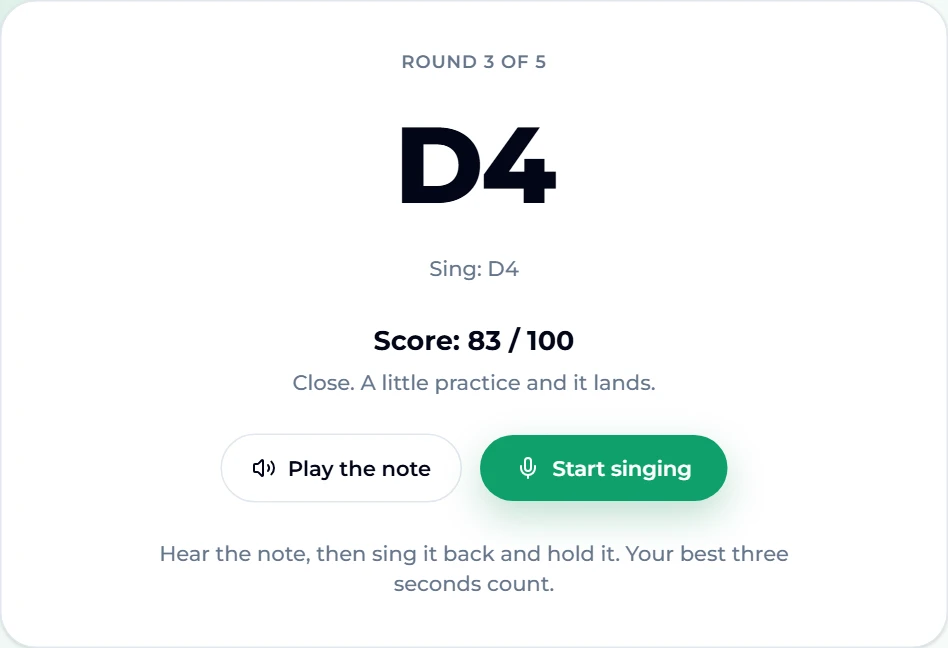
The score scale: 100 is dead on, a quarter tone off (50 cents) scores about 50, a semitone off scores near zero. In the round below, the E4 was sung 18 cents flat and scored 83; the page has already moved on to the next target, D4:
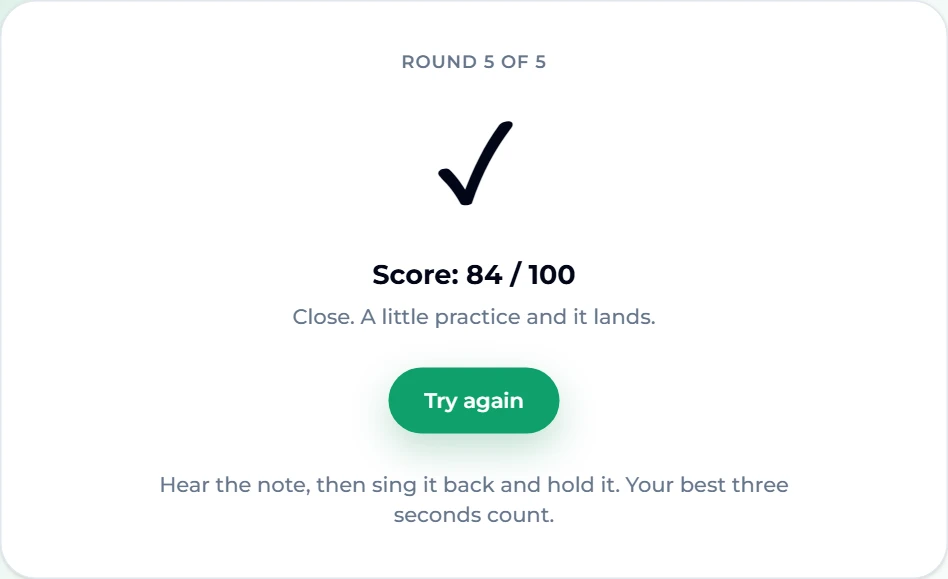
After five rounds, the big letters turn into a tick and you see the average. This run scored 94, 83, 92, 65 and 84 — the G4 was sung a third of a semitone flat — for an average of 84:
What a good score looks like
| Result | What it means |
|---|---|
| Singing test 85+ | Within about 15 cents of each target. You sing in tune. |
| Singing test 60–84 | Where most untrained singers land. You hear the note; you arrive a little under or over. |
| Singing test below 60 | Often a sign of pitch-matching trouble, or a note outside your comfortable range. Very fixable. |
| Steadiness under 15 cents | You hold a note well; sounds in tune to nearly anyone. |
| Steadiness 15–30 cents | Normal for a moving melody; aim lower on long notes. |
| Steadiness over 30 cents | Wide vibrato, scooping into notes, or strain. Try a single long note and watch it drop. |
A low score on the first try is not a verdict on your voice. True tone-deafness (congenital amusia) is rare — estimates are around 1.5% to 4% of people. Much more often, people who "can't sing" have simply never practised matching pitch, and improve within weeks once they get feedback.
How to get a fair result
- Warm up first. Two minutes of humming and sirens. A cold voice scores worse on both tests.
- Use a quiet room. Background music or a TV confuses the pitch detector. Turn it off.
- Keep the tone out of the microphone. In the singing test, play the target through headphones or low speakers so the mic hears you, not the reference.
- Sing a vowel, not words, for the singing test. "Ah" is easiest to hold steady.
- Hold the note. Three seconds for the singing test; sustained notes for Rate my voice. Short notes give the detector little to work with.
- Stay in your range. If G4 is a strain, sing it an octave down. The test allows it.
What to practise if you scored low
If accuracy is the problem (singing test):
- Play the note, hum it before you sing it. Humming lets you hear yourself against the reference more easily.
- Slide into the target from below, slowly, and stop when it "locks" — you will feel the beating between the two sounds disappear.
- Use the voice tuner as a mirror: sing, watch the needle, adjust. After a few days, sing first, then look.
- Train the ear separately. Interval ear training teaches you to hear the distance between notes, which is what you use to find the next note of a melody.
If steadiness is the problem (Rate my voice):
- Sing one long note for eight seconds, three times a day, and watch the steadiness number drop.
- Breathe low — belly, not shoulders. Pitch sags when air runs out.
- Start notes on pitch instead of scooping up to them; a slide at the start of every note reads as unsteady.
If range is the problem: that is a separate skill with separate exercises — see our guide to finding your vocal range.
Then sing real songs. A backing track without the vocal is the best practice partner there is; the karaoke maker strips the voice from a track so you can sing over it. And if you want a song written around your own voice, describe it in the AI music studio — "warm alto vocal, easy melody, key of G" — and sing along to what comes back.
FAQ
Can these tests tell me if I have a good voice?
They tell you whether you sing in tune and hold notes steadily, which is the foundation of a good voice. They cannot judge tone, style or expression. Pair the numbers with a recording of yourself and an honest listener.
Why did I score lower on a high note?
Notes near the top of your range are harder to hold steady, and pitch tends to go flat when you strain. Sing that note an octave down — the singing test counts it as correct — or practise it separately with the voice tuner.
Is my singing recorded?
No. Both tests read the microphone inside your browser and calculate pitch there, frame by frame. No audio is stored or uploaded, and closing the tab ends it.
Do I need an account or to pay?
No. Both tests are free and work without signing in.
What is the difference between Rate my voice and the singing test?
Rate my voice measures whatever you sing — steadiness, range covered and voiced time — with no target. The singing test gives you a note and measures how accurately you match it. Take both: one tests control, the other tests your ear-to-voice connection.
How often should I test?
Once or twice a week is enough to see progress. Test at the same time of day, warmed up, in the same room, so the numbers are comparable.
Final take
You do not need anyone's opinion to find out whether you can sing in tune — you need a microphone and two minutes. Record twelve seconds on Rate my voice to see how steadily you hold pitch, run the five rounds of the singing test to see how accurately you match a note, and practise whichever number is lower. Most people who start in the 60s reach the high 80s with a few weeks of short, regular practice.