

TL;DR
Your vocal range is the distance between the lowest and the highest note you can hold — not squeak, not growl, hold. To find it, warm up for two minutes, open the free vocal range test, press Start, slide down on an "ah" until your voice runs out, then slide up as high as it goes without straining. The test only keeps a note once you have held it for a moment, so a crack or a breath does not set a record. It shows your lowest note, your highest note, the span in semitones and octaves, and the voice type your range overlaps most. Most untrained adults land somewhere between 1.5 and 2 octaves. If you want to check one note rather than the whole range, the voice tuner and the pitch detector name a single note live, in cents.
In this guide
- What vocal range actually means
- Before you test
- Step by step with the vocal range test
- Reading your result
- Voice types and their ranges
- Checking a single note
- What to do with your range
- Why your result might be off
- FAQ
What vocal range actually means
A range is two notes and the distance between them. Notes are named with a letter and an octave number: middle C on a piano is C4, the A above it is A4 (440 Hz), and each time you pass a C going up, the number goes up by one. So a range written as A2 – G4 means your lowest held note is the A two octaves below A4 and your highest is the G just below A4.
The distance is counted in semitones — the step from one piano key to the very next, black keys included. Twelve semitones make an octave. A2 to G4 is 22 semitones, or about 1.8 octaves.
Two things are worth separating early:
- Total range is everything you can phonate, including the fragile notes at each end.
- Comfortable range (singers call it tessitura) is where you can sing a whole song without strain. It is usually a few semitones narrower on each side.
A browser test measures the first, and your judgment decides the second. Both are useful; you pick songs by the second.
Before you test
Five minutes of preparation changes the result more than anything else.
- Warm up. Hum for a minute, then do lip trills or sirens — a slow "woo" sliding up and down. Cold voices lose two or three semitones at the top.
- Use headphones off, a quiet room on. The microphone should hear you, not a fan, a TV or your own speakers.
- Sit or stand a hand's width from the microphone. A laptop's built-in mic is fine; a phone held too close clips the loud notes.
- Pick one vowel. "Ah" is the easiest to hold in tune across the whole range. "Ee" gets thin at the top; "oo" gets breathy at the bottom.
- Drink some water. Not a trick — a dry throat cracks earlier.
Step by step with the vocal range test
The vocal range test is free, needs no account, and runs entirely in your browser: the microphone feeds a pitch detector on the page, and nothing is recorded or uploaded.
- Open the page and press Start. The browser asks for microphone permission once. Allow it.
- Sing a comfortable note in the middle of your voice and hold it. The Now box in the centre shows the note it hears, live. Wait until it settles on one note.
- Slide down, slowly. Step down a note at a time or glide, but pause on each note for about a second. The Lowest box updates only after a note has been held for a few frames — that is on purpose, so the rumble at the end of a breath does not count.
- Stop when the note turns into air or fry. Your lowest usable note is the last one that still had a clear tone.
- Take a breath and climb. Same thing upwards: steady steps, a second on each note. Let the voice go light as it rises; pushing harder closes the top off sooner.
- Stop before it hurts. The last note you can hold cleanly is your highest. A squeak you cannot sustain is not your range.
- Read the summary under the three boxes, then press Reset and do it once more. The second run, with the voice fully warm, is usually a tone or two wider.
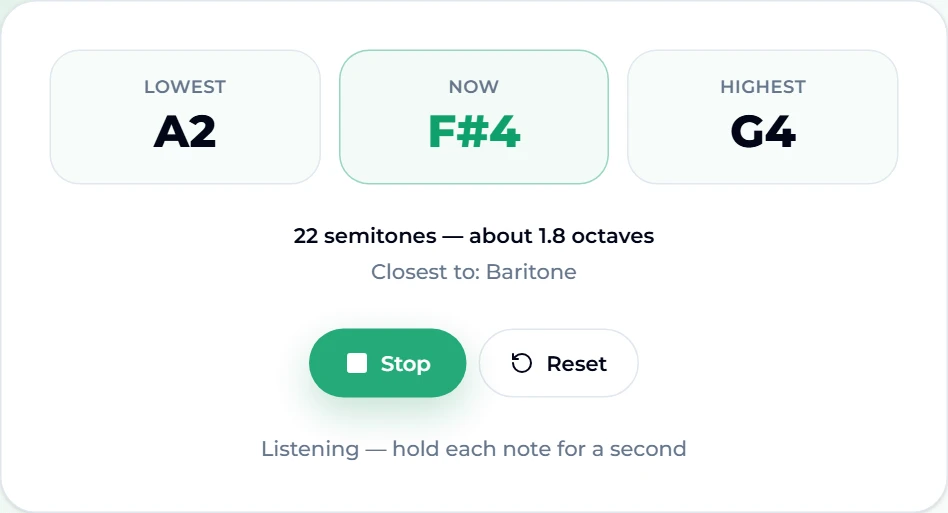
Here is a real run: sung down from D3 to A2, then up in steps to G4.
Reading your result
The result has four parts.
- Lowest and Highest are your extremes, as note names. Write them down with the date; ranges grow with practice and it is satisfying to watch.
- Now is whatever you are singing this instant. It is useful mid-test to see whether the detector has locked on.
- Semitones and octaves. The line under the boxes gives the span both ways — "22 semitones — about 1.8 octaves" in the run above. For reference: a comfortable pop melody needs about an octave and a half; many hymns and folk songs fit in an octave; big ballads ask for two octaves or more.
- Closest to names the voice type whose textbook range overlaps yours most. It is a description, not a verdict. The test says "closest to" because plenty of voices sit between two types.
Voice types and their ranges
The test compares your range with six classical voice types, each spanning about two octaves. These are the ranges it uses:
| Voice type | Typical range | Roughly |
|---|---|---|
| Bass | E2 – E4 | 82 – 330 Hz |
| Baritone | A2 – A4 | 110 – 440 Hz |
| Tenor | C3 – C5 | 131 – 523 Hz |
| Contralto | F3 – F5 | 175 – 698 Hz |
| Mezzo-soprano | A3 – A5 | 220 – 880 Hz |
| Soprano | C4 – C6 | 262 – 1047 Hz |
They overlap heavily, as real voices do. A baritone and a tenor share most of an octave and a half; what separates them in a choir is where the voice sounds best, not only where it can reach. That is why a range alone is a starting point. If your result says "closest to Tenor" but your voice feels tired above E4, you may be a high baritone — try songs in both keys and trust how it feels after three choruses.
Checking a single note
Sometimes you do not need the whole range; you need to know what one note is. Two tools do that live.
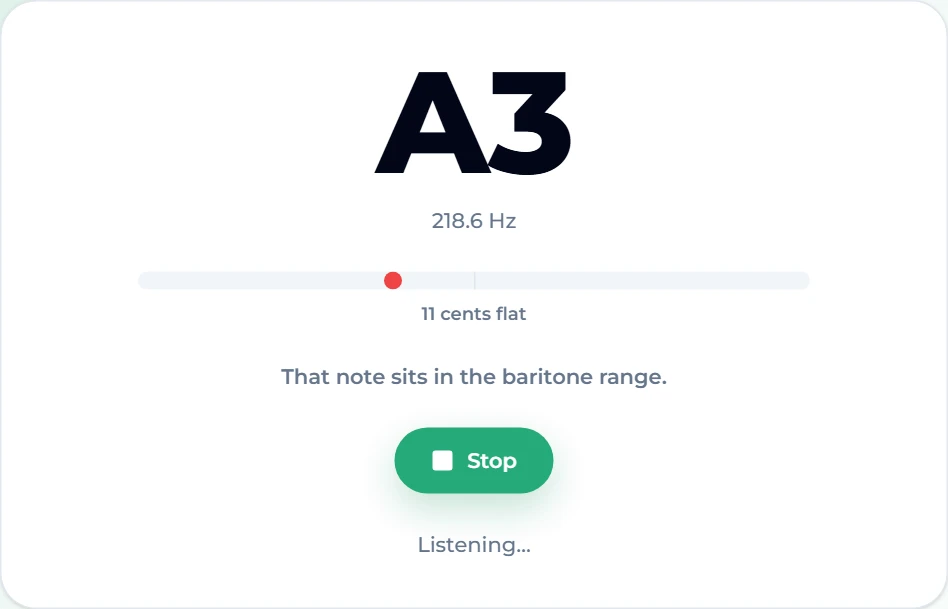
The voice tuner shows the note you are singing, its frequency, how many cents sharp or flat you are, and which voice part that note usually belongs to. In the example below, an "ah" held on A3 reads 11 cents flat — close, but not centred — and the tool notes that A3 sits in the baritone range.
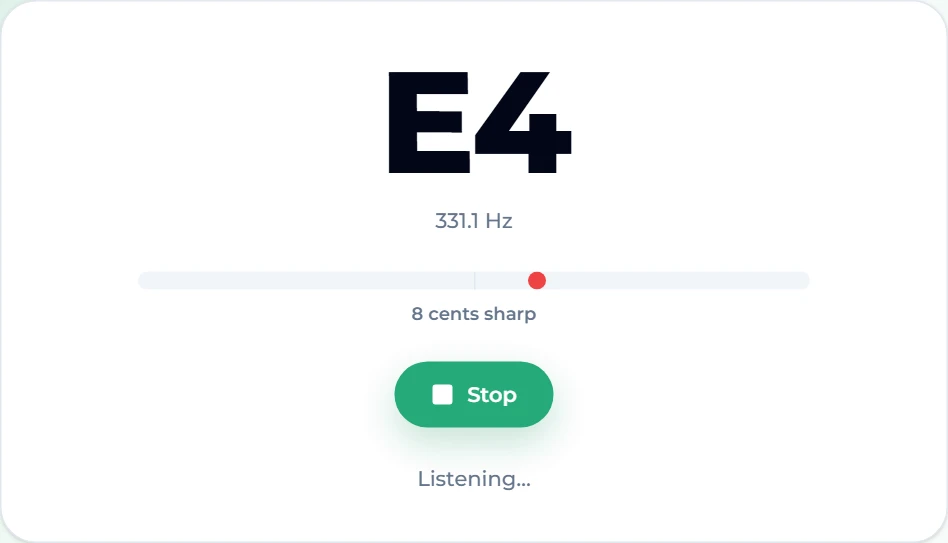
The pitch detector is the same idea without the voice-part line, and works for instruments that play one note at a time — a whistle, a violin string, a flute. It marks anything within 5 cents as In tune. Here an E4 held slightly high reads 331.6 Hz, 11 cents sharp:
A cent is a hundredth of a semitone. Most listeners stop hearing a note as out of tune somewhere between 5 and 15 cents off, depending on the context — a held note next to a piano is less forgiving than a quick passing note in a busy mix.
Use these tools to:
- Find your starting pitch before you sing along to a track.
- Check a note at the edge of your range — is that top note really a G4, or a flat F#4?
- Watch pitch sag as your breath runs out on a long note. It is almost always downward.
What to do with your range
A range is only worth measuring if it changes what you sing.
Choose songs that fit. Look up the lowest and highest notes of a song you want to sing (many sheet-music listings print the vocal range) and compare. If the song's top note is above your highest held note, it will not work in that key.
Transpose instead of straining. Moving a song down two or three semitones is what professional singers do all the time. Karaoke apps have a key control; so does most notation software. If you prefer to practise over the backing track itself, strip the vocal first — our guide to making a karaoke version of a song walks through it with the vocal remover.
Write for your own voice. If you generate songs with AI and want to sing them yourself, describe the voice in the style prompt ("warm baritone male vocal", "low alto female vocal") so the melody lands near your range. You can try that in the AI music studio, and the Suno prompts guide has more phrasing that works.
Track it. Test once a week at the same time of day, warm, and write the two notes down. Regular practice typically adds a couple of semitones at the top over a few months — the bottom changes much less.
Why your result might be off
- The top note did not register. You probably did not hold it long enough. The test ignores notes that last only a few frames. Hold for a full second.
- The lowest note is suspiciously low. Vocal fry — the creaky sound below your real voice — can produce a pitch the detector reads. If you could not sing a word on that note, do not count it.
- The result jumps by an octave. Breathy or very quiet notes can be read an octave off. Sing a little louder and steadier.
- Nothing happens. Check that the browser has microphone access for the site (the lock icon in the address bar) and that the right input device is selected in your system settings.
- Background noise. A fan or music in the room drags readings around. Turn it off and test again.
FAQ
How many octaves is a good vocal range?
For an untrained adult, 1.5 to 2 octaves is typical, and it is enough for most pop, folk and rock songs. Trained singers often reach 2.5 to 3 octaves. The number matters less than how much of it you can use comfortably.
Can I increase my vocal range?
Yes, mostly at the top, and slowly. Regular warm-ups, sirens and light head-voice practice extend it by a few semitones over months. The low end is set largely by the size of your vocal folds and changes little. Never force a note that hurts.
Why does the test say I am closest to a voice type I did not expect?
It compares only your extremes with textbook ranges. Voice type also depends on tone and on where your voice sits comfortably. Treat the label as a hint, sing songs written for that type and for its neighbours, and see which feels natural.
Is my voice recorded or uploaded?
No. The microphone is read in your browser, the pitch is calculated there frame by frame, and only the note names stay on the page. Closing the tab ends it.
Does it work on a phone?
Yes, in any modern mobile browser that allows microphone access. Hold the phone at arm's length rather than against your mouth, and sing in a quiet room.
What is the difference between the voice tuner and the pitch detector?
Both name the note you are singing and show cents sharp or flat. The voice tuner also tells you which voice part that note belongs to; the pitch detector is voice-neutral and works just as well for a single-note instrument.
Final take
Finding your vocal range takes five minutes: warm up, hold each note for a second on the way down and on the way up, and let the vocal range test keep the extremes. Write the two notes down, read the voice type as a hint rather than a label, and use the range to pick keys you can actually sing. When you want to check one note — a starting pitch, a shaky top note — the voice tuner and the pitch detector tell you exactly where you are, to the cent.