
TL;DR
To transpose a song, move every chord by the same number of semitones. Paste the chord chart into a chord transposer, press the up or down arrow until the key fits your voice, choose sharps or flats, and copy the result — the lyrics and the spacing stay exactly where they were, and slash chords keep their bass note. To decide how far to move, find the song's current key and your comfortable range first; the circle of fifths shows how "far" two keys are in accidentals, which tells you how awkward the new key will be to play. On guitar, a capo often gets you there without learning a single new shape.
In this guide
- What transposing means
- Step by step with the chord transposer
- How far to transpose
- Sharps or flats
- Transposing on guitar with a capo
- Using the circle of fifths
- FAQ
- Final take
What transposing means
Transposing shifts a whole piece up or down in pitch while keeping every relationship inside it the same. The melody keeps its shape, the chords keep their function, the song is still the song — it just sits higher or lower.
The unit is the semitone, one key on a piano (white or black). There are 12 in an octave. Transposing "up 2" means every chord moves two semitones up: G becomes A, Em becomes F♯m, C becomes D, and D/F♯ becomes E/G♯.
Why people do it:
- A singer's range. The most common reason by far. A song written for a tenor may sit a third too high for a baritone.
- An instrument's comfort. Guitarists prefer E, A, D, G and C; horn players prefer flat keys like B♭ and E♭.
- Matching another song in a medley or a DJ set.
- Accompanying a transposing instrument, like a B♭ clarinet or trumpet.
Step by step with the chord transposer
The transpose music tool works on plain text, so any chord chart you can copy from a website, a notes app or a PDF will do. Nothing is uploaded — the text never leaves your browser.
We used an original chart in G major — a verse and a refrain with chords written above the lyrics — and moved it up two semitones.
- Paste your chart into Your chords. Chords over lyrics is fine; the layout is kept. (Load an example fills in a sample if you want to try it first.)
- Set the amount with the arrows next to Move by. Each press is one semitone. The default is +2.
- Pick Sharps or Flats for how the new chords are spelled.
- Read the result under Transposed, and press Copy to take it with you.
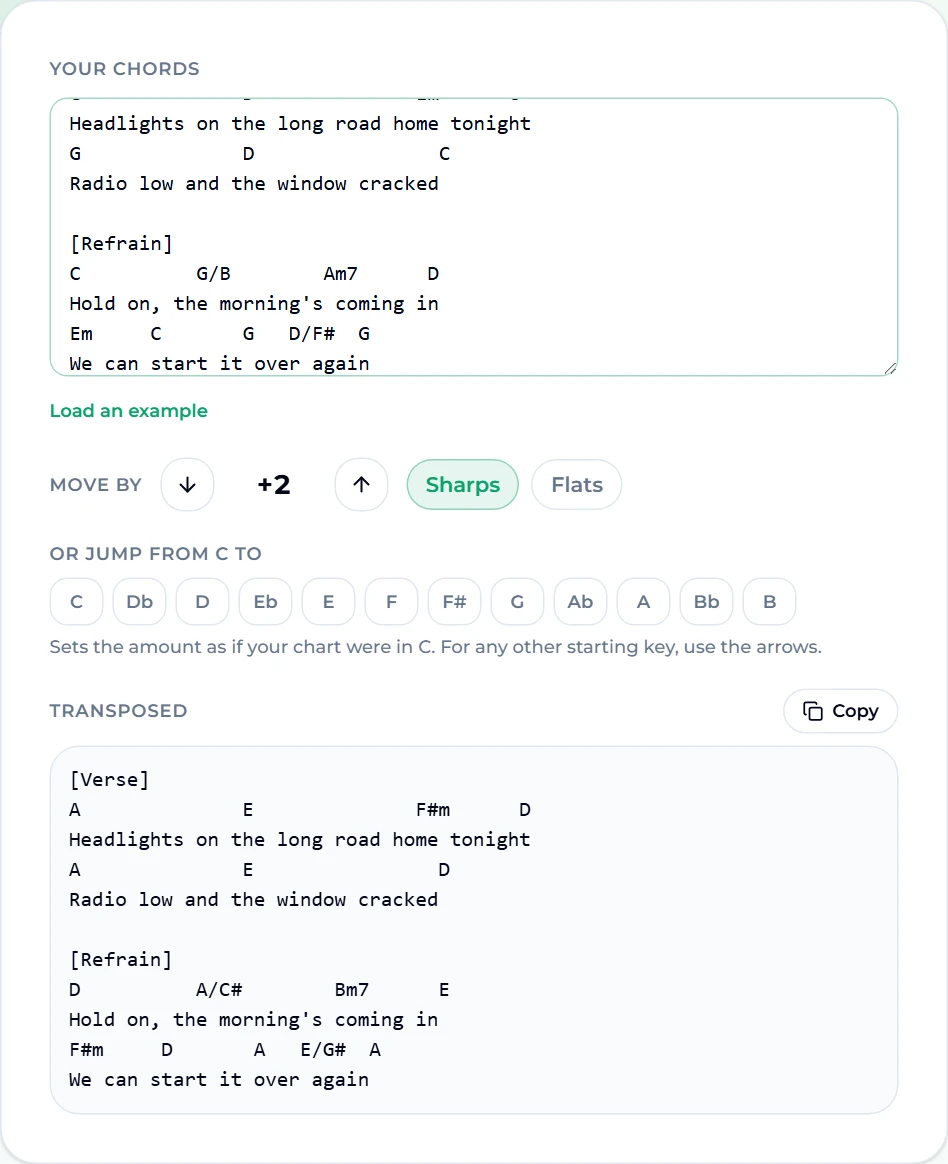
Look at the slash chords: G/B became A/C♯ and D/F♯ became E/G♯ — the bass note moves with the chord, which many simpler transposers forget. And because only the chord symbols change length, the chords stay above the right words.
Going down works the same way. Here the same chart is moved down two semitones, from G to F, and spelled with flats — the natural spelling for F major:
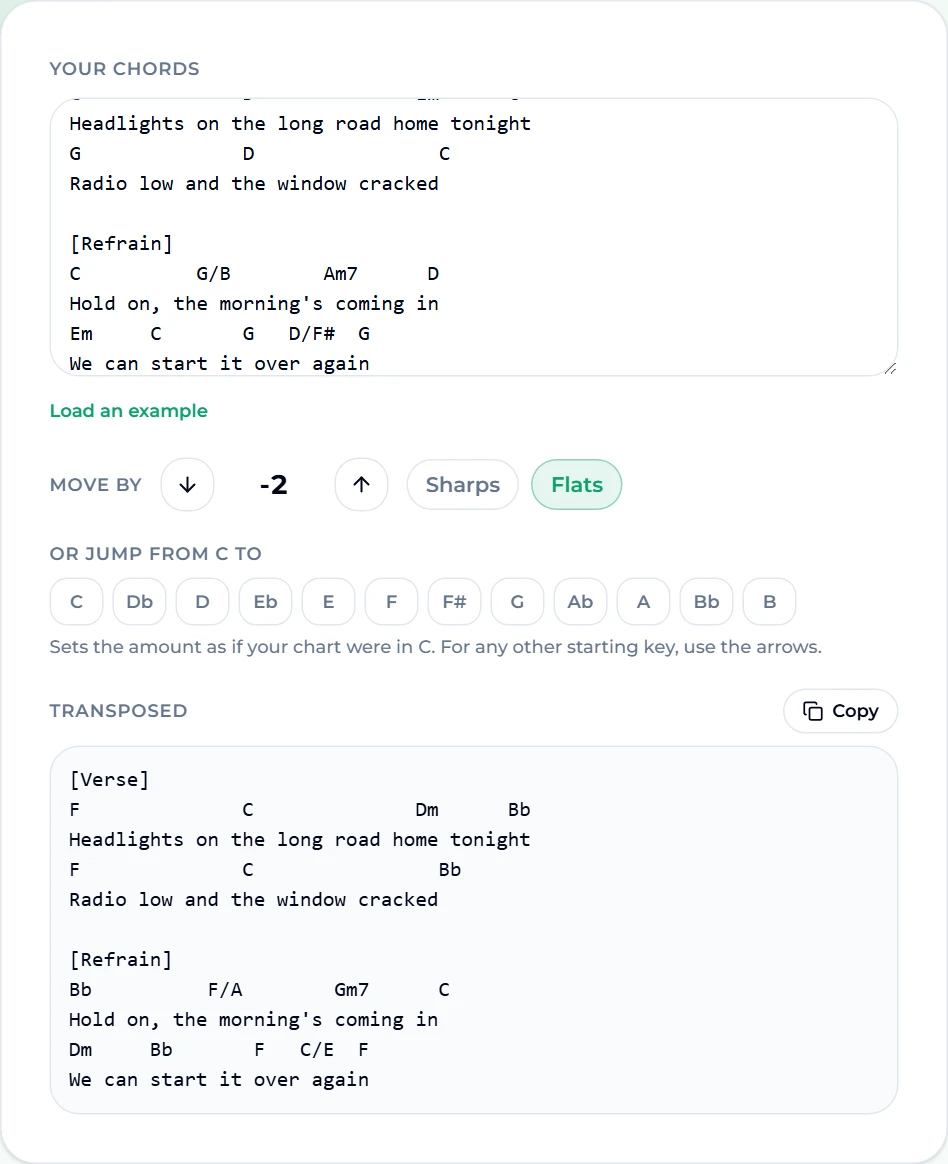
Shortcut for charts in C: the row of note buttons under Or jump from C to sets the amount as if your chart were in C — press F and it moves everything up five semitones. For a chart in any other key, use the arrows.
How far to transpose
The tool does the arithmetic; the decision is yours. Three ways to make it:
By the key names. Count semitones from the old key to the new one: G → A is +2, G → F is −2, C → E♭ is +3. The key finder tells you the original key if you do not know it — our guide on finding the key of a song explains how to read it.
By your voice. Sing the highest line of the song (usually the end of the chorus). If you strain, go down; if the verses sit in a mumbly low zone, go up. Move one or two semitones at a time and sing again — small changes feel bigger than they look. Most singers find their key within ±3 semitones of the original.
By the smallest change that works. Moving up 7 semitones and down 5 land on the same key name, an octave apart. Pick whichever is closer to where you actually want to sing.
Sharps or flats
The same pitch has two names — F♯ and G♭, C♯ and D♭ — and a chart reads more easily when it uses the one the key expects. Rules of thumb:
- Sharp keys: G, D, A, E, B, F♯ and their relative minors. Use Sharps.
- Flat keys: F, B♭, E♭, A♭, D♭ and their relative minors. Use Flats.
- C major and A minor: either; most charts use flats for borrowed chords (B♭, E♭) and sharps for secondary dominants (E7, D7).
If a transposed chart suddenly shows things like "Dbm" in what should be E major, you picked the wrong spelling — switch the toggle and it becomes C♯m.
Transposing on guitar with a capo
A capo raises the pitch of every open string, so you can keep playing the same shapes in a higher key. The capo fret is the number of semitones you move up:
| Shapes you play | Capo fret | Sounding key |
|---|---|---|
| G | 2 | A |
| G | 4 | B |
| C | 3 | E♭ |
| D | 2 | E |
| E | 1 | F |
The trick for any song: transpose the chart down to a friendly shape key, then capo back up to the original. A song in B♭ is awkward in open chords; transpose it −3 to G, put the capo on fret 3, and play G shapes. The transposer handles the first half of that in seconds.
A capo only goes up. To play a song lower than the guitar's open-chord shapes allow, transpose the chart down and learn the new shapes, or tune the guitar down.
Using the circle of fifths
The circle of fifths lays out the 12 major keys like a clock, each one fifth from its neighbours, with the relative minors inside. Press a key and it shows its sharps or flats, its relative minor and the seven chords of the key, which you can hear by pressing them.
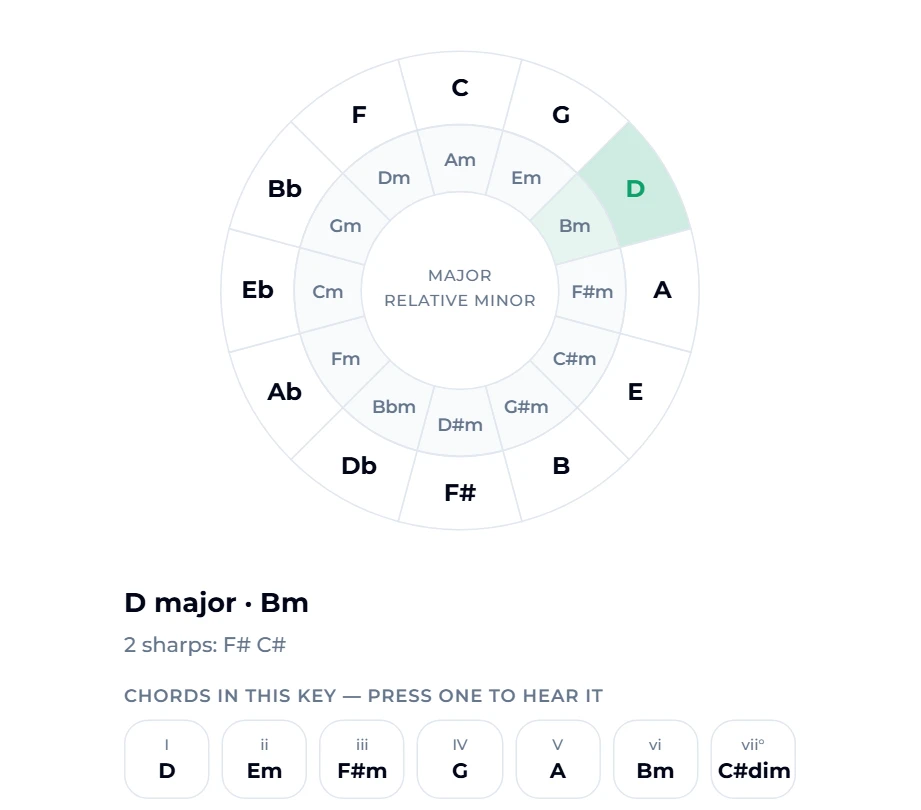
For transposing, it answers two practical questions:
- How hard will the new key be? Each step clockwise adds a sharp. G has one, D two, A three, E four. Moving a song from G to D keeps things easy; moving it to B (five sharps) will be hard on piano and horns.
- What are the chords in the new key? The seven diatonic chords are listed for every key, so you can check your transposed chart — every chord should come from that list, except the occasional borrowed chord.
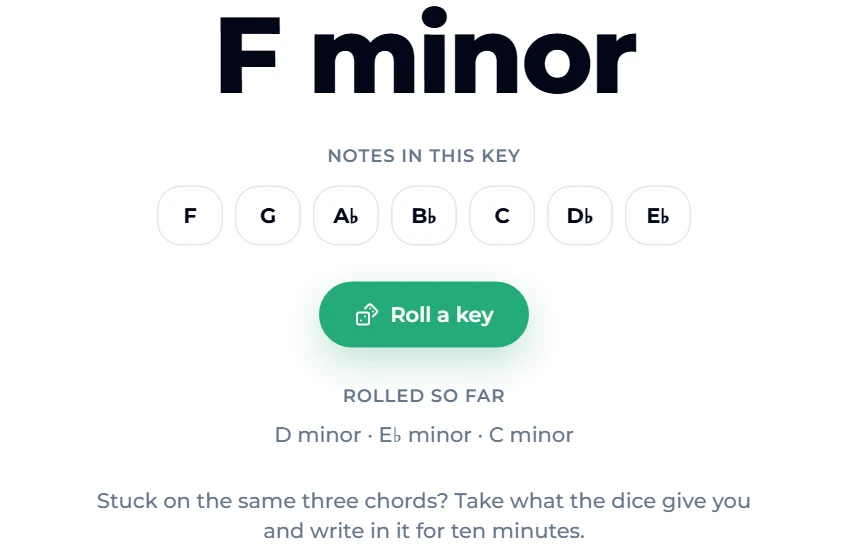
And if you are writing rather than rearranging, the random key generator rolls a key and shows its scale notes — a handy nudge out of the same three keys every songwriter drifts back to.
FAQ
How do I transpose a song to a different key?
Find the original key, choose the new one, count the semitones between them, and move every chord by that amount. The transpose music tool does the moving: paste the chords, press the arrows, copy the result.
Does the transposer change the lyrics or spacing?
No. Only the chord symbols change; the lyrics and line layout stay as you pasted them. Slash chords keep their bass note in the new key.
Can it transpose sheet music or an audio file?
It works on text chord charts. To transpose sheet music, use the transpose function in your notation software. To change the key of an audio recording, you need a pitch-shifting tool in a DAW. If you have a recording and want its notes, MP3 to MIDI converts it into MIDI, which any DAW can transpose.
Should I transpose up or down to fit my voice?
Sing the highest phrase first. If you strain, move down one or two semitones at a time; if the lowest phrase is weak and breathy, move up. Test the whole song, not one line.
What is the difference between transposing and a capo?
Transposing rewrites the chords in the new key; a capo keeps the chords and changes the guitar's pitch. They combine well: transpose to a key with easy shapes, then capo up to the key you need.
Is the transposer free?
Yes — free, no account, and it runs in your browser. The circle of fifths and the random key generator are free too.
Final take
Transposing is simple arithmetic on chord names, and the chord transposer does it without disturbing a single lyric. The musical decisions are the part worth your time: which key suits the singer, which spelling the players will read, and whether a capo gets you there with the shapes you already know. Find the original key, try a couple of semitones either way, check the new key's chords on the circle of fifths — and when the song finally sits right in your voice, that is your key.