

TL;DR
Drop the song into a key and BPM finder and it tells you the most likely key — say, F minor — along with a second guess, the tempo, the length and the loudness. It runs in your browser, takes a few seconds, and is free with no account. Treat the answer as a strong hint, not a verdict: when a key finder is wrong, it is almost always wrong in a predictable way — the relative major or minor, or a neighbour on the circle of fifths. Two minutes at a keyboard confirms it: find the note the song keeps resolving to, then check whether the chords feel major or minor.
In this guide
- What the key of a song is
- Step by step with the key finder
- How key detection works
- How to check the key by ear
- When the answer looks wrong
- What to do with the key
- FAQ
- Final take
What the key of a song is
A key is two things: a home note (the tonic) and a scale built on it. "F minor" means the music keeps coming back to F and mostly uses the seven notes of the F minor scale: F, G, A♭, B♭, C, D♭, E♭. The home note is where phrases feel finished; the scale decides which notes sound "inside" the song.
Knowing it matters whenever you do something with a song:
- Singers check whether the key sits in their range, and transpose if it does not.
- DJs mix in key — two tracks in compatible keys blend without clashing.
- Producers pick samples, basslines and vocal chops that match.
- Players learning by ear know which notes to try first.
Step by step with the key finder
We ran the key and BPM finder on two songs generated on our AI music generator: a late-night smooth-jazz saxophone track and a solo felt-piano piece.
- Open the finder. The same analyser is also at song analyzer and music analyzer; all three give the same readout.
- Choose an audio file. MP3, WAV, M4A or FLAC, up to 50 MB and at least a few seconds long. Nothing is uploaded: the page analyses the file on your device.
- Wait a few seconds. A progress line shows Reading the track… with a percentage; a 4-minute song finishes in a few seconds on a laptop.
- Read the result. The top two cards show Key (with a second guess) and Tempo (with half- and double-time alternatives). Underneath: length, sample rate and format, peak level and average level.
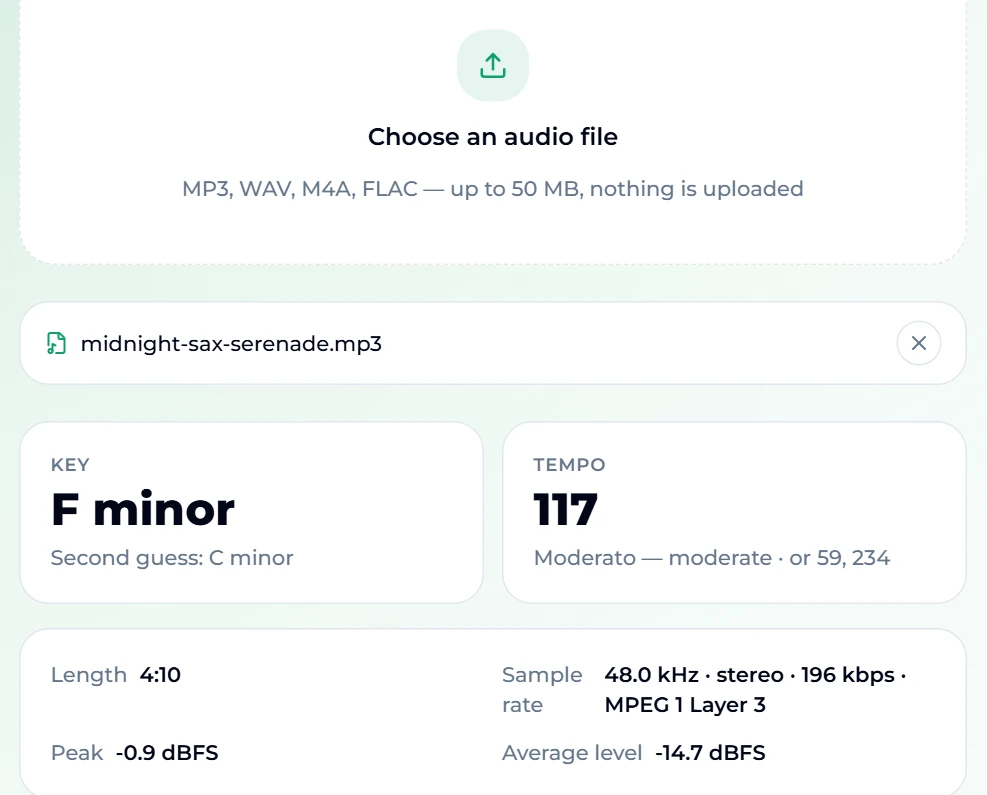
The saxophone track reads as F minor, second guess C minor. C minor is F minor's neighbour on the circle of fifths (one flat fewer), which is exactly the kind of runner-up you should expect.
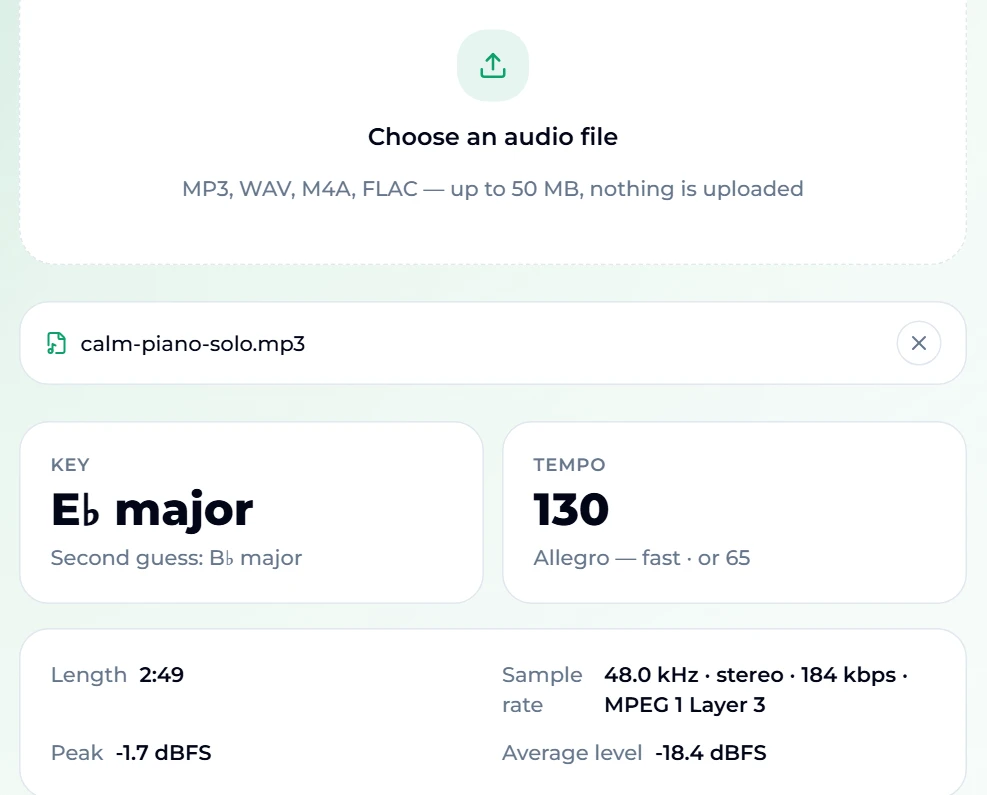
The piano piece reads as E♭ major, second guess B♭ major — again a circle-of-fifths neighbour. Note the tempo on this one: it was prompted at 66 BPM with "gentle rubato", and the finder offers 130 or 65. Free-flowing piano has no steady drum pulse, so the tempo reading is the part to double-check, while the key reading is solid. (Our guide on how to find the BPM of a song covers tempo readings in depth.)
The level readings are useful on their own: an average level around −14 dBFS is a loud, finished master; −18 dBFS leaves more headroom, typical of quiet piano.
How key detection works
The method is the standard one from music-cognition research, and knowing it makes the results easy to interpret.
- Measure the notes. The analyser takes up to two minutes from the middle of the track — intros and outros often wander — and measures how much energy each of the 12 pitch classes (C, C♯, D … B) carries across five octaves.
- Compare with key profiles. It compares that 12-number fingerprint with the Krumhansl–Kessler profiles: templates of how strongly each note is typically heard in each of the 24 major and minor keys. The home note and the fifth weigh most; notes outside the scale weigh least.
- Pick the best fit — and report the runner-up.
Because the method looks at which notes ring out, it cannot tell two keys apart that share the same notes. C major and A minor use identical white-key notes; only the home note differs. That is why the disclaimer under the result says the second guess is usually the relative major or minor.
How to check the key by ear
Two minutes with any keyboard or piano app settles it.
- Find the home note. Play the song and, at the end of a chorus, hold down notes one at a time until one sounds like "home" — settled, not wanting to move. Start with the finder's suggestion: F for F minor.
- Decide major or minor. Play the major chord and the minor chord on that note (F–A–C versus F–A♭–C) over the song. One will sit comfortably; the other will clash on its middle note.
- Check the last chord. Most pop songs end, or end their choruses, on the tonic chord. If the final chord matches your answer, you are done.
If you want to practise hearing this, the ear training drills build exactly that skill.
When the answer looks wrong
When the finder's first guess does not match what you hear, the right answer is usually one of these:
- The relative key. F minor and A♭ major share all seven notes. If the song sounds bright and resolves to A♭, it is A♭ major.
- A circle-of-fifths neighbour. F minor and C minor differ by one note (D♭ versus D). A song that borrows chords from the next key over can tip the fingerprint.
- Modal music. Songs in Dorian or Mixolydian mode (common in funk, folk and a lot of rock) do not fit either major or minor profile cleanly.
- A key change. The finder reports one key for the analysed stretch. A song that modulates up a step for its last chorus will show the key it spends most time in.
- Tuning. A recording that is tuned noticeably sharp or flat — some older records, some lo-fi — can land a semitone off. If every chord you play along is slightly out, this is the cause.
The circle of fifths shows each key's relative minor and neighbours at a glance, which makes the "which of these two is it" question quick.
What to do with the key
- Transpose to fit your voice. If the song is in F minor and it sits too high, move it down. Our guide to transposing a song covers chord charts and capos, and the transpose tool does the arithmetic.
- Mix in key. Keys next to each other on the circle of fifths, and relative major/minor pairs, blend cleanly in a DJ set.
- Write parts that fit. A bassline or a topline in the song's scale will sound right on the first try.
- Generate music to match. Writing the key into the style prompt on the AI music generator — "in F minor" — steers the song it produces. Our Suno prompts guide has more on this.
FAQ
Is the key finder free, and does it upload my song?
It is free with no account, and the analysis happens entirely in your browser; the file never leaves your device.
How accurate is automatic key detection?
On tonal pop, rock, jazz and electronic music the first guess is usually right, and when it is not, the second guess usually is. Modal songs, songs with key changes and atonal or heavily percussive tracks are where it struggles — confirm those by ear.
Why does it show a second guess?
Because the method compares note fingerprints, and some keys have nearly identical fingerprints. The second guess is typically the relative major or minor, or a neighbouring key on the circle of fifths.
Can it find the key from a YouTube link?
No — it reads audio files. If you have the file, upload it; if you only have a link, find the key by ear with the steps above.
What is the difference between the key finder, song analyzer and music analyzer?
They are the same analyser under three names, so use whichever you found first. Each shows key, tempo, length, format and levels.
Does it tell me the chords?
No. It gives the key, which narrows the likely chords to seven (the diatonic chords, shown for each key on the circle of fifths). To get the actual notes played, convert the song with MP3 to MIDI and read them in a DAW.
Final take
A key finder turns "what key is this?" from a half-hour of trial and error into a few seconds — as long as you read its answer the way a musician would. Upload the song to the key and BPM finder, take the first guess as the likely answer and the second as the usual suspect, then play the home note and its chord along with the track. When they sit right, you know the key — and you can transpose it, mix it, or write to it.