
TL;DR
Writing a song for someone who passed away starts with small, concrete memories rather than big words: the chair by the window, the hymn they sang while hanging the laundry, the lake at sunrise. Put their name where it will be sung, choose a style they loved, and let the chorus say the one thing you most want to tell them. If you would like help turning those memories into a finished song, our custom memorial song page writes the lyrics from what you share and records two versions in a few minutes. You can listen to 45 seconds of each and read the lyrics before deciding anything; the full song, with MP3 downloads and a private page to share with family, is a one-time $9.99. Take this at whatever pace feels right.
In this guide
- Before you start
- Gathering the memories
- A simple tribute song structure
- A worked example
- Turning your memories into a memorial song
- Choosing a style that fits them
- Sharing the song with family
- Things that are easy to get wrong
- FAQ
- Final take
Before you start
There is no right way to write a song for someone who passed away, and no deadline that matters more than how you feel. Some people write the week of the funeral because they want something to play at the service. Others wait a year, for a birthday or the anniversary of the day they died. Both are fine.
It can help to decide two things first:
- Who the song is for. Is it for you, to say something you did not get to say? For the family, to play when everyone is together? For the service, to be heard by people who knew them in different ways? The answer changes the tone.
- Where it will be played. A funeral or celebration of life usually suits a gentle style. A family gathering on their birthday can be warmer, even joyful, if that was who they were.
If writing a song for someone who passed away feels like too much on your own, sit down with a sibling, a parent or an old friend. Saying memories out loud is often the easiest way to find the right ones.
Gathering the memories
The most moving tribute songs are built from ordinary details. "She was a wonderful person" could describe anyone. "She kept butterscotch candies in every coat pocket and sang hymns while she hung the laundry" could only be one person.
Take ten minutes and write a list. Do not edit it yet. Some prompts:
- What did they do every day? The morning coffee, the walk, the radio station.
- What did they make or fix? The lawnmowers, the quilts, the Sunday breakfast.
- What did they always say? A phrase, a nickname, a terrible joke.
- Where do you picture them? A kitchen, a porch, a lake, a chair by the window.
- What music did they love? A singer they whistled, a hymn, a song from their wedding.
- What do you most want to say to them now? One sentence, plainly.
From that list, circle three or four details. That is enough for a whole song. Write their name the way the family said it: Dad, Grandma June, Pops.
A simple tribute song structure
You do not need to be a songwriter. Most songs for someone who passed away use the same simple shape:
- First verse: who they were. Open on their name and one picture of them. Robert, up before the sun, the lake still grey.
- Chorus: what you want to tell them. Short, repeated, with their name in it. This is the line people will remember.
- Second verse: a specific memory. The fishing trip, the hymns on laundry day, the treehouse built without the instructions.
- Chorus again.
- Bridge: where things are now. The empty chair, the open door, the habit you have picked up from them.
- Last chorus, sometimes changed slightly, so it feels like a goodbye or a promise.
If you write your own lyrics, keep the lines short and the words plain. Simple language is what makes a memorial song easy to sing at a service and easy to listen to again later.
A worked example
Here is how a short list of memories becomes the outline of a song for someone who passed away. Anna's list for her father had more than a dozen lines; she kept four:
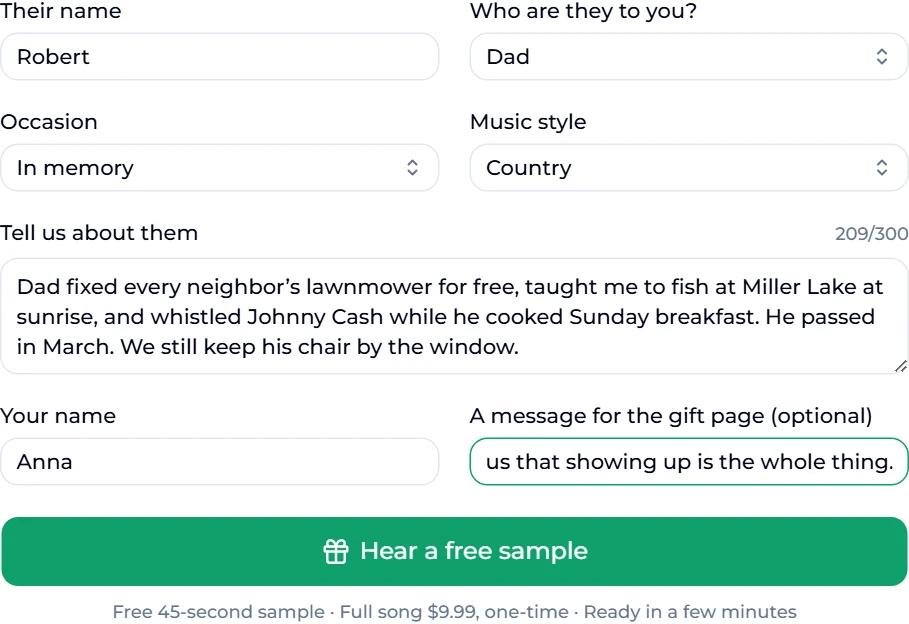
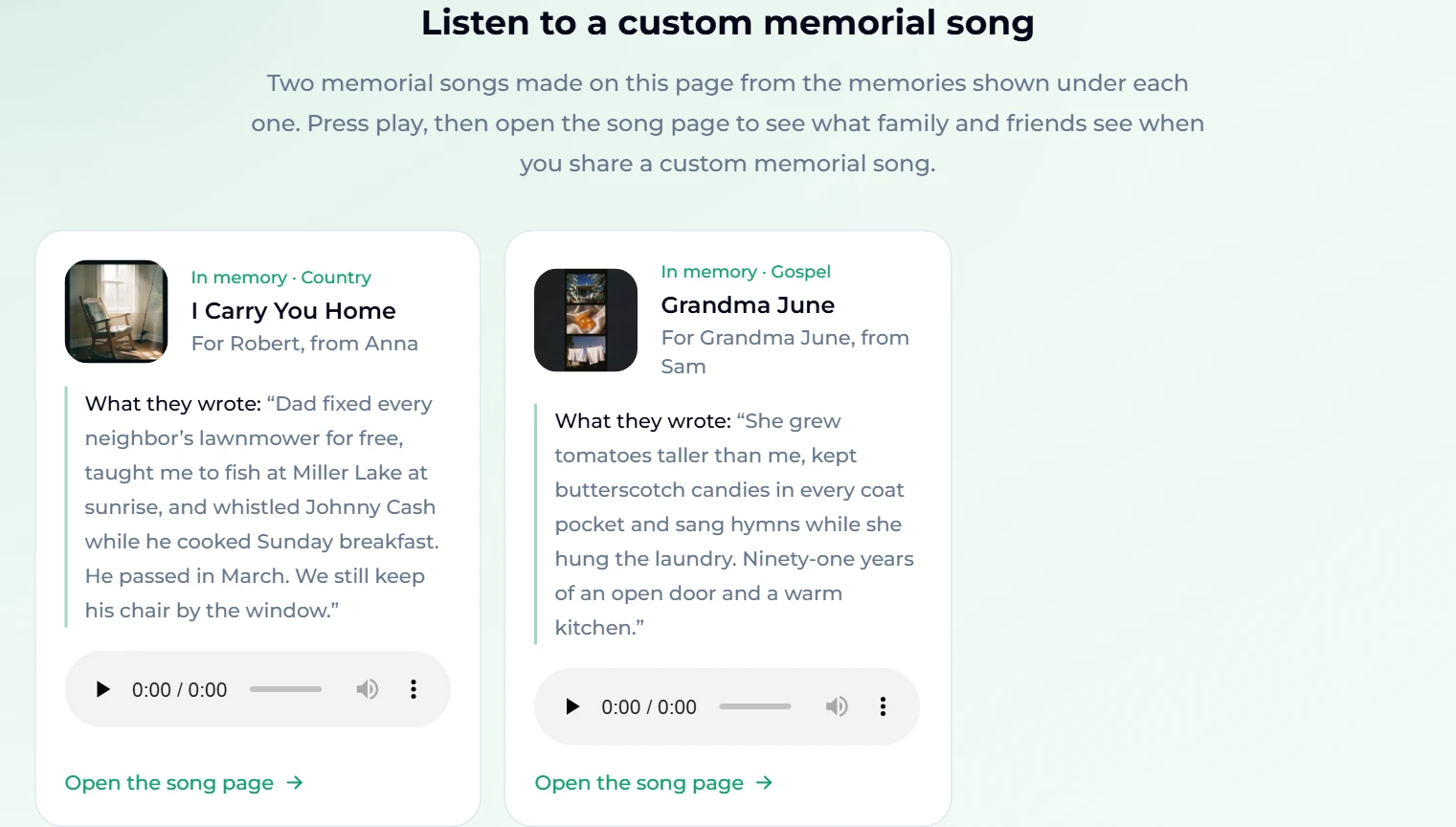
- He fixed every neighbor's lawnmower for free.
- He taught her to fish at Miller Lake at sunrise.
- He whistled Johnny Cash while he cooked Sunday breakfast.
- The family still keeps his chair by the window.
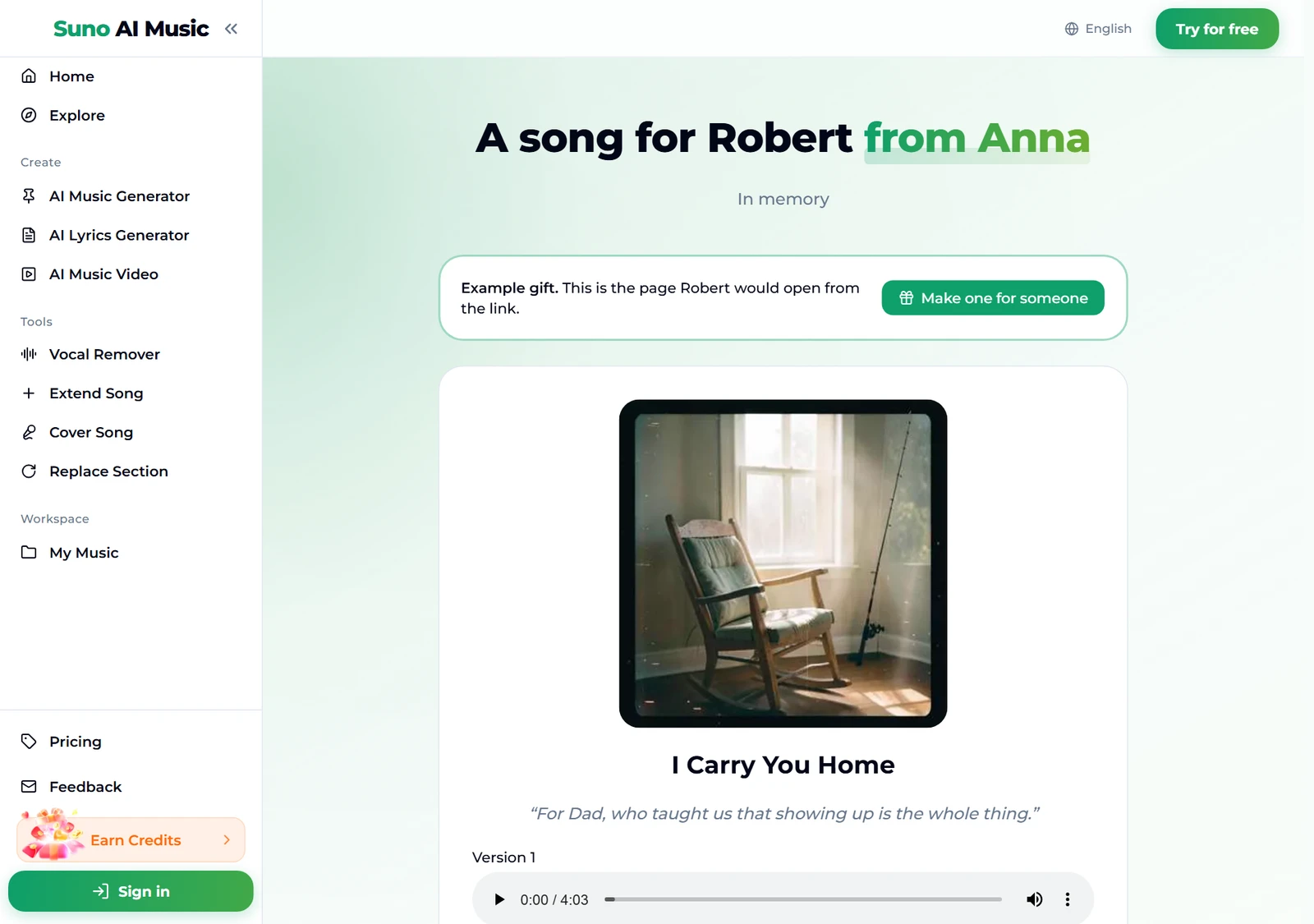
Mapped onto the structure above, the first verse opens on Robert at the lake before the sun is up. The chorus carries his name and the one thing she wants him to know. The second verse is the Sunday kitchen, the whistling and the smell of breakfast. The bridge is the chair by the window, which is where the song admits he is gone. Nothing in that outline needs poetic language; the memories do the work. You can hear how it turned out in the example further down.
Turning your memories into a memorial song
If you have the memories but not the music, the custom memorial song page can write and record the song for you. It uses the structure above and builds the lyrics around the details you give it.
- Open the page. The Occasion field is already set to In memory.
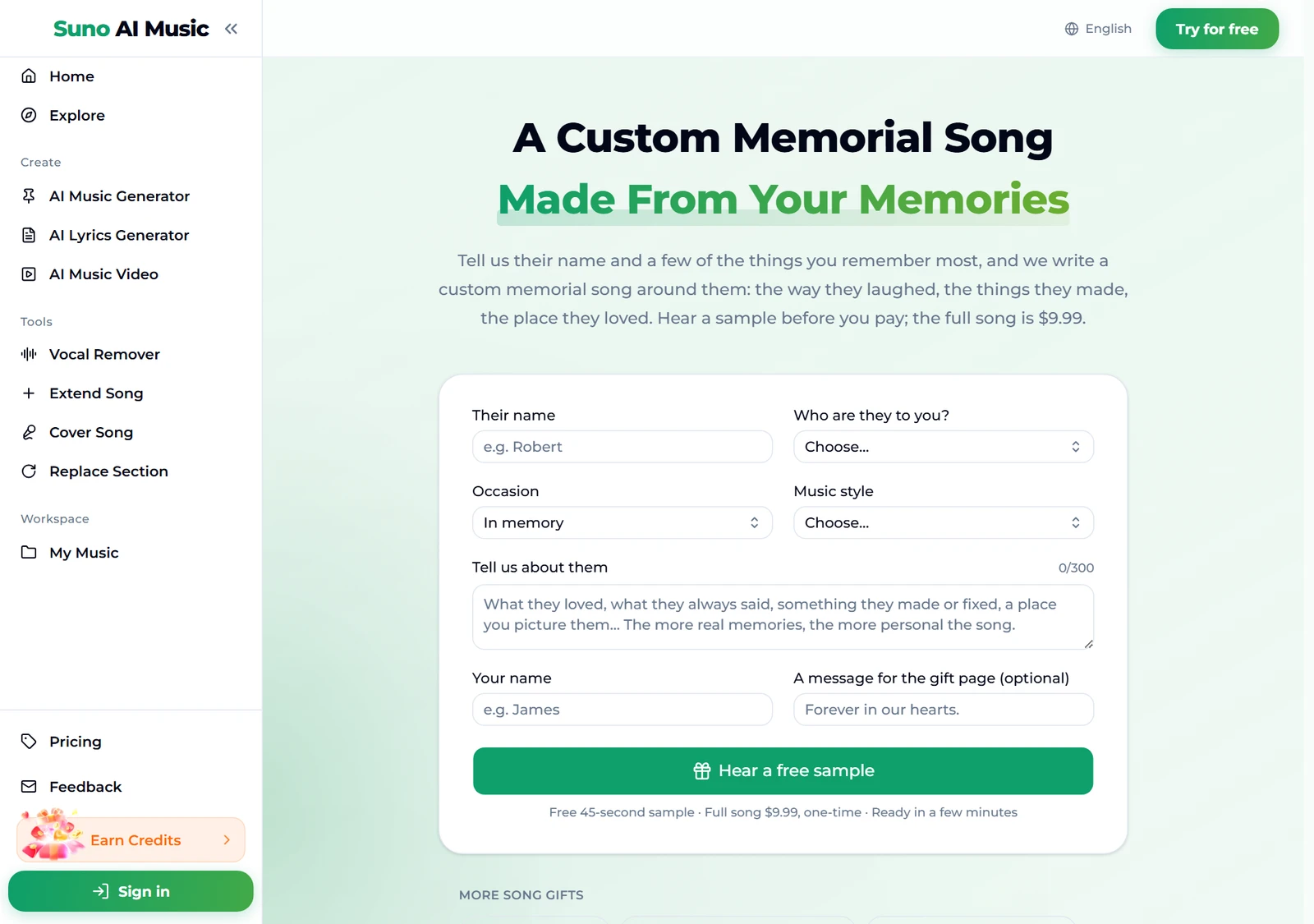
- Share a few memories. Their name, who they were to you (Dad, Mom, Grandparent, Husband, Wife, Friend, even Pet), a music style, about 300 characters of memories, your name and, if you like, a short message for the song page. Here are the answers Anna gave for her father:
-
Press Hear a free sample. You are asked to sign in first if you have not, and your answers are kept. The lyrics are written from your memories and two versions are recorded, usually in about two minutes.
-
Listen quietly first. You hear 45 seconds of each version and can read all the lyrics. If a memory is missing or a word feels wrong, choose Edit my answers; Make another version records two new takes. You can make three samples before paying, and attempts that fail do not count. The page looks like this (shown here with a birthday example):
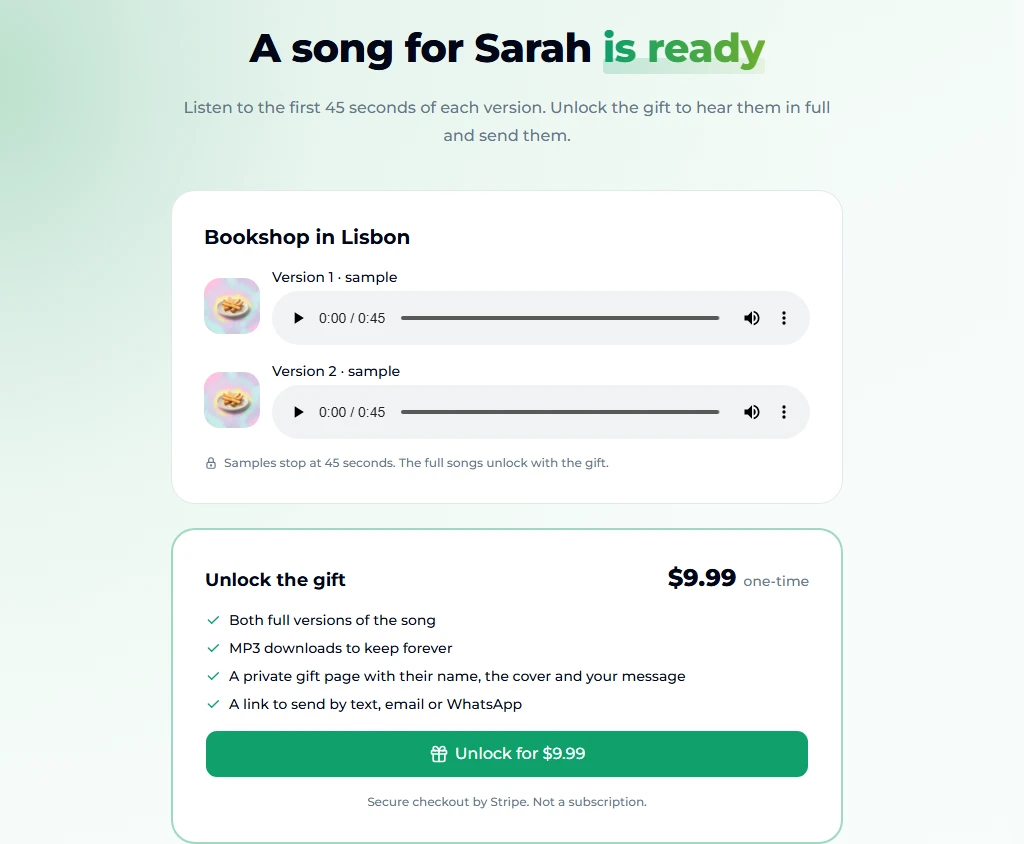
- Keep it when it feels right. The full song is a one-time $9.99 through Stripe. It includes both full versions, MP3 downloads and a private page with their name, the cover and your message. After unlocking you get a Copy gift link button to share it:
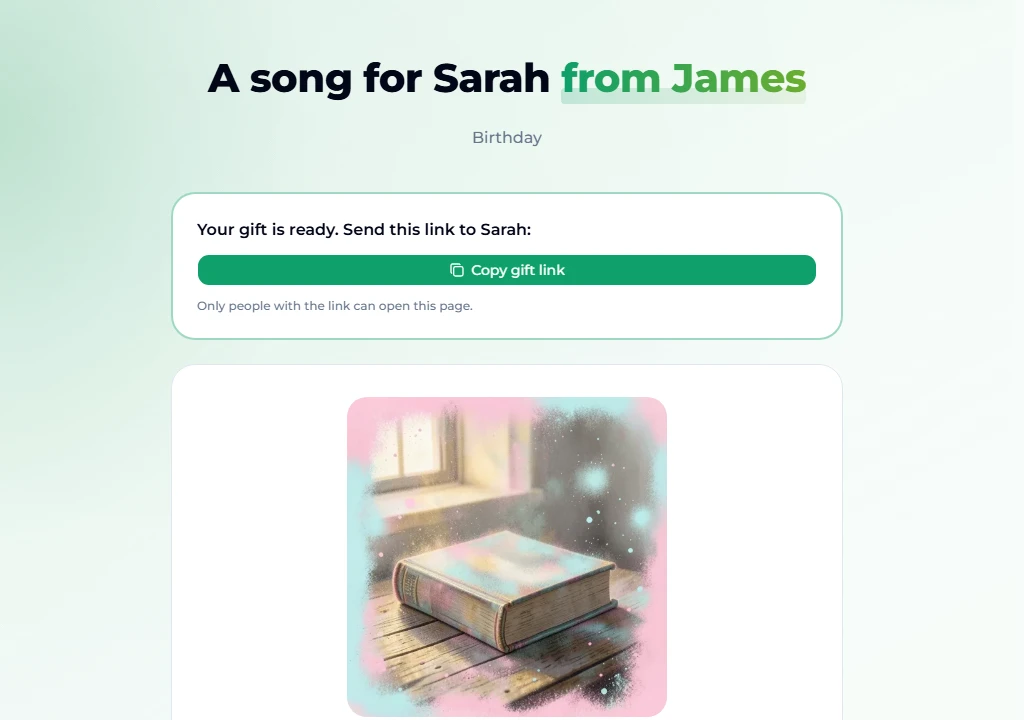
The page has two memorial songs you can listen to, each shown with the memories that made it:
This is the page Anna's family opens from the link, I Carry You Home:
The second example, Grandma June, is a gospel song built from tomatoes, butterscotch candies and hymns on laundry day.
Choosing a style that fits them
When you choose the style for a song for someone who passed away, pick the music they would have put on, not what you think a sad song should sound like.
- Country or Folk for storytellers, fishermen, farmers and anyone who whistled Johnny Cash.
- Gospel for a church family, a grandmother who sang hymns, or a song full of gratitude.
- Acoustic if you are unsure. It is gentle and close, and it suits a service.
- Romantic ballad for a husband or wife.
- Jazz for someone who loved records and long dinners.
- Pop or Rock if they would have wanted a celebration rather than tears.
A song for someone who passed away does not have to be slow. Many families find that an upbeat song in the style they loved is the one everyone sings along to.
Sharing the song with family
When the song is unlocked you get a private link to its page: their name, your message, the cover and both versions. Only people with the link can open it, and nobody needs an account.
- Send it to relatives by text, email or WhatsApp, especially those who could not travel.
- Print the link in the order of service.
- Play it at the gathering, using the MP3 so it does not depend on the venue's internet.
- Add it to a slideshow of photos.
- Keep it for their birthday or the anniversary of their passing.
With a song for someone who passed away, many people listen alone first, then with family. There is no wrong order.
Things that are easy to get wrong
- Writing about grief instead of about them. The sadness will be there anyway. Spend your words on who they were.
- Using their formal name when nobody did. If everyone called him Pops, write Pops.
- Too many memories. Three or four strong details make a better tribute song than ten rushed ones.
- Picking a style for the room rather than for them. Think about what they would have played.
- Rushing. It is fine to make a sample, sit with it for a day and change it.
FAQ
How do I start writing a song for someone who passed away?
Write down ten small memories without editing, circle the three or four that feel most like them, and build a first verse around their name and one picture of them. The chorus is the thing you most want to say.
What is the difference between a tribute song and a memorial song?
They are mostly the same thing. "Tribute song" is often used for a celebration of someone's life; "memorial song" for one played at a service or on an anniversary. Both are written about one person from real memories.
Can I play it at a funeral or celebration of life?
Yes. Playing it at a service or a family gathering is personal use. Download the MP3 for the venue's sound system.
Will the song say their name?
Yes. The lyrics are written from your memories with their name in the first line and the chorus. You can read them all before deciding.
Is it okay to use AI to make a song for someone who passed away?
Many families do. The memories, the name and the message are yours; the AI only turns them into lyrics and music. You read every line before deciding, and you can change anything that does not sound like them.
Can I make one for a pet?
Yes. Choose Pet as the relationship and write about them the way you would about anyone you loved.
Do family members need an account to listen?
No. Anyone with the link can open the page and play both versions on a phone or computer.
What does it cost?
Hearing a sample costs nothing. Keeping the full song is a one-time $9.99, with no subscription and no credits. Plans for other kinds of music are on the pricing page.
Final take
Writing a song for someone who passed away is a way of keeping them in the room a little longer. Start with the small things: what they did every day, what they made, what they always said. If you would like those memories turned into a finished song, the custom memorial song page is there whenever you are ready.