

TL;DR
AIVA does one thing no one else on this list matches: on its Pro plan, the copyright in the composition is yours, and every track exports as MIDI you can reorchestrate in a DAW. If that is what you need, stay. People look elsewhere for other reasons: AIVA is instrumental only (no singing), its sweet spot is orchestral, cinematic and ambient work, and ownership costs €33 a month billed annually. For a full song with vocals that you keep editing, try Suno AI Music (a disclosure: that is us); for background music for video, Soundraw or Beatoven.ai; for ad-safe licensing, ElevenLabs Music; for open weights you run yourself, Stable Audio 3. The table below says which tool fits which job.
In this guide
- What AIVA gives you, and why people look elsewhere
- How the alternatives compare
- The seven alternatives
- Which one for which job
- FAQ
What AIVA gives you, and why people look elsewhere
AIVA works like a composer's assistant. You pick a style preset (or train one of your own), a key, tempo, length and mood, and it writes an arrangement across instrument sections that you can then edit note by note. Its three plans, from its own pricing page as of September 2026:
| AIVA plan | Price (billed annually) | Downloads | Formats | Copyright | Monetisation |
|---|---|---|---|---|---|
| Free | €0 | 3 a month, up to 3 min | MP3, MIDI | Owned by AIVA, credit required | None |
| Standard | €11/month | 15 a month, up to 5 min | MP3, MIDI | Owned by AIVA | YouTube, Twitch, TikTok and Instagram only |
| Pro | €33/month | 300 a month, up to 5:30 | MP3, MIDI, WAV, all formats | Owned by you | Full |
Monthly billing costs more; AIVA shows the annual prices as discounts of 26% (Standard) and 33% (Pro). Its licence agreement says the licence for each track continues after you cancel.
That is a strong offer for one kind of user, and it leaves out several others:
- No vocals. AIVA writes instrumentals. Its next-generation audio model, Lyra, which is in private beta, is instrumental only by design. AIVA says it would rather support artists than replace them.
- Style range. It has hundreds of presets, but its strength is scoring: orchestral, cinematic, ambient, game music. Pop, hip-hop or a sung hook are not what it is built for.
- Ownership costs money. On Free and Standard, AIVA keeps the copyright, and Standard monetisation covers four social platforms only. Releasing to streaming services or licensing to a client means Pro.
- Five and a half minutes max per download, even on Pro.
If none of that matters to you, AIVA remains the right tool. If one of them does, read on.
How the alternatives compare
| Tool | Vocals | MIDI / stems | Licence or ownership | Best at | Entry price |
|---|---|---|---|---|---|
| AIVA (for reference) | No | MIDI on every plan | Copyright yours on Pro | Scores you own | Free; Pro €33/mo annual |
| Suno AI Music | Yes | Vocal/instrumental split | Commercial licence from Standard | Songs you keep editing | 16 free credits; from $9.99/mo |
| Suno (official) | Yes | Stems; Studio on Premier | Commercial use on paid plans | Song quality | Free; Pro $10/mo |
| Mureka | Yes | Stems and MIDI on Premier | Commercial rights on paid plans | Vocal songs + MIDI | Free (no downloads); Pro $10/mo |
| Soundraw | No | Stems from Artist Pro | Perpetual commercial licence | Instrumentals for video | Creator $16.99/mo |
| Beatoven.ai | No | Stems | Perpetual non-exclusive licence | Background music | See its pricing page |
| ElevenLabs Music | Yes | — | Commercial use on paid plans | Ads and brand work | Starter $6/mo |
| Stable Audio 3 | No | — | You own outputs (Community License) | Local / open weights | Open weights free |
| Google Lyria 3.5 | Yes | — | Google's terms, SynthID watermark | Developers, quick ideas | Gemini app; API per song |
Prices are the published figures at the time of writing, in the vendor's own currency; check each pricing page before you buy.
The seven alternatives
1. Suno AI Music — when the piece needs a voice
This is our product, so here is where it wins and where it doesn't. AIVA gives you a score; Suno AI Music gives you a finished song with vocals, and then tools to keep working on it. It runs Suno v6, v6 Wild and v6 Mini on the paid plans. Each generation costs 10 credits and returns two songs, and a new account starts with 16 credits to try it. Every song in the library can be extended, covered into another style, have one section replaced with new lyrics, be split into vocal and instrumental, or turned into an MP4 music video. If you liked AIVA for instrumentals, the AI instrumental generator and background music generator cover that too.
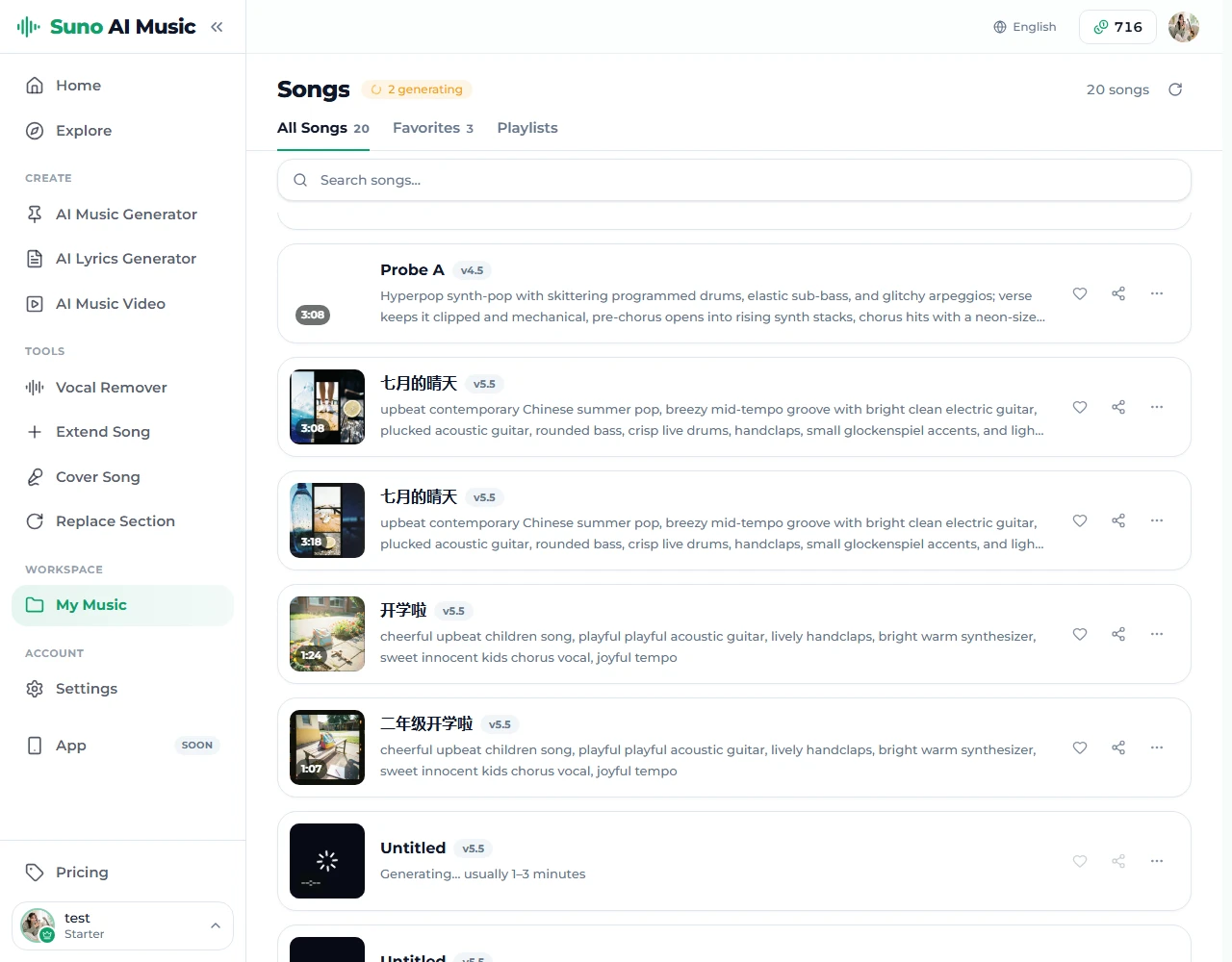
Plans are Starter $9.99 (800 credits a month), Standard $29.99 (3,000) and Premium $99.99 (12,000). Yearly billing gives two months free, and one-time credit packs start at $9.99 for 600 credits that never expire. MP3 downloads come with any plan or credit pack; WAV export and a commercial licence come with Standard and above.
Where AIVA wins: we give you a commercial licence, not the copyright, and we don't export MIDI. If you need to own the composition or open the notes in Logic or Cubase, AIVA Pro is the better tool.
2. Suno (official) — the quality reference for songs
For raw song quality with vocals, Suno's own app is the one to beat. On September 9, 2026 it replaced its models with a new family trained on licensed music from its label partners. Pro is $10 a month (2,500 credits) and Premier $30 (10,000 credits plus Suno Studio, its browser DAW). The limit to plan around is downloads: since September 3, 2026 the free plan gets seven downloads in total, Pro 20 a month and Premier 60, with no limit when exporting from Studio. By comparison, AIVA Pro allows 300 downloads a month.
3. Mureka — vocals plus MIDI
Mureka is the closest thing to "AIVA with a singer", because its top plan exports MIDI as well as audio. The free plan allows four songs a day but no downloads. Pro is $10 a month ($8 billed yearly) for 500 songs with MP3 and commercial rights. Premier is $30 ($24 yearly) for 2,000 songs and adds WAV, stems and MIDI, Mureka Studio and voice cloning. You get commercial rights, not a copyright assignment, but if you want sung songs and MIDI from one tool, start here.
4. Soundraw — instrumentals shaped to a video
Soundraw overlaps with AIVA's instrumental side but is built for editors rather than composers. It generates tracks from a model trained on music produced in-house, and you set length, sections and intensity to fit a cut. Creator is $16.99 a month ($11.04 billed annually) with unlimited downloads, MP3 only, under a perpetual worldwide commercial licence. WAV and stems start at Artist Pro ($35.99, or $23.39 annually). There is no free plan, only a free trial of the editor, and no vocals. For a video bed it is quicker than AIVA; for a score you want to rework note by note, it is not the right tool.
5. Beatoven.ai — background music with clean sourcing
Beatoven.ai makes royalty-free background music for podcasts, courses, games and social video. Its Maestro model is Fairly Trained certified, and the company says contributing musicians are paid. Every download comes with a non-exclusive, perpetual licence, and stems are available for remixing. It is the opposite of AIVA Pro on ownership: Beatoven.ai keeps ownership of the tracks, and it does not allow distributing them to Spotify, Apple Music or other streaming services. That is fine for music under your content and wrong for a release.
6. ElevenLabs Music — the licence for ads
When the question is whether you can put the track under a paid campaign, ElevenLabs Music has the clearest paperwork. The model is trained on licensed data (with deals with Merlin and Kobalt) and makes vocal or instrumental tracks in many languages. Commercial use starts on Starter at $6 a month. The Free plan does not include it, and film, TV and studio games need an Enterprise plan. Its terms also say output may not be unique and bar using artist names in prompts. If AIVA's four-platform Standard licence is too narrow and Pro too expensive for ad work, look here. You don't get a copyright transfer.
7. Stable Audio 3 — you own it, on your own machine
Stability AI released Stable Audio 3.0 on May 20, 2026: four models trained on licensed data. Small SFX, Small (up to two minutes) and Medium (over six minutes) have open weights on Hugging Face; Large is API-only. Under the Stability AI Community License you own your outputs and can sell them. Organisations with more than $1M in annual revenue need the Enterprise licence. It makes instrumentals and sound design only, and there is no score editor or MIDI. Of the tools here it comes closest to AIVA on ownership, and it is the only one you can run offline.
Also worth knowing: Google Lyria 3.5. Since September 4, 2026 it has been in the Gemini app and the Gemini API: full songs a couple of minutes long, with vocals or instrumental, from text or an image, billed per song through the API. Every track carries a SynthID watermark and falls under Google's terms. It's good for trying ideas quickly or building music into an app, but it's not a composition tool.
Which one for which job
- A film, game or trailer score you must own outright, with MIDI: stay on AIVA Pro. Stable Audio 3 comes next if you want to run it locally.
- A song with a singer: Suno for quality. Suno AI Music if you'll keep editing it with extend, cover and replace section.
- Sung songs and MIDI from one subscription: Mureka Premier.
- Music cut to a YouTube edit: Soundraw.
- Podcast or course background with clean sourcing: Beatoven.ai.
- A paid ad: ElevenLabs Music (Enterprise for film and TV).
- Music inside your own app: Lyria 3.5 in the Gemini API.
Writing lyrics for a vocal tool? The AI lyrics generator and the Suno prompts guide help. If the track is headed for Spotify, read can you upload AI music to Spotify first.
FAQ
Is AIVA still worth it in 2026?
Yes, if you need orchestral or cinematic instrumentals and want the copyright. The Pro plan assigns it to you and includes MIDI and WAV. It is not worth it if you need vocals or mostly make pop and hip-hop.
Which AIVA alternative can sing?
Suno, Suno AI Music, Mureka, ElevenLabs Music and Google Lyria 3.5 all generate vocals. AIVA, Soundraw, Beatoven.ai and Stable Audio 3 are instrumental.
Which alternative exports MIDI like AIVA?
Mureka, on its Premier plan. The others export audio, and some export stems. If MIDI editing is central to how you work, AIVA is still the more complete tool, because you edit the composition itself.
Do I own the music from AIVA alternatives?
Mostly you get a licence, not ownership. Stable Audio 3's Community License says you own your outputs; the rest grant commercial rights under their own terms. Whether purely AI-generated audio can be protected by copyright at all depends on the country, so treat "ownership" as a contract term, not a legal guarantee.
Is there a free AIVA alternative?
Stable Audio 3's open weights are free to run locally. Suno AI Music gives 16 credits on signup, enough for one generation of two songs, and more free options are in our free AI music generator comparison.
Can I monetise AIVA music on YouTube without Pro?
On Standard, yes. Its licence allows monetisation on YouTube, Twitch, TikTok and Instagram only, and AIVA keeps the copyright. The Free plan allows no monetisation and requires credit to AIVA.
Final take
AIVA is not really in competition with most of this list. It is a scoring tool that hands you the copyright and the notes, and for that job it is still the answer. People leave it because the job changed: they need a voice, a genre it doesn't do well, or a licence without paying for ownership. Pick the alternative that fits the new job. If that job is a song with vocals that you will keep reshaping, try it on Suno AI Music with your 16 signup credits.