TL;DR
Yes, you can upload AI music to Spotify, and DistroKid will distribute it — provided you own 100% of the rights to the track, disclose the AI involvement where the platform asks, and are not doing the three things the platforms now remove: imitating a real artist's voice, mass-uploading near-identical tracks, or faking streams. Spotify said so in its September 2025 policy update and has not banned AI since; Apple Music is adding "Made With AI" labels in 2026; Deezer tags AI tracks automatically and demonetises the fraudulent streams around them. The practical requirements: a commercial licence for the track (on Suno AI Music that is the Standard plan and above, with a certificate), a WAV export, a prompt that described a sound rather than a singer, and a release plan that looks like an artist's, not a spam farm's.
In this guide
- Spotify's rules in 2026
- DistroKid and the other distributors
- Apple Music, Deezer, YouTube Music
- What gets a release pulled
- The copyright question
- What you need before you upload
- A release checklist
- FAQ
Spotify's rules in 2026
Spotify has never banned AI-generated music, and its policy update of September 25, 2025 made the position explicit: it supports artists using AI creatively, and it targets three specific abuses.
- Unauthorized voice impersonation is removed. A track that clones or imitates a named artist's voice without consent comes down under the impersonation policy, and repeat offenders lose accounts.
- Spam patterns are filtered. Mass uploads of near-duplicate tracks, tracks under 30 seconds designed to game royalties, SEO-bait titles, and "AI persona" profiles with dozens of releases a week are deprioritised or removed. Spotify said it had removed more than 75 million spam tracks in the twelve months before the announcement — the enforcement is aimed at fraud, not at responsible AI use.
- AI disclosure through credits. Spotify adopted the DDEX industry standard for declaring AI involvement — synthetic vocals, AI composition, AI-assisted mastering — in a track's credits. Disclosure is delivered through your distributor's metadata; it is encouraged rather than mandatory today, and it does not affect whether a track is allowed.
In short: an original AI track with your own name on it, disclosed as AI-assisted, released at a human pace, is exactly what the policy permits.
DistroKid and the other distributors
Distributors are the gatekeepers in practice, because you cannot upload to Spotify directly.
DistroKid accepts AI-generated music. Its conditions are the ones every distributor shares: you must own 100% of the rights to the recording and the composition, you must not use a real artist's name or likeness, and you tick a mandatory AI disclosure checkbox during upload — that is the DDEX credit Spotify asks for. DistroKid also lets you opt in or out of YouTube Content ID; if you plan to use the same track under your own YouTube videos, either leave Content ID off for it or whitelist your channel, or you will claim yourself (the YouTube guide covers that trap).
The other majors — TuneCore, CD Baby, Amuse, LANDR — follow the same shape: rights, disclosure, no impersonation, and a spam filter of their own. Some ask for the tool used; answer honestly.
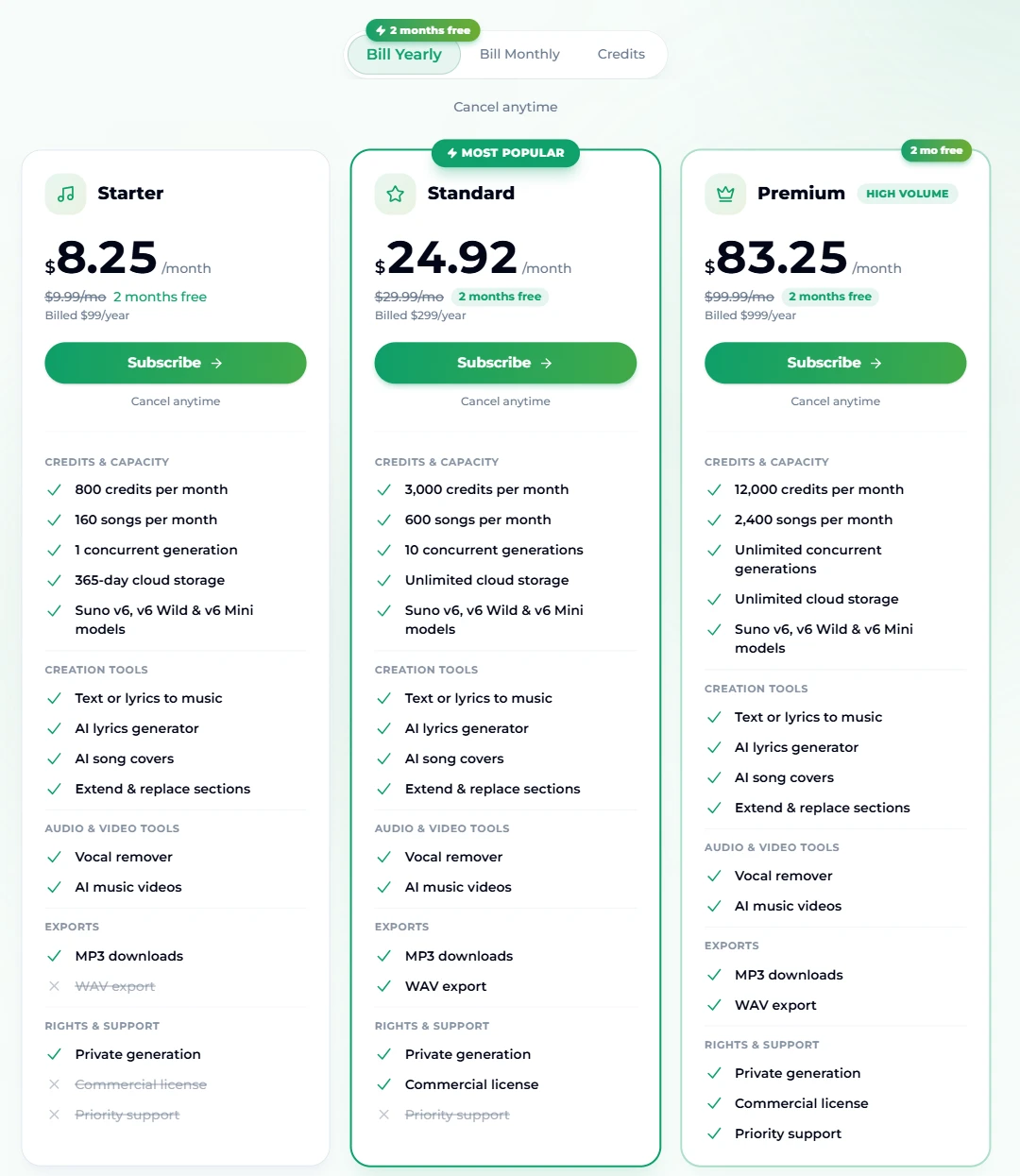
What "owning 100% of the rights" means for an AI track: the platform you generated it on must grant you the commercial rights, in writing, and the prompt must not have borrowed anyone else's property. On Suno AI Music the commercial licence, with a downloadable certificate, is included on the Standard plan and above; the free tier and Starter are for personal use and are not enough for a release. Plans are on the pricing page.
Apple Music, Deezer, YouTube Music
The platforms differ mostly in how loudly they label.
Apple Music introduced Transparency Tags in March 2026, letting labels and distributors flag AI-generated music and artwork, and has said a "Made With AI" label will appear on tracks later in 2026 where "a material portion" of the content was AI-made — supplied by distributors as metadata. Apple also runs its own detection and reported redistributing royalties from around two billion manipulated streams in 2025. AI music is accepted; disclosure is becoming the norm.
Deezer is the strictest. Its detection tags fully AI-generated tracks automatically — it says it recognises the signatures of the major generators — and it reported that AI tracks passed half of all daily uploads by mid-2026. Tagged tracks are excluded from editorial playlists and algorithmic recommendations, and Deezer found up to 85% of AI-track streams were fraudulent and removed those streams from the royalty pool. Since January 2026 it has sold the detection tool to other platforms and distributors, so expect the tagging to spread. Your track can be on Deezer; it will not be pushed there.
YouTube Music inherits YouTube's rules: AI music allowed, the "altered or synthetic content" disclosure for realistic synthetic material, and the "inauthentic content" policy against mass-produced uploads. Details in the YouTube guide.
What gets a release pulled
Across every platform the takedown reasons are the same four:
- Voice impersonation. A prompt that names a real singer, a cloned voice, a "sounds like" persona. This is the one that ends accounts, and it is also the one a licence cannot protect, because the rights belong to the person imitated.
- Mass uploading. Hundreds of near-identical tracks, fake artist profiles, the same track under several titles. Spotify's spam filter and Deezer's tagging both key on it.
- Streaming fraud. Bots, stream farms, playlist schemes. Deezer's 85% figure is why platforms now assume AI-heavy catalogues are fraud until proven otherwise; a clean release history is worth protecting.
- Borrowed material. A sample, a melody or a lyric that belongs to someone else. Content ID and Apple's detection catch it; the prompt habit that avoids it is to describe sound, never records — the prompts guide is built on that habit.
One more, specific to 2026: Suno's own downloads policy. Announced in August and in force since September 3, 2026, it caps exports at 7 ever on the free plan, 20 a month on Pro and 60 a month on Premier (no limit from Suno Studio), counting songs made before that date too. It targets the spam pattern above rather than individual releases — but if you generate on Suno's own app, count the WAVs a release actually needs against that monthly allowance before planning a catalogue. (The Suno v6 write-up tracks that policy.)
The copyright question
The US Copyright Office's position, unchanged in 2026: copyright requires human authorship. A track generated entirely from a prompt is not copyrightable as such; a track with meaningful human creative contribution — your lyrics, your arrangement decisions, your editing, your performance layered on top — can be registered, with the AI-generated portions disclaimed.
What that means in practice for a release:
- You can distribute and earn. Registration is not a condition of uploading; the distributor asks whether you have the rights, which the generator's licence provides.
- What you cannot do with a purely generated track is stop someone else from using it, because there is no copyright to enforce. The more of you there is in the song — your words, your edits, your voice — the more of it is protectable.
- "Copyright-free" on Suno AI Music means the platform makes no claim on your output and no third party's rights are embedded in it; the commercial licence is what lets you monetise. It does not manufacture a copyright the law will not grant. Write the lyrics yourself, and the words at least are yours.
Outside the US the rules vary — the UK, for one, has a provision for computer-generated works — so a release aimed at a specific market is worth ten minutes with that market's rules.
What you need before you upload
The concrete pile of things a clean AI release has:
- The commercial licence certificate for the track, downloaded and filed. On Suno AI Music it is on the song page, on the Standard plan and above.
- A WAV. Distributors want lossless; MP3 gets re-encoded and sounds it. WAV export is included from the Standard plan.
- Your own lyrics, or at least lyrics you edited — for the copyright reason above, and because the model's first draft is rarely the best line.
- A finished master, not a first take. Two takes come back per run; extend the arrangement to a full-length structure, replace the weak line, and if you want a radio edit, the vocal remover gives you the instrumental for a clean version.
- Artwork and a visual if the platform wants one — the music video generator renders an MP4 for a canvas or a YouTube upload.
- A real artist identity. A name, a bio, a consistent release schedule. It is what separates you from the spam pattern in every platform's filter.
A release checklist
- Prompt described a sound, not a singer. ☐
- Lyrics are yours, or edited by you. ☐
- Licence certificate downloaded; plan is Standard or above. ☐
- WAV exported; loudness in the normal range (around -14 LUFS integrated for streaming). ☐
- AI disclosure ticked at the distributor. ☐
- Content ID set the way you want it for your own channels. ☐
- Release cadence looks human — singles weeks apart, not fifty in a day. ☐
- No purchased streams, ever. ☐
FAQ
Can you upload AI music to Spotify?
Yes. Spotify permits AI-generated music. It removes tracks that impersonate real artists, filters spam-pattern uploads, and asks for AI disclosure in the credits through your distributor.
Does DistroKid accept AI-generated songs?
Yes, if you own 100% of the rights, do not use a real artist's name or voice, and tick the AI disclosure checkbox at upload.
Do I have to say the track is AI?
Spotify's disclosure through DDEX credits is encouraged; DistroKid's checkbox is mandatory; Apple Music's labels are arriving through distributor metadata in 2026. Disclose. It does not affect whether the track is allowed.
Will Deezer pay for AI streams?
It pays for genuine ones. Deezer tags fully AI tracks, keeps them out of recommendations, and removes fraudulent streams — which it found to be most AI-track streams — from the royalty pool.
Can I copyright an AI song?
Not the purely generated part, in the US. Parts with meaningful human authorship — your lyrics, arrangement, edits — can be registered with the AI portions disclaimed.
What licence do I need to release a track from Suno AI Music?
The commercial licence on the Standard plan and above, with the certificate downloaded from the song page.
Final take
The platforms have settled on a position: AI music is allowed, impersonation and spam are not, and disclosure is the price of admission. Make the track yours — your lyrics, your edits, a real artist name — get the licence and the WAV from the Standard plan, disclose at the distributor, and release at a human pace. That is a catalogue the filters leave alone.