

TL;DR
Trap is a handful of parts you can name: long sliding 808 bass, triplet hi-hat rolls, a hard snare on the half-time backbeat and a dark bell, piano or synth melody on top. If you want to learn how to make trap music without programming every hi-hat by hand, open the AI trap generator, describe the energy and the story in one sentence, and press Generate. The form opens with a working trap anthem prompt already filled in, and six "Start from a vibe" tiles let you hear a finished example before you spend a credit. One run costs 10 credits and returns two songs in about a minute; new accounts get 16 free credits.
In this guide
- What makes trap music sound like trap
- Step by step with the AI trap generator
- Writing a trap prompt that works
- The six trap vibes and their prompts
- Common trap mistakes
- Choosing a model
- After the track is made
- FAQ
- Final take
What makes trap music sound like trap
Trap grew out of Atlanta hip hop in the 2000s and now shows up everywhere from rap albums to festival stages. The sound is recognisable in one bar because it is built from the same few pieces. Each one is a word or two you can put in the Prompt box:
- Tempo. Trap usually sits between 130 and 160 BPM but is felt at half time, so a 140 BPM beat grooves like 70. Write the number: 145 BPM. Festival trap runs faster, chill trap slower.
- The 808. A long, tuned bass drum that slides between notes and carries the bass line. Booming 808s, sliding 808 bass and soft 808s each give a different weight.
- Hi-hats. Fast hats with triplet rolls and stutters are the signature rhythm. Rolling hi-hats, rapid hi-hats or rolling triplet hi-hats.
- Snare. A hard snare or clap on the third beat of the bar, the half-time backbeat. Hard snares is enough.
- Melody. Sparse and dark: piano bells, a music box, a choir, a flute loop, an emotional guitar. Name one: dark piano bells, haunting music box melody.
- The voice. A confident rapper with a chant hook, an auto-tuned sung vocal for melodic trap, or none at all for a beat. Male rapper with a catchy chant hook, auto-tuned sung male vocal, confident female rapper.
That is the whole recipe for trap music. A prompt that names the mood, the voice, the 808s, the hats and one melody instrument already describes a trap track.
Step by step with the AI trap generator
- Open the AI trap generator. It is the same form as the main AI music generator, set up for trap. You do not need an account to look around or play the examples.
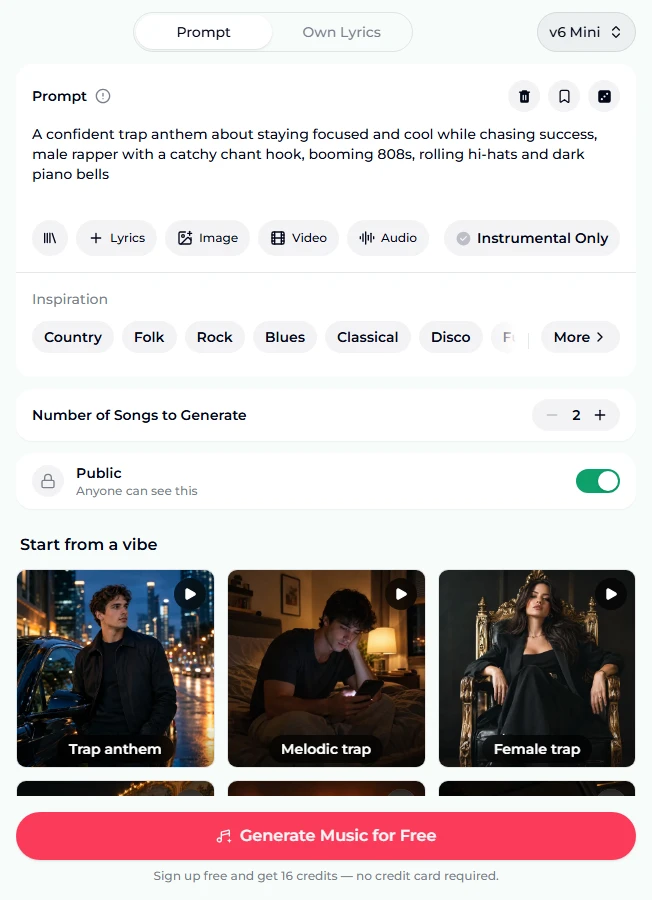
- Read the preset. The Prompt box already holds a complete trap prompt: A confident trap anthem about staying focused and cool while chasing success, male rapper with a catchy chant hook, booming 808s, rolling hi-hats and dark piano bells. Notice the shape: mood, story, voice, beat, melody. Instrumental Only is off, so this makes a song with a rapper.
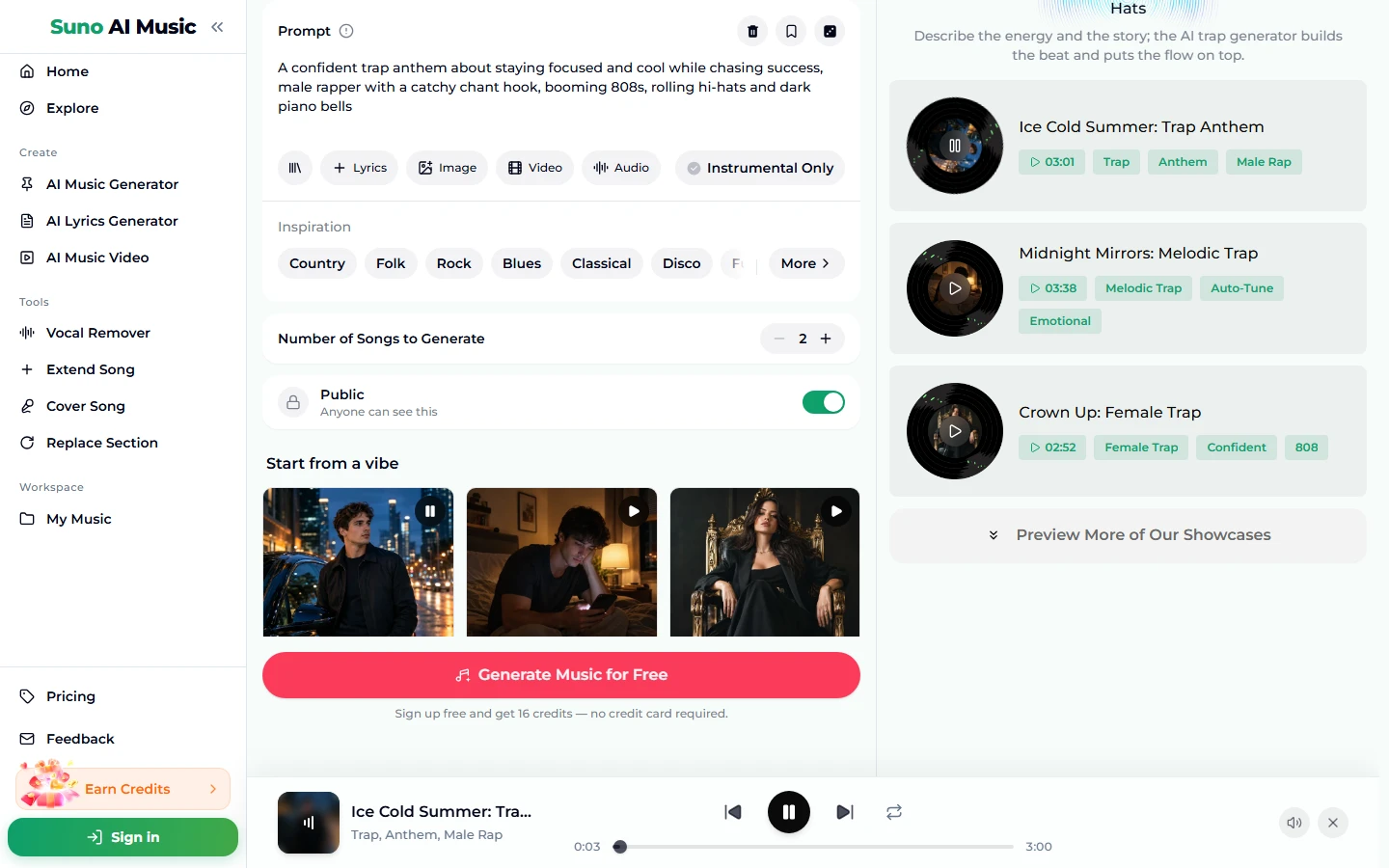
- Tap a vibe. Under "Start from a vibe" there are six tiles. One tap plays that tile's example song and copies its prompt into the Prompt box, switching Instrumental Only on or off to match. The "Trap anthem" tile holds the same prompt as the preset, so the box stays the same while its example, Ice Cold Summer: Trap Anthem, plays in the bar at the bottom. That example was made on v6 from exactly this prompt and runs 3:01.
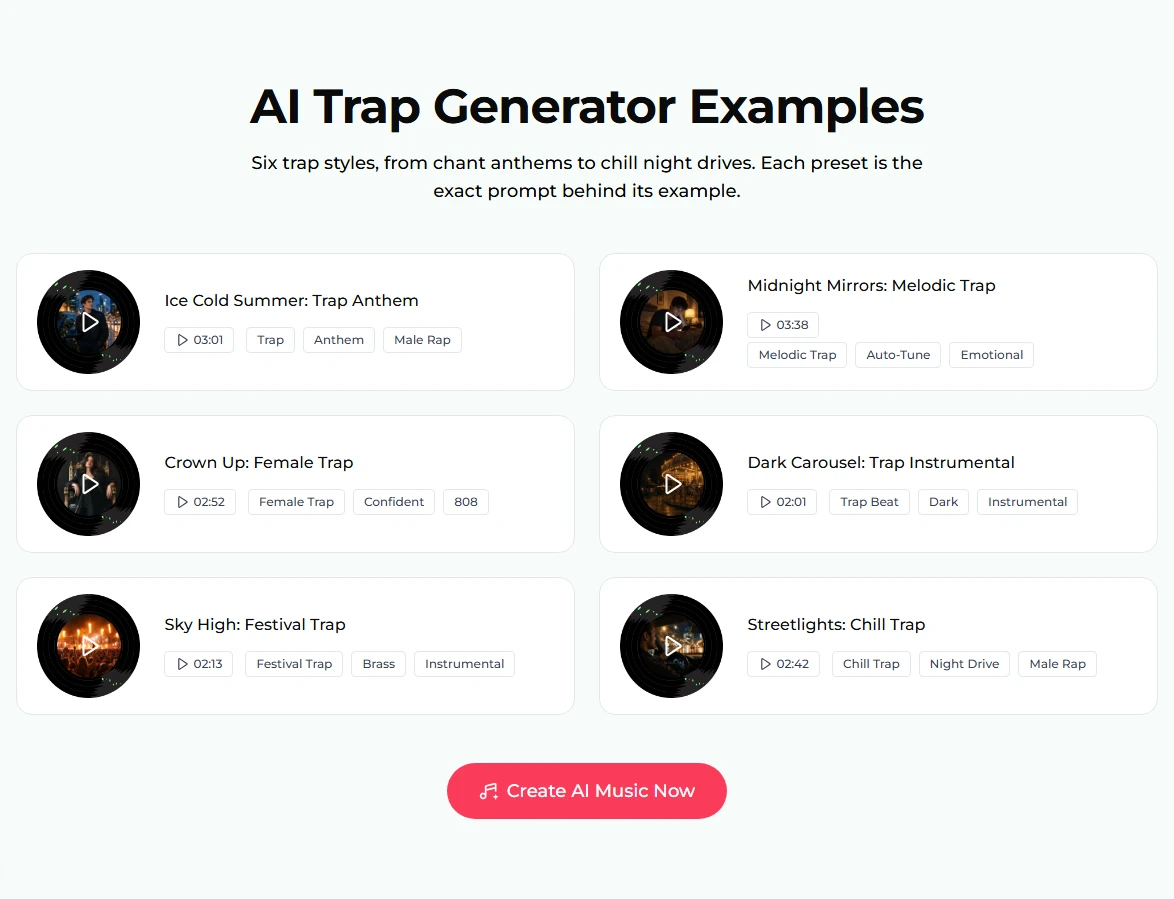
- Compare the six examples. Further down the page, the examples list shows all six with their length and tags, so you can hear the range before choosing: a 3:38 melodic trap song, a 2:01 dark instrumental beat, a 2:13 festival track with brass.
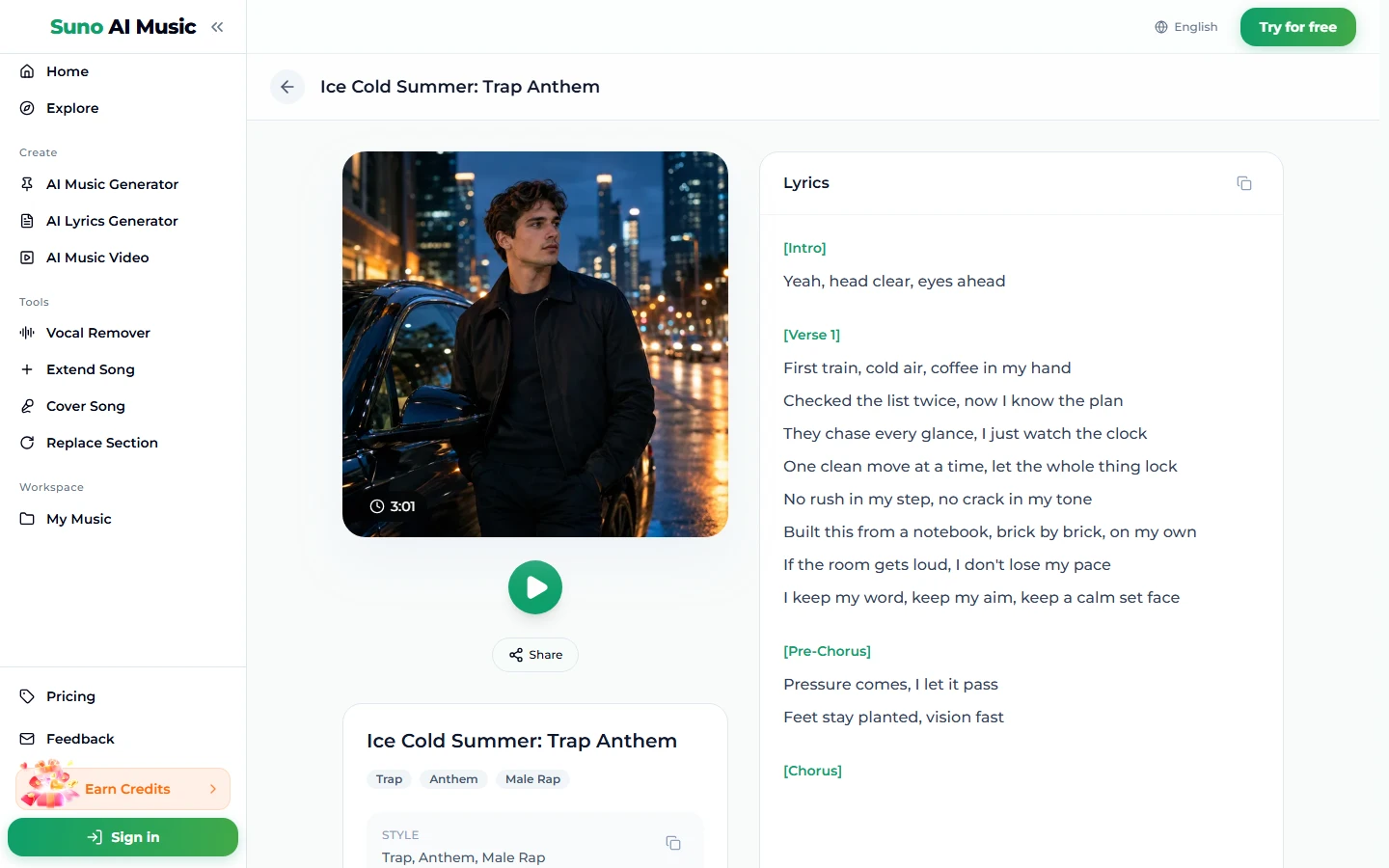
- Open a song page if you want the lyrics. Every example has its own page. Ice Cold Summer shows the cover, a play button, Share, the tags and the full lyrics, checked word for word against the vocal. The chorus is as simple as trap hooks get: "Stay cool, stay sharp, keep going."
- Press Generate. Logged out, the button reads "Generate Music for Free"; signing up gives you 16 credits with no card. One run costs 10 credits and returns two songs in about a minute. They are new songs in the style of the prompt, not copies of the example, so the two takes will differ from it and from each other.
- Keep the better take. If both miss in the same way, change one word in the prompt and run again. The stepper can queue more songs at once, in steps of two, up to ten.
Writing a trap prompt that works
The Prompt box takes up to 500 characters, but the six presets on the page are all one sentence long. That is a good limit to copy.
- Start with the flavour. Trap anthem, melodic trap, dark trap instrumental beat, chill trap. The first words set the frame for everything after them.
- Give it a story. "About staying focused while chasing success" or "about driving through the city at night thinking about the future" gives the lyrics somewhere to go. Without it you get generic flexing.
- Describe the voice. Gender, delivery and the hook: laid-back male rap vocal, confident female rapper, auto-tuned sung vocal, catchy chant hook.
- Name the beat in trap words. 808s, hi-hats, snares. Add an adjective for weight: booming, hard, soft, sliding.
- Pick one melody instrument. Dark piano bells or emotional guitar loop, not both plus strings plus choir.
- Add a number if tempo matters. 145 BPM works better than fast. The model honours it roughly, not to the exact beat.
- Want only the beat? Switch on Instrumental Only and write instrumental beat in the prompt, as the two instrumental presets below do.
- Want your own bars? Switch to the Own Lyrics tab: lyrics up to 5,000 characters, a style box up to 1,000 characters (paste a trap prompt there) and a title up to 80. If you need help writing them, the AI lyrics generator drafts verses and hooks.
For a longer list of words that reliably change the sound, see the Suno prompts guide.
The six trap vibes and their prompts
These are the six tiles on the AI trap generator. Each prompt is copied verbatim; each example song was made on v6 from exactly that prompt.
| Vibe | What it is | Prompt |
|---|---|---|
| Trap anthem | Chant-hook anthem with a male rapper, 3:01 | A confident trap anthem about staying focused and cool while chasing success, male rapper with a catchy chant hook, booming 808s, rolling hi-hats and dark piano bells |
| Melodic trap | Sung, auto-tuned heartbreak song, 3:38 | A melodic trap song about late nights and a love that ended, auto-tuned sung male vocal, emotional guitar loop, soft 808s and spacey pads |
| Female trap | Bold female rap with a chanting hook, 2:52 | A bold female trap song about building your own empire, confident female rapper, hard 808s, rapid hi-hats and a chanting hook |
| Dark trap beat | Instrumental beat with a music box lead, 2:01 | dark trap instrumental beat, 145 BPM, haunting music box melody, sliding 808 bass, rolling triplet hi-hats, hard snares, eerie atmosphere |
| Festival trap | Instrumental with brass and a big drop, 2:13 | festival trap instrumental, 150 BPM, epic brass and horn stabs, massive 808 drop, snare rolls, air horns, huge festival energy |
| Chill trap | Laid-back night-drive rap, 2:42 | A chill trap song about driving through the city at night thinking about the future, laid-back male rap vocal, mellow piano, soft 808s and lo-fi textures |
Two extra recipes of our own, untested, built on the same pattern:
- dark trap instrumental beat, 140 BPM, eerie choir pad, sliding 808 bass, rolling triplet hi-hats, hard claps, cold and cinematic
- A motivational trap song about the last rep in an empty gym at 5am, gritty male rapper, shouted chant hook, booming 808s, rapid hi-hats and dark strings
Common trap mistakes
- Too many melody instruments. Trap is sparse on purpose. Piano, guitar, strings, flute and choir together read as a film score with 808s under it.
- No story. "Hard trap song" gives the rapper nothing to say. One clause about what the song is about fixes most weak lyrics.
- Forgetting Instrumental Only. If you want a beat to record over, write instrumental beat and switch the toggle on. Otherwise you get a rapper.
- Expecting an exact BPM. The number steers the tempo; it does not lock it. If you need a precise tempo for a mix, check the result and adjust.
- Naming artists. Describe the flow, the voice and the beat instead of a famous name. You get an original track in that spirit.
- Judging from one take. Every run gives two. If only one misses, it is chance; if both miss the same way, the prompt is the problem.
Choosing a model
The model picker sits at the top right of the form. v6 Mini is the free tier, labelled "Fast drafts, high volume", and it is what new accounts use. v6 ("Most powerful, for any song") is the model all six examples were made on, and gives the heaviest 808s and the clearest rap vocals. v6 Wild ("Best for experimental ideas") is worth a try when you want a stranger beat or an unusual vocal texture. v6 and v6 Wild need a paid plan.
Whatever the model, a run costs the same 10 credits for two songs. Plans and credit packs are on the pricing page.
After the track is made
- Make it longer. Extend Song continues a take from any point, useful for an extra verse or a longer outro.
- Fix one part. Replace Section regenerates one section you do not like, such as a weak second verse, and keeps the rest.
- Get the beat alone. The vocal remover splits any song into two stems, vocals and instrumental, so you can rap your own verse over the beat.
- Try it in another style. Cover Song remakes a track in a new style, for example your trap anthem as a drill or rock version.
- Put it under a video. The AI music video tool turns a song into a video for reels and Shorts.
- Download. Downloads come with a plan; see pricing.
Related generators: the AI rap generator for rap in every sub-genre, the rap beat maker and AI beat maker for instrumentals, and the phonk generator for cowbell-heavy drift phonk. For making a beat by hand in a DAW, our guide on how to make a beat covers the basics.
FAQ
Is the AI trap generator free?
You can start free. New accounts get 16 credits with no card, and one run costs 10 credits for two songs on v6 Mini. After that, credits come from a plan or a credit pack.
Can I get just the trap beat?
Yes. Switch on Instrumental Only and describe the beat, or split a finished song into vocals and instrumental with the vocal remover.
What BPM is trap?
Usually 130 to 160 BPM, felt at half time. Write the number in the prompt, such as 145 BPM; the model follows it roughly.
Can I rap my own lyrics over it?
Yes. Paste your bars into the Own Lyrics tab to have them performed, or generate an instrumental beat and record your own vocal over it.
Can I use AI trap music commercially, on YouTube or Spotify?
Commercial use is included only on the Standard plan and above, 2,500+ credit packs, and Team plans. Free credits, the Starter plan and Mini credit packs are personal use only. Check the pricing page before you release or monetize a track.
Can I keep the lyrics clean?
Yes. Ask for clean lyrics in the prompt, or write your own in the Own Lyrics tab.
Can I make a trap song private?
Turning the Public switch off keeps a song private. That option is part of the paid plans.
Final take
Learning how to make trap music with AI comes down to naming the parts: the mood and story, the voice and hook, the 808s, the hats and one dark melody. Start on the AI trap generator, tap the six vibes to hear what each prompt produces, then change one word at a time until the beat sounds like yours. Two songs per run makes every change easy to judge.