
TL;DR
Your ears can catch a lazy AI song — smeared cymbals, lyrics that rhyme without meaning anything, a voice that never takes a breath — but a well-prompted track from a current model will pass a casual listen. For anything that matters (a licence, a playlist submission, a contest, a purchase), run it through a detector. The AI music detector on Suno AI Music takes a link or a file, listens for the artefacts each major generator leaves, and returns a probability plus the generator the track most resembles. We tested it on a track we generated with Suno — 98% AI, closest match Suno — and on Rick Astley's Never Gonna Give You Up — 0%, closest match Human. A check costs 20 credits.
In this guide
- Why this got hard
- What to listen for
- Clues outside the audio
- How to check a song with a detector
- Our test two songs two verdicts
- How to read the result
- When the number lands in the middle
- FAQ
Why this got hard
Two years ago the tell was obvious: metallic vocals, lyrics that fell apart by the second verse, songs that wandered for three minutes without a chorus. Current models — Suno v6, Udio, ElevenLabs Music, Google's Lyria — write a verse-chorus structure, keep a vocal consistent across a whole track and master to streaming loudness. Play a well-made one to a friend without telling them, and odds are they will not flag it.
So the question has changed from "does it sound fake?" to "what evidence do I have?". Your ears give you some. Context gives you more. A detector gives you a number you can act on.
What to listen for
None of these proves anything on its own, and each is also something a human production can have. But when three or four stack up, lean towards AI.
High frequencies that smear
Listen to cymbals, hi-hats and the "s" sounds in the vocal on good headphones. Generated audio often renders them as a fizzy wash rather than distinct hits, especially in dense choruses. It is the single most reliable ear test, and the hardest one for a model to fix, because it comes from how the audio is synthesised.
A voice that never breathes
Human singers breathe, and engineers usually leave some of it in. Many AI vocals go from line to line with no intake at all, or with a breath that sounds pasted on. Listen for consonants too: a word that starts cleanly and ends in a slur is a common artefact.
Lyrics that rhyme but say nothing
AI lyrics tend to be generically evocative — neon lights, midnight dreams, fire in my soul — with perfect rhymes and no specific detail. A human lyricist names a street, a year, a person. If you could swap the verses of two songs without anyone noticing, that is a clue.
Structure that is too tidy, or ends strangely
Tracks often hit every section boundary exactly on the bar, with the energy curve of a template. Endings are another tell: a fade that starts mid-phrase, or a final chord that arrives abruptly because the model hit its length limit.
Instruments that change identity
Listen to one instrument across the whole track. A guitar tone that subtly morphs between the verse and chorus, or a piano that becomes a slightly different piano, is typical of generation rather than recording.
Clues outside the audio
Often the fastest answer is not in the waveform at all:
- The artist has no history. An account with forty releases in three months, no live dates, no photos beyond one moody portrait and no social presence is a pattern worth noticing.
- Credits are missing. Real releases list writers and producers. A track with no songwriter credit anywhere is a flag.
- The catalogue is suspiciously broad. Lo-fi on Monday, country on Wednesday, drill on Friday — all from one "artist".
- The song cannot be identified. A popular-sounding track that a song finder has never heard of is either new, unreleased, library music — or generated. Our guide on how to find a song without knowing the name explains what a miss usually means.
How to check a song with a detector
The detector is an audio model trained on output from the major generators — Suno, Udio, Mureka, ElevenLabs and others. It listens for the artefacts each one leaves: how transients smear, how stereo width behaves, how vocals sit in the mix.
- Open the AI music detector and sign in. The same tool also sits on the AI song checker, AI music checker, AI song detector and is this song AI? pages — pick whichever you like, they give the same verdict.
- Choose how to send the song:
- Paste a link — YouTube, TikTok, Instagram, X, Vimeo or Facebook. The audio is fetched for you.
- Upload — MP3, WAV, M4A or the audio inside an MP4, up to 10 MB. Thirty seconds is plenty; you do not need the whole song.
- Press Check this song (20 credits).
- Read the verdict, the probability, the closest match and the per-generator scores.
If the check cannot run — an unreadable file, a page that will not load — the 20 credits come straight back.
Our test two songs two verdicts
We wanted a clean comparison, so we fed the detector one song we knew was AI and one we knew was not.
Song one was a tech house track with female vocals that we generated ourselves on Suno for the site's example gallery. We uploaded the MP3 as it came out of the generator:
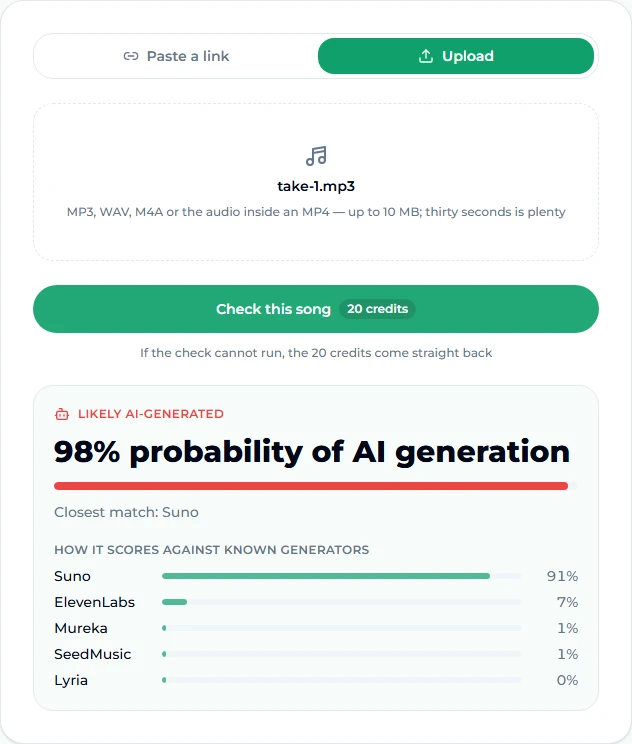
98% probability of AI generation, and it named the right generator: Suno at 91%, with ElevenLabs a distant second at 7%. We had told it nothing about where the file came from.
Song two was Rick Astley's Never Gonna Give You Up, recorded in 1987 — decades before any of these models existed. We pasted the official YouTube link:
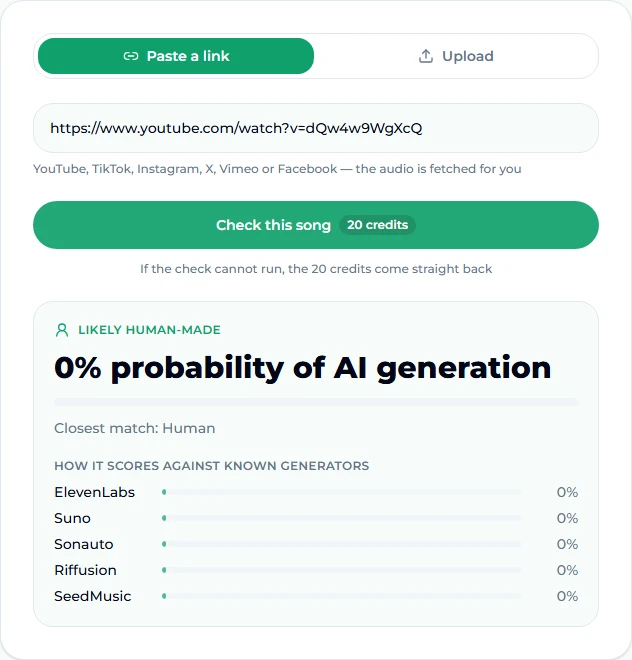
0%, closest match Human, every generator at zero. Two clear inputs, two clear answers — which is what you want to see before you trust a tool on the unclear ones.
How to read the result
The result card has four parts:
- The verdict — Likely AI-generated or Likely human-made. The word "likely" is deliberate.
- The probability — how confident the model is that the track was generated.
- The closest match — the generator it most resembles, or Human.
- Scores against known generators — the breakdown behind the closest match. A single dominant bar (like Suno at 91% above) is a stronger signal than several middling ones.
As a working rule: above about 90% the call is solid. Below about 10% you can treat it as human. In between, the result is a lean, not a finding.
When the number lands in the middle
A mid-range score does not mean the tool failed. It usually means the track is genuinely mixed, or has been processed:
- Heavy mastering or re-encoding can blur the artefacts the model listens for.
- Re-recording through speakers — someone playing an AI track and filming it — adds a room and a microphone on top.
- Hybrid tracks are real: a human producer who sampled an AI stem, or a singer who recorded over a generated instrumental, will score somewhere in the middle because both things are true.
What to do next: check a different 30-second section (the chorus and a verse can score differently), try the highest-quality source you can find rather than a re-upload, and weigh the result together with the context clues above. Treat any detector — this one included — as evidence, not proof.
If you are checking your own music before submitting it somewhere, the reverse also applies: a track you made with the AI music generator will read as AI, and that is fine as long as you disclose it where the platform asks. Our guide on uploading AI music to Spotify covers what the major distributors want to know.
FAQ
Can you really tell if a song is AI by listening?
Sometimes. Smeared cymbals, breathless vocals and generic lyrics are real tells, and a lazy generation usually has several. A carefully made track from a current model often has none you can hear, which is why a detector exists.
How accurate is an AI music detector?
No detector is certain. On clean inputs the calls are clear — our Suno track scored 98% and a 1987 recording scored 0%. In the middle of the range the result is a lean. Processing, re-recording and hybrid production all move the number.
What does it cost?
20 credits per check. Credits come with any plan or credit pack. A check that cannot run refunds automatically.
Which generators can it recognise?
It is trained on output from the major generators — Suno, Udio, Mureka, ElevenLabs and others — and the result lists the ones the track scored against, such as Lyria, SeedMusic, Sonauto and Riffusion.
Can I check a song on Spotify?
The detector takes links from YouTube, TikTok, Instagram, X, Vimeo and Facebook. For a Spotify-only track, find the same song on YouTube, or upload a file.
What happens to my file?
It is sent to the analysis service for that check and nothing else. The site keeps the verdict, not the audio. Pasted links are fetched by the service directly.
Does a high score mean the song breaks any rules?
No. It only says how the audio was likely made. Whether that matters depends on where the song is going — a contest, a distributor, a licence — and what they ask you to disclose.
Final take
Start with your ears and the context: smeared highs, a voice that never breathes, lyrics with no specifics and an artist with no history are all worth noticing. When the answer actually matters, get a number. Paste the link or upload 30 seconds to the AI music detector, read the verdict together with the generator scores, and treat anything between 10% and 90% as a reason to look closer rather than a conclusion.