

TL;DR
A standard ukulele is tuned G4 C4 E4 A4 — "GCEA", or "My Dog Has Fleas" if you learned it by singing. Open the free ukulele tuner, press Start, allow the microphone and pluck one string at a time. The tuner names the note, shows how many cents sharp or flat you are, and highlights the string you are nearest to; tighten when it says flat, loosen when it says sharp, and stop at In tune (within 5 cents). The G string is higher than the C next to it — that is normal, not a mistake. If your uke has a thick low G string, pick Low G; if it is a baritone, pick Baritone (DGBE). Banjo and mandolin players get their own tunings on the banjo tuner and mandolin tuner. Free, no sign-up, nothing uploaded.
In this guide
- The four strings of a ukulele
- Why the G string is higher than the C
- How to tune a ukulele step by step
- Low G, Baritone and D tuning
- Tuning without a screen
- Why ukuleles go out of tune so fast
- Banjo and mandolin
- FAQ
- Final take
The four strings of a ukulele
Hold the ukulele in playing position. The string nearest your face is the 4th string, the one nearest the floor is the 1st. In standard tuning they are:
| String | Note | Frequency |
|---|---|---|
| 4th (top, nearest your face) | G4 | 392.00 Hz |
| 3rd | C4 | 261.63 Hz |
| 2nd | E4 | 329.63 Hz |
| 1st (bottom) | A4 | 440.00 Hz |
This is the same for soprano, concert and tenor ukuleles — the three sizes most people own. Only the baritone is different (below). The tuner uses concert pitch, A4 = 440 Hz, which also happens to be the exact frequency of your 1st string.
Why the G string is higher than the C
On a guitar, strings go steadily from low to high. On a standard ukulele they do not: the G at the top is pitched above the C and the E next to it. This is called re-entrant tuning, and it is what gives the uke its bright, close-voiced strum — every chord sits within a small range, like a choir of four similar voices.
It trips beginners up in one specific way: they tune the G string to the G below middle C, find the string is floppy and buzzing, and assume the tuner is wrong. It is not. For standard tuning the G is G4, the G above middle C, at 392 Hz. If you want the lower, fuller G3 instead, that is a different string and a different tuning — see Low G below.
How to tune a ukulele step by step
- Open the ukulele tuner. Standard GCEA is selected by default.
- Press Start and allow the microphone when the browser asks. The line under the button says Listening….
- Pluck the G string with your thumb and let it ring. Read the display a moment after the pluck, not on the attack — nylon strings take a split second to settle.
- Turn the peg. Flat means the note is too low: tighten. Sharp means too high: loosen. On most ukuleles with friction or geared pegs, a small nudge is all you need.
- Do C, E and A the same way. The string row lights up the string the tuner thinks you are playing, and the line under it names it — Nearest string: C4, for example.
- Go round again. Four strings on a light neck pull on each other; a second pass catches the drift.
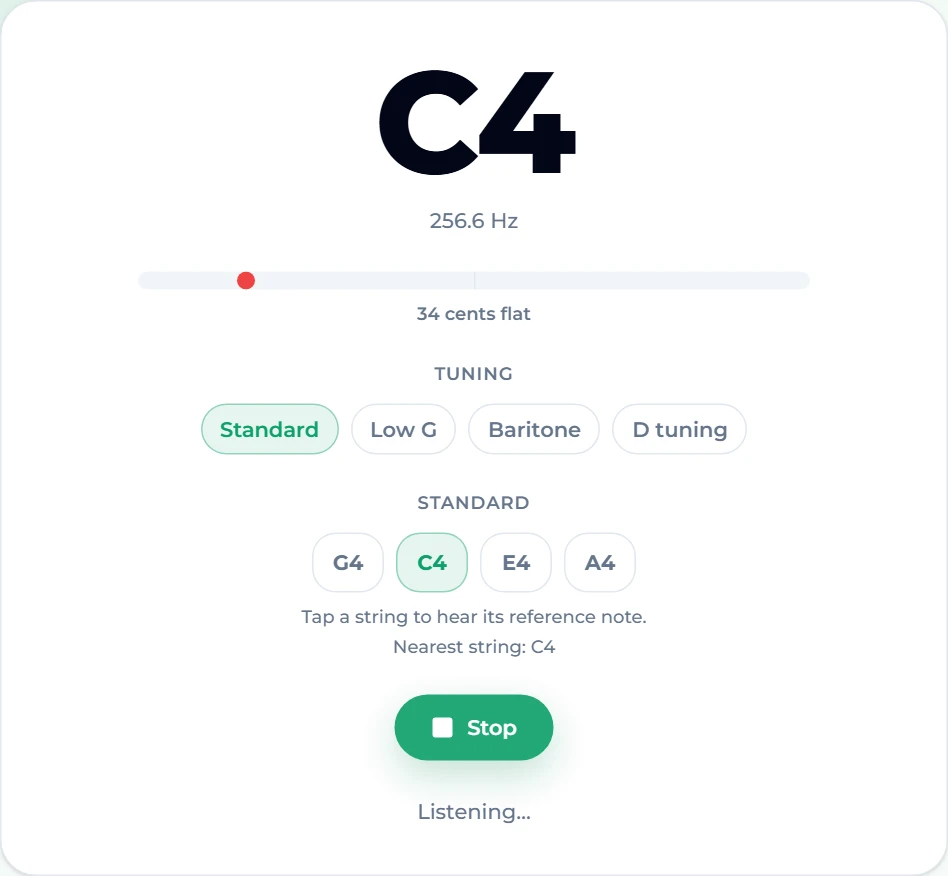
Here is a C string that has sagged a third of a semitone. The tuner hears 256.5 Hz, names it C4, and puts the needle left of centre with 34 cents flat underneath:
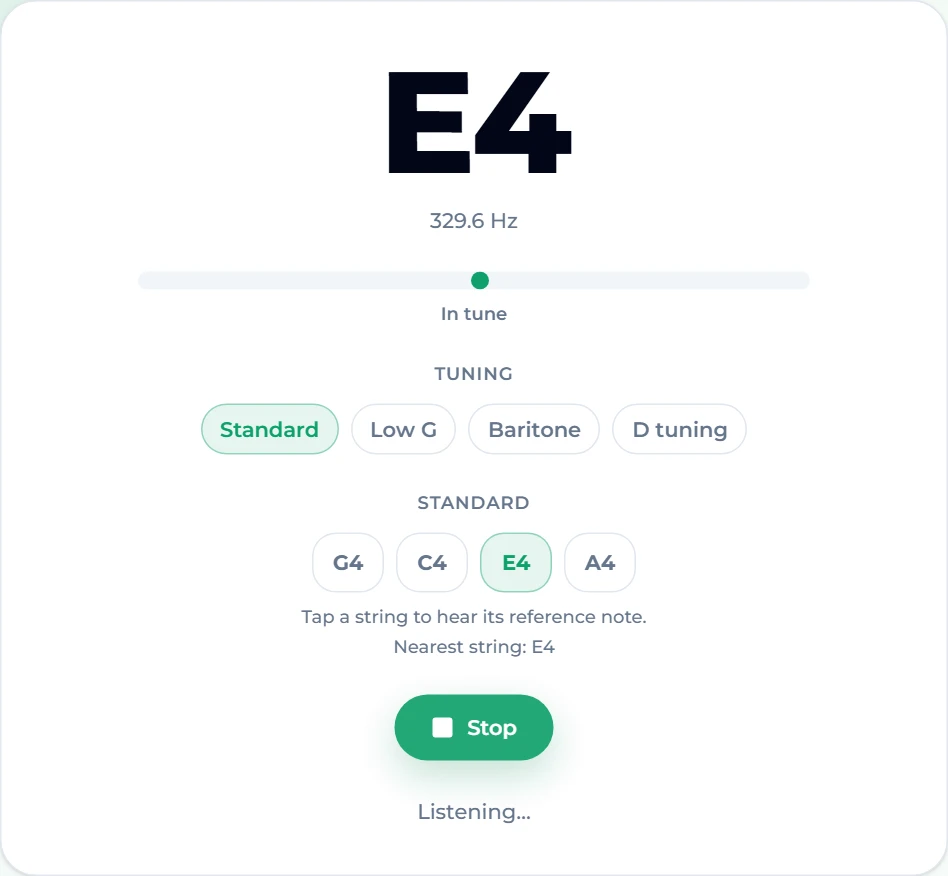
And here is the E string once it is right — the needle centred, the reading changed to In tune:
One cent is a hundredth of a semitone. The tuner counts anything within 5 cents as in tune, which is tighter than most ears can hear on a single note.
Low G, Baritone and D tuning
Above the strings is a row of tuning chips. Pick the one that matches your instrument before you start.
- Standard — G4 C4 E4 A4. Re-entrant; the default for soprano, concert and tenor.
- Low G — G3 C4 E4 A4. Same notes, but the G is an octave lower, at 196 Hz. You need a thicker (often wound) G string for this; a standard G string tuned down an octave will flap. Low G gives a fuller, more guitar-like bass and is popular with tenor ukulele players and fingerstyle arrangements.
- Baritone — D3 G3 B3 E4. The baritone ukulele is tuned like the top four strings of a guitar. Guitar chord shapes work directly on it.
- D tuning — A4 D4 F#4 B4. Everything up a whole step from standard. It is the older "ADF#B" tuning, still used for a brighter, sweeter sound on sopranos and in a lot of vintage songbooks.
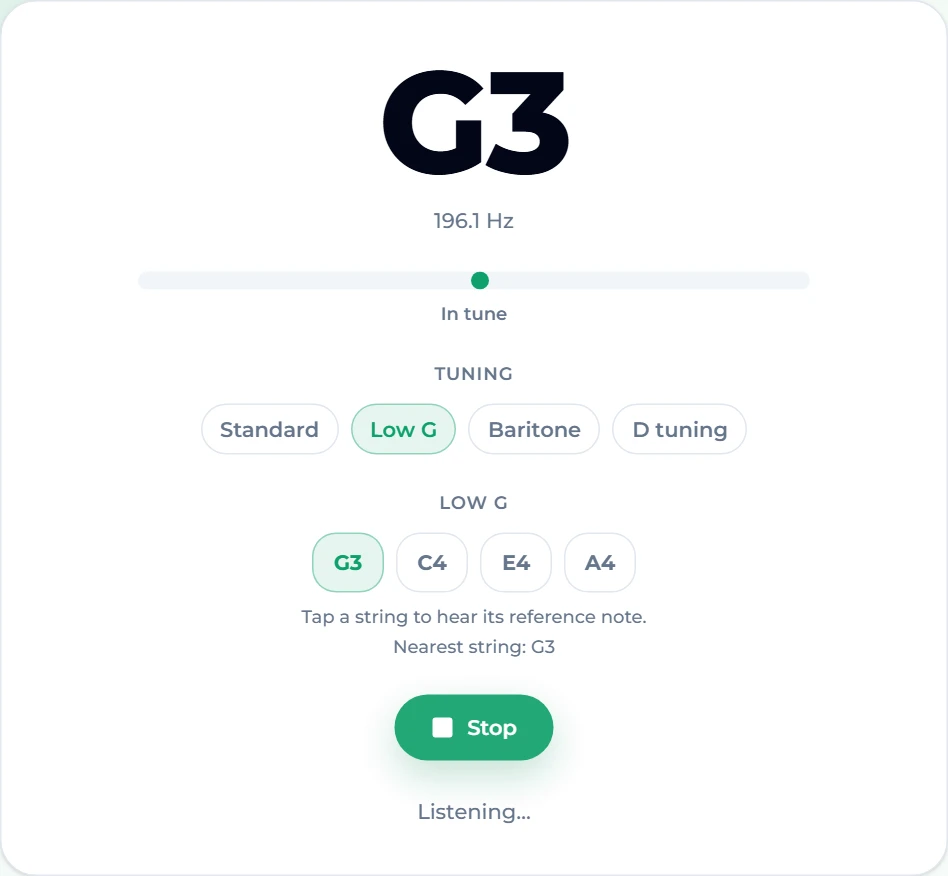
Select a chip and the string row switches to that tuning's notes, along with the reference tones. Here is Low G, with the thick G string reading exactly 196 Hz:
If you play an unusual tuning that is not listed — slack-key, open tunings, a guitalele tuned ADGCEA — use the chromatic tuner, which names any note without assuming which instrument you are holding.
Tuning without a screen
Every string chip is also a play button. Tap G4 and the tuner plays a G4 for about a second and a half. That lets you tune by ear:
- Tap the chip for the string you want.
- Pluck the string straight after and listen to both.
- If you hear a slow "wah-wah" wobble, the two are close but not equal. Turn the peg until the wobble slows and vanishes.
Press Stop before you do this, or use headphones — otherwise the microphone hears the reference tone and tunes to itself.
There is also the old relative method, useful when you have no device at all: once the A string is right, the E string fretted at the 5th fret should match the open A; the C string at the 4th fret should match the open E; and the G string at the 2nd fret should match the open A. It only makes the uke agree with itself, not with the rest of the world, which is why a tuner is better when you are playing with other people or along with a recording.
Why ukuleles go out of tune so fast
If your new ukulele will not stay in tune, the instrument is almost certainly fine. The strings are the reason.
- Nylon and fluorocarbon strings stretch for days. A freshly strung ukulele can drop a semitone overnight. Tune it, play for ten minutes, tune it again — and repeat over a few days. Gently pulling each string away from the fretboard along its length speeds this up.
- Temperature and humidity. A uke left near a window or taken outside will move. Let it adjust to the room before tuning.
- Friction pegs. Cheaper ukuleles use friction pegs that can slip. There is usually a small screw on the end of each peg; a slight tightening stops the slipping.
- Tune up to the note. If a string is sharp, go below the target and come back up. The peg holds better that way.
Banjo and mandolin
The same tuner engine covers two more small-bodied string instruments.
The banjo tuner lists the strings the way banjo players do, starting with the short 5th string. Its tunings are Open G (G4 D3 G3 B3 D4 — the bluegrass default), Double C (G4 C3 G3 C4 D4), Standard C (G4 C3 G3 B3 D4), Open D (F#4 D3 F#3 A3 D4) and the four-string Tenor banjo in CGDA (C3 G3 D4 A4).
The mandolin tuner uses G3 D4 A4 E5 — the same notes as a violin. Mandolins have paired strings; tune each string of a pair on its own, muting the other with a finger, and then check that the pair sounds as one note with no wobble.
FAQ
What notes are the ukulele strings?
G, C, E and A — specifically G4, C4, E4 and A4 for a soprano, concert or tenor ukulele in standard tuning. A baritone uses D3, G3, B3 and E4.
Is the ukulele tuner free?
Yes. The ukulele tuner is free, needs no account and has no limit. The microphone audio is analysed in your browser on your own device and is never uploaded.
Why does my G string sound higher than my C string?
Because it should. Standard ukulele tuning is re-entrant: the G string is tuned to G4, above the C4 next to it. If you prefer a low G, you need a thicker low-G string and the Low G setting.
Does it work for soprano, concert and tenor ukuleles?
Yes. All three sizes use the same GCEA tuning. Only the baritone ukulele is different, and it has its own chip on the tuner.
How often should I tune my ukulele?
Every time you pick it up. It takes under a minute, and new strings can drift noticeably within an hour of playing for the first few days.
Can I tune a guitalele or an 8-string ukulele with it?
Yes, with the chromatic tuner. A guitalele is usually tuned A2 D3 G3 C4 E4 A4; an 8-string ukulele has octave pairs on the G and C. The chromatic page names any note, so you tune each string to the letter it should be.
Final take
Open the ukulele tuner, pick Standard, Low G, Baritone or D tuning, press Start, and pluck each string until it reads In tune — remembering that the G sits above the C. New strings will need a few days of retuning before they settle. If the family has a banjo or a mandolin in the corner too, the banjo tuner and mandolin tuner work the same way, and the metronome guide is a good next step once your strums need to land in time. Want a song to strum along to? Make one in the style you are learning.