
TL;DR
A violin is tuned in fifths: G3 D4 A4 E5, lowest to highest, with the A at exactly 440 Hz. Open the free violin tuner, press Start, allow the microphone, and pluck or bow one string at a time. Tune the A first, then D, G and E. The display names the note, the needle shows how many cents sharp or flat you are, and within 5 cents it reads In tune. Use the fine tuners on the tailpiece for small corrections and the pegs only when a string is more than about a quarter-tone out. Violists use the viola tuner (C3 G3 D4 A4) and cellists the cello tuner (C2 G2 D3 A3). All three are free, need no account, and analyse the sound in your browser without uploading it.
In this guide
- The strings of a violin, viola and cello
- Pegs or fine tuners
- How to tune a violin step by step
- Reading the tuner
- Tuning a viola or cello
- Checking your fifths by ear
- Common tuning problems
- FAQ
- Final take
The strings of a violin, viola and cello
All three instruments are tuned in perfect fifths — each string seven semitones above the one below it. They share strings with each other, which is useful to know if you play in a quartet: the violin and viola share G, D and A; the viola is exactly an octave above the cello.
| Instrument | Strings, low to high | Frequencies |
|---|---|---|
| Violin | G3 · D4 · A4 · E5 | 196.00 · 293.66 · 440.00 · 659.25 Hz |
| Viola | C3 · G3 · D4 · A4 | 130.81 · 196.00 · 293.66 · 440.00 Hz |
| Cello | C2 · G2 · D3 · A3 | 65.41 · 98.00 · 146.83 · 220.00 Hz |
The tuner works at concert pitch, A4 = 440 Hz. Some orchestras tune a little higher, to 441 or 442 Hz; the tuner does not have a calibration setting, so in that situation tune your A to the oboe or the leader and then use the tuner (or your ear) for the fifths relative to it.
Pegs or fine tuners
A violin has two ways to change a string's pitch, and using the right one is half of tuning well.
The pegs, in the scroll at the top, are wooden and held by friction. One small turn moves the pitch a lot. Use them when a string is badly out — a new string, or one that has slipped by more than a quarter-tone. Push the peg gently into the pegbox as you turn so it holds, and move in tiny amounts.
The fine tuners, the small screws on the tailpiece, move the pitch by a few cents per turn. Use them for everyday tuning. Clockwise raises the pitch, anticlockwise lowers it. Many student violins have fine tuners on all four strings; many advanced players keep one only on the E, whose thin steel string is hard to tune accurately with a peg.
If a fine tuner is screwed all the way in and the string is still flat, back the screw out to the middle of its travel and make up the difference with the peg. A fine tuner screwed fully down can scratch the violin's top.
How to tune a violin step by step
- Open the violin tuner and press Start. Allow the microphone. The screen shows the four strings, G3 D4 A4 E5, under Standard tuning.
- Hold the violin about half a metre from the microphone. Laptop and phone microphones are fine; there is nothing to clip on.
- Start with the A string. Pluck it (or bow it gently) and look at the display. It is the reference string for the whole instrument and the one an orchestra tunes to.
- Correct it. Sharp means too high — turn the fine tuner anticlockwise. Flat means too low — turn it clockwise. Stop when the needle is centred and the line reads In tune.
- Tune the D, then the G, then the E the same way. Going from the middle outwards keeps the bridge from being pulled to one side.
- Check the A again. Changing the tension on the other strings nudges it. A second pass takes ten seconds.
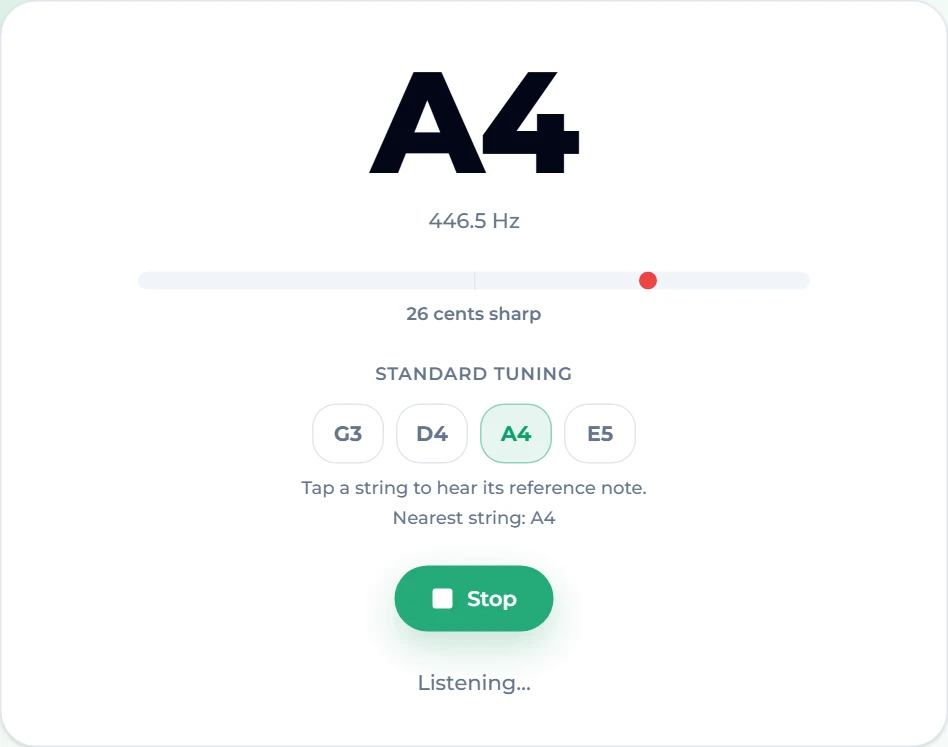
Here is an A string that has crept up. The tuner hears 446.5 Hz — the note is still A4, but the needle sits to the right and the line says 26 cents sharp. A quarter-turn anticlockwise on the fine tuner brings it back.
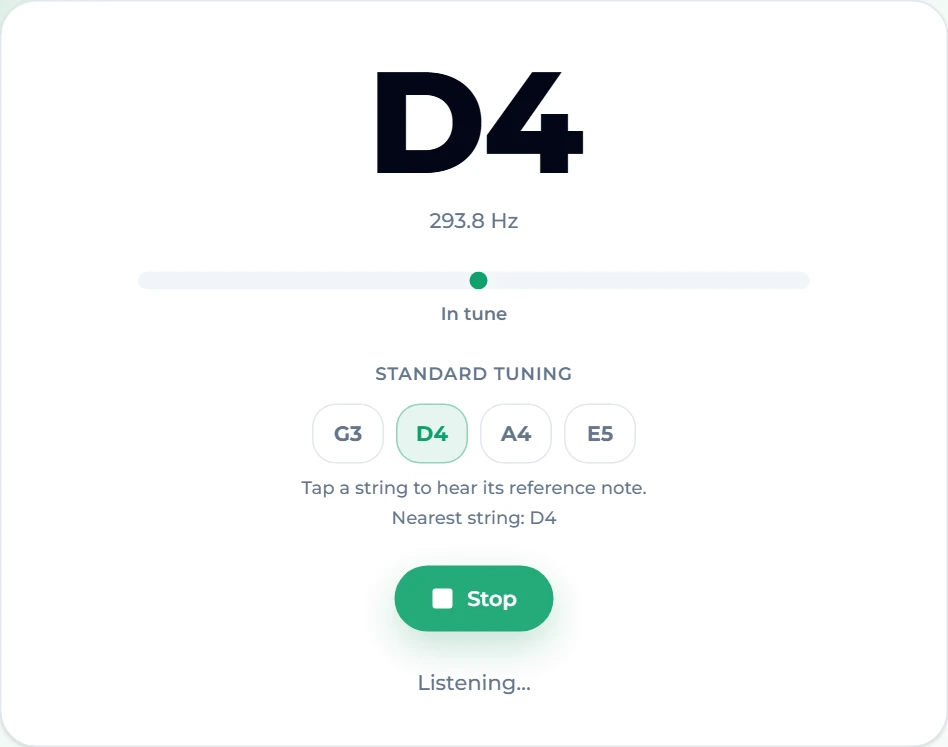
And the D string once it is right: needle centred, In tune:
Pluck or bow? Both work. Plucking is easier while you are turning a peg, because both hands are busy. Bowing gives a longer, steadier note that is easier to read — and it is how you will actually hear the instrument, so a string tuned while bowed sounds right when you play.
Reading the tuner
- The big note is what the tuner hears. It is chromatic, so if the E string has slipped a long way it may read D#5, not E5. Do not panic — look at the next line.
- The frequency is the raw measurement in hertz.
- The needle runs from 50 cents flat on the left to 50 cents sharp on the right. A cent is a hundredth of a semitone. It is red when you are off and switches to In tune when you are within 5 cents.
- Nearest string names the open string you are closest to and highlights its chip. When the big letter reads a neighbouring note, this line tells you which string you are actually on and therefore which way to turn.
The reading is smoothed so the needle settles rather than flickering, and it holds the last note during a silence — so you can pluck, look up to turn the peg, and still see where you were.
Tuning a viola or cello
The viola tuner and the cello tuner work in the same way with their own strings. Tune the A first on both, then D, G and C.
Two things are different on a cello. First, the low C at 65.41 Hz is a slow wave; bow it with a steady, full stroke rather than plucking, which gives the detector a clean, sustained note. Second, cellos often have fine tuners only on the A (or none at all), so most of the work happens on the pegs — turn in very small amounts and push the peg in as you go.
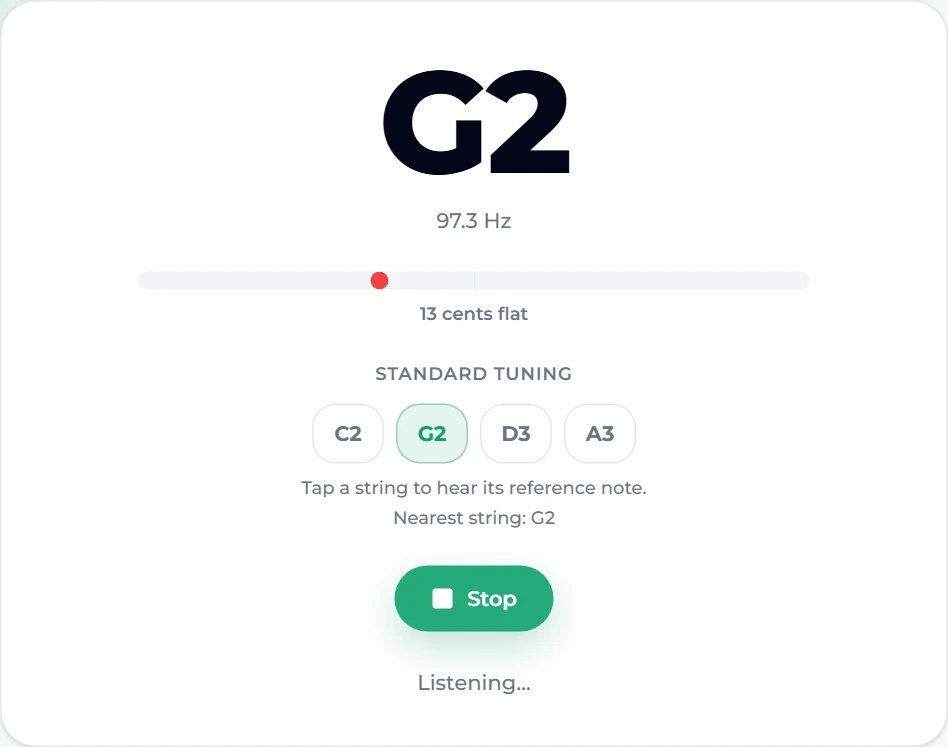
Here is a cello G string slightly under pitch — the tuner reads G2, 13 cents flat:
Checking your fifths by ear
String players are expected, eventually, to tune without a screen: set the A from a reference, then tune each other string as a perfect fifth against its neighbour by bowing two strings together. It is worth practising early, and the tuner helps you learn it.
- Get a reference A. Tap the A4 chip on the violin tuner. It plays a 440 Hz tone for about a second and a half. Stop the tuner first so the microphone does not hear its own note.
- Tune the A to it by ear. Listen for "beats" — a slow pulsing in volume when two notes are nearly the same. As you get closer the pulsing slows; when it stops, you are there.
- Bow the A and D together. A pure fifth rings, open and still. If it pulses or sounds sour, adjust the D until the sound calms.
- Do the same for D and G, then A and E.
- Now start the tuner and check. If the tuner agrees with your ear, you are learning. If it does not, your ear is telling you which direction you tend to lean — most beginners tune fifths slightly narrow.
Every chip on the tuner plays its note, so you can also use them to check one string at a time before you are confident with double stops.
Common tuning problems
- The peg will not stay put. It is slipping back because it is not pushed in firmly enough while you turn. If it still slips, the peg may need peg compound (peg dope) — a teacher or luthier can apply it.
- The peg sticks and then jumps. The opposite problem, often in dry winter air. Again, peg compound fixes it.
- The bridge is leaning forward. Tuning up drags the top of the bridge towards the fingerboard. Check after every few tunings, especially with new strings, and ask a teacher to show you how to ease it upright. A bridge left leaning can warp or fall.
- The E string keeps breaking. Usually tuned too high by mistake — an octave above, at E6. Watch the octave number on the tuner: it should read E5.
- The reading jumps between octaves on the cello C. Bow instead of plucking, and bow closer to the bridge for a stronger fundamental.
FAQ
What are the violin strings from low to high?
G, D, A and E — specifically G3, D4, A4 and E5, at 196, 293.66, 440 and 659.25 Hz.
Which string do I tune first?
The A. It is the reference string for the instrument and for the orchestra. Then D, G and E.
Is the violin tuner free?
Yes. The violin tuner, viola tuner and cello tuner are free, with no sign-up and no limit. The microphone audio is analysed on your device and never uploaded.
Can I tune to 442 Hz?
The tuner is fixed at A4 = 440 Hz. For a 442 ensemble, tune your A to the group's reference by ear, then tune the other strings as fifths against it.
Should I pluck or bow when tuning?
Either works with the tuner. Pluck while your hands are on the pegs; bow for the final check, because a bowed note is steadier and is how the violin will actually sound when you play.
Can I use a guitar tuner for a violin?
Any chromatic tuner will work — our plain tuner names every note. The violin page is quicker because it knows the four strings, highlights the nearest one, and plays a reference tone for each.
Final take
Tune the A first, use the fine tuners for small moves and the pegs only for big ones, and go D, G, E, then check the A again. The violin tuner shows exactly how far off each string is while you learn to hear it yourself; the viola tuner and cello tuner do the same for the rest of the section. Once you are in tune, practise with a steady pulse — the metronome guide shows how — and if you want an accompaniment to play over, you can generate one in any style.