
TL;DR
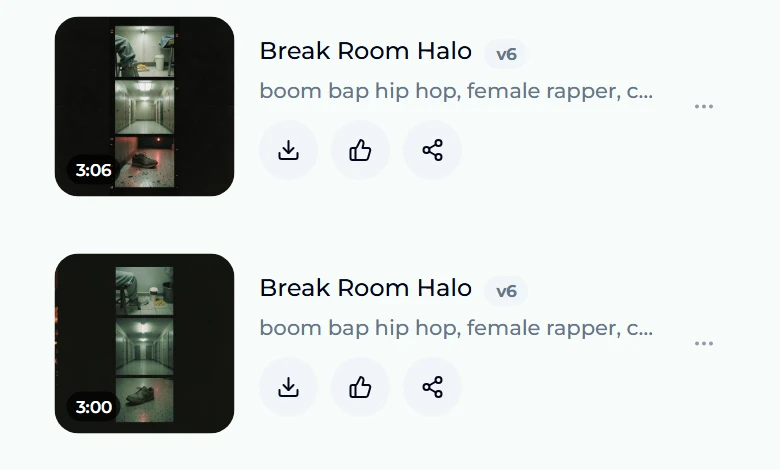
Good rap lyrics start with a specific story, a hook you can shout back, and verses where the rhymes land inside the lines as well as at the ends. Write the hook first, keep your bars to a steady syllable count, and replace every generic line with a detail only your character would say. If you are stuck, a rap lyrics generator gives you a draft to cut up: on Suno AI Music a one-line brief costs 1 credit and returns tagged verses, a pre-chorus, a hook and a bridge. We tried it with a brief about a nurse on a 3 a.m. break, took the draft into the studio with one click, and got two finished boom bap takes — 3:06 and 3:00 — about a minute later.
In this guide
- Start with a story, not a topic
- Write the hook first
- Bars, rhyme schemes and flow
- Using a rap lyrics generator
- From lyrics to a rap track
- Editing an AI draft into your own verse
- FAQ
- Final take
Start with a story, not a topic
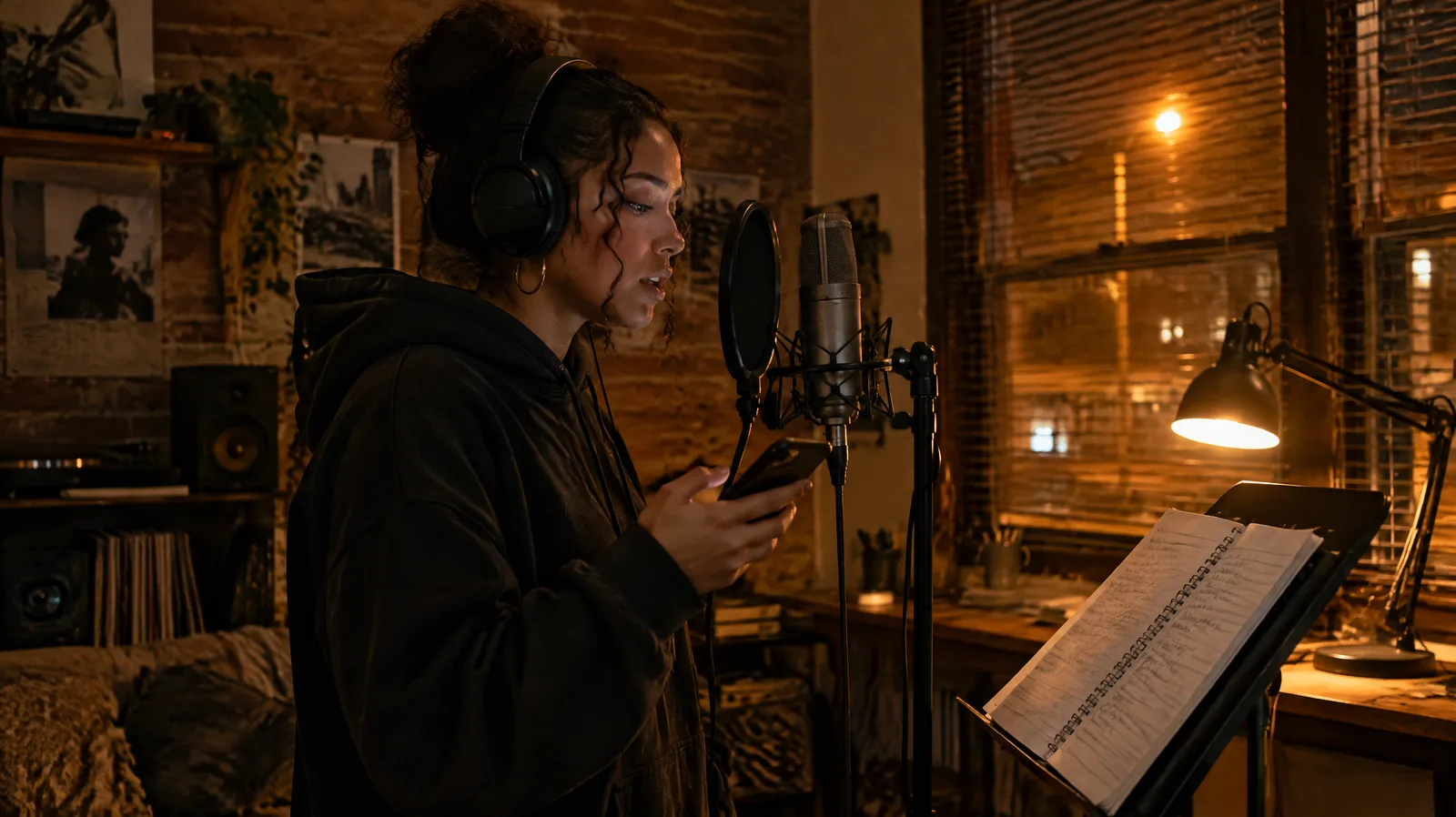
"Grinding", "haters", "the come-up" are topics. They are also the three most over-written subjects in rap, and a verse about them reads like every other verse about them. A story is a person, a place and a moment: a nurse on her 3 a.m. break, feet aching, drinking vending-machine coffee while the city sleeps. That one sentence hands you imagery (tile floors, paper cups, a badge), a point of view (tired but proud), and a stake (people depend on her).
Before you write a single bar, answer three questions in a line each:
- Who is talking? You, a character, someone you know.
- Where are they, right now? A place specific enough to have objects in it.
- What do they want the listener to feel? Proud, angry, amused, homesick.
Those three lines are also exactly what a lyrics generator needs, which is not a coincidence.
Write the hook first
The hook is the part people remember and the part the verses point at. Writing it first tells you what the verses are for.
- Short and repeatable. Two to four lines, often with one line repeated. "I keep the city alive / I keep it breathing" works because you could chant it after hearing it once.
- The title lives here. If your hook has a phrase that could be the song's name, you have found the centre of the song.
- Rhythmically simpler than the verses. Verses can be dense; the hook should be singable by a room.
Bars, rhyme schemes and flow
Count your bars
A bar is one measure of the beat — in most hip-hop, one line of lyrics. Verses are usually 16 bars, hooks 8, but the number matters less than consistency: lines of roughly equal syllable count sit on the beat; a 20-syllable line after an 8-syllable one forces you to rush. Say every line out loud over a beat, or over a metronome at the tempo you want — boom bap tends to live around 85–95 BPM, trap around 130–150. The tap tempo tool will give you the BPM of a beat you already love.
Rhyme inside the line
End rhymes (cup / up) are the minimum. What makes a verse sound written is internal and multisyllabic rhyme: sounds that echo within and across lines. "Vending machine drip in a paper cup / Tastes like rust, still I drink it up" has an end rhyme and a near rhyme (rust / up) pulling the ear along.
Pick a scheme and break it on purpose
Couplets (AABB) are the default. Once a verse is working, breaking the pattern for one line — the punchline — makes that line land harder, because the listener was expecting the rhyme.
Leave room to breathe
A verse with no gaps is exhausting. Short lines ("Count one more room / One more pulse") are where the beat gets to speak, and where your listener catches up.
Using a rap lyrics generator
When the page is blank, a draft is faster than inspiration. The rap lyrics generator is the same writer as the AI lyrics generator with Hip-Hop preselected; the AI lyrics studio is another door to it.
- Write the brief in Describe Your Song: who, where, what feeling — one or two sentences. Keep it to about 150 characters: the writer works from a short theme, and anything past roughly 180 characters is trimmed off before it is read — so put the part that matters first.
- Leave Hip-Hop selected, or switch genre if you want the words sung instead. More opens Blues, Funk, Soul, Reggae, Gospel and others.
- Press Generate Lyrics (1 credit). You need to be signed in; new accounts start with free credits.
Here is the brief we used:
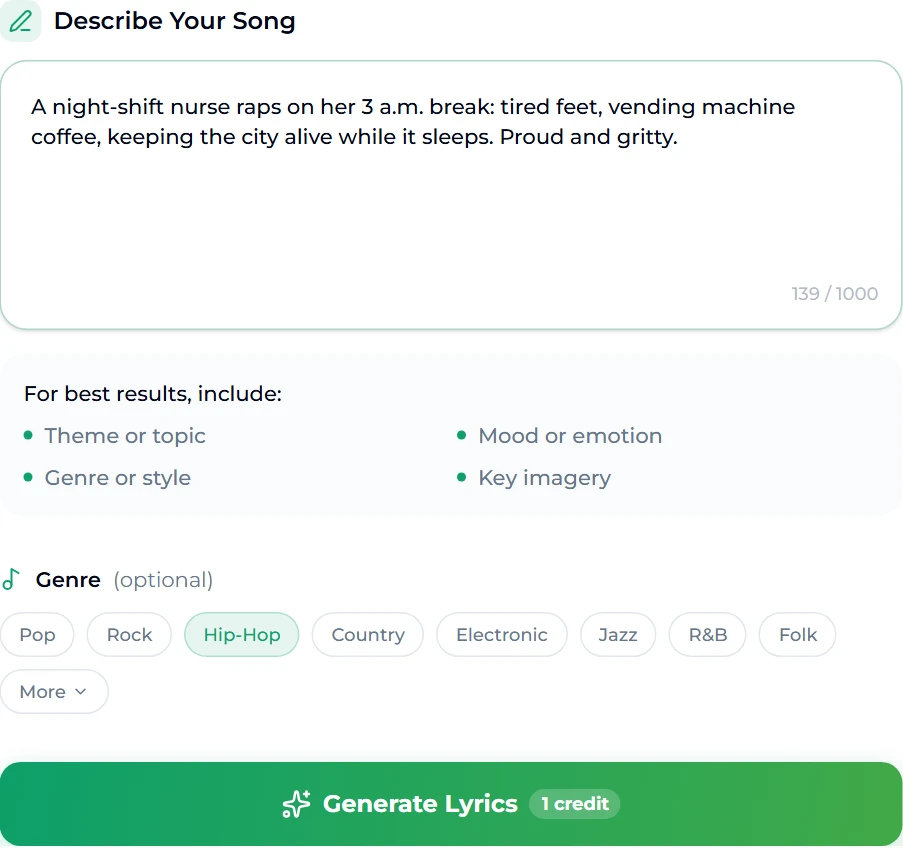
Within a minute the draft appeared under Your Lyrics, already tagged — [Verse 1], [Pre-Chorus], [Chorus], [Verse 2], [Bridge] — with Copy and Regenerate buttons above it:
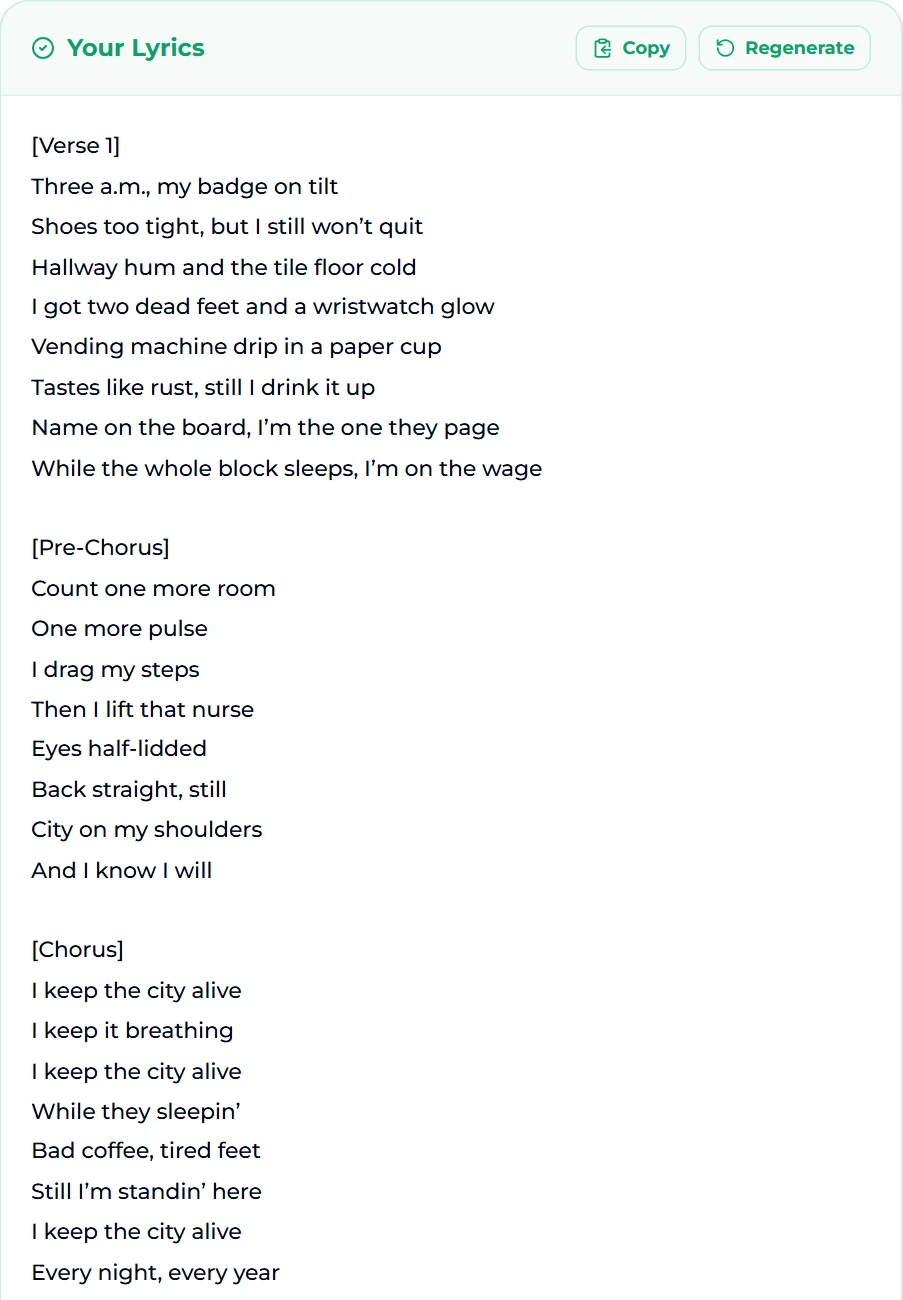
The same brief a second time gave a different draft, with the hook "Break room halo, break room halo / I keep this city whole, I keep it stable". That is what Regenerate is for: two or three drafts, then keep the best hook from one and the best verse from another.
From lyrics to a rap track
Under every draft is a Create Song with These Lyrics button:
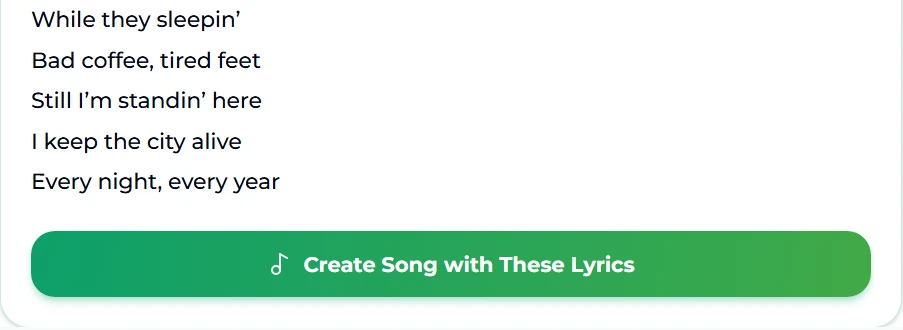
It opens the studio on the Own Lyrics tab with the words already in Your lyrics — nothing to copy. Add a Styles line and a title. We used the Break Room Halo draft with boom bap hip hop, female rapper, confident gritty flow, dusty drums, deep bass, 92 bpm:
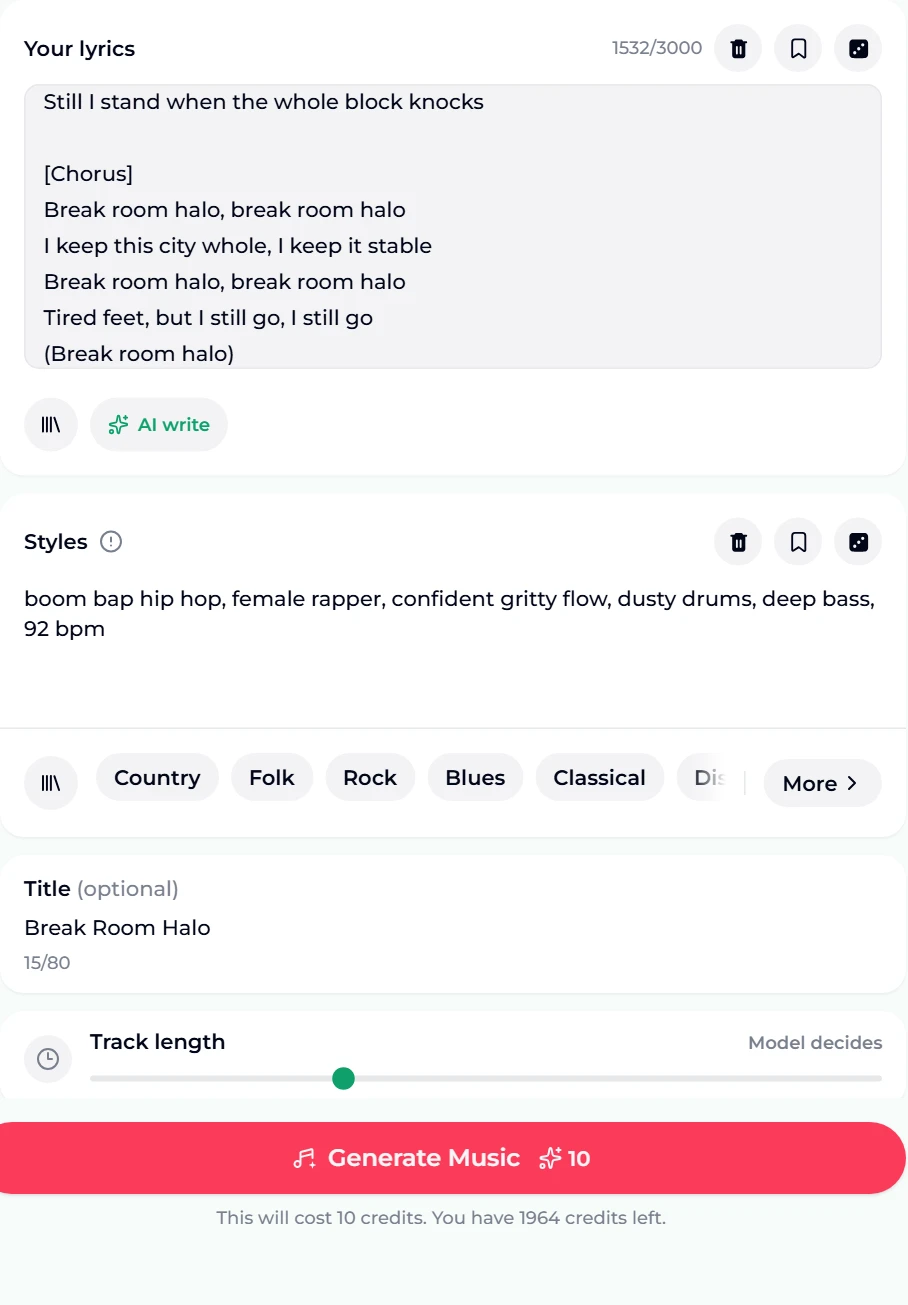
Generate Music costs 10 credits and makes two takes. They appeared at the top of the song list straight away, spinning while they rendered:
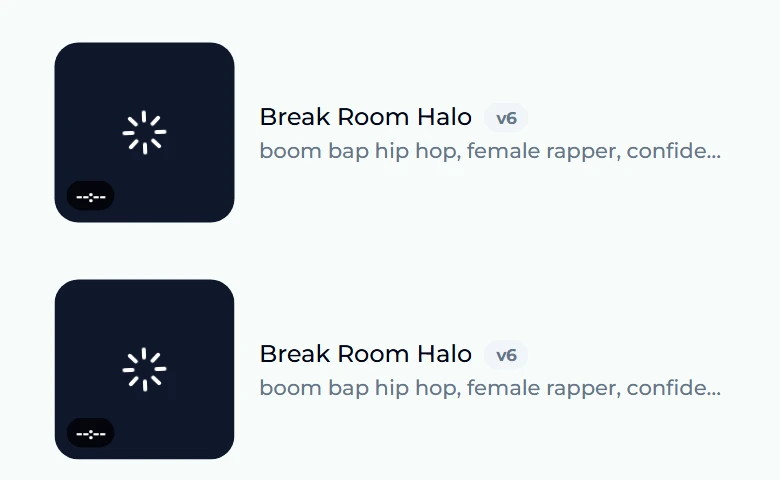
and were finished about a minute later, at 3:06 and 3:00, each with its own cover:
A few style habits that matter more for rap than for sung genres:
- Name the voice. "Female rapper", "male rapper, deep voice", "melodic rap". Without it you may get a singer.
- Give a tempo. 92 bpm for boom bap, 140 for trap. It sets the density the model will try to fit your bars into.
- Name the drums. "Dusty drums", "hard 808s, crisp hi-hats". The beat carries a rap track.
If you would rather write over a beat you made first, the rap beat maker and the AI trap generator make instrumentals; if you would rather skip the writing entirely, the AI rap generator takes a one-sentence description and writes and performs the whole thing.
Editing an AI draft into your own verse
A generated draft is a sketch. The drafts we got were solid on structure and hook, and — like most AI lyrics — a little generic in places ("I keep on moving, I don't bust"). Three passes turn a draft into a verse that sounds like a person:
- Swap in real details. Every line that could be in any song, replace with one that could only be in yours: a name, a street, a brand of shoe, a time on a clock.
- Tighten the rhymes. Where two lines rhyme on one syllable, look for a two- or three-syllable rhyme instead.
- Say it out loud, at tempo. Anything you trip on, cut. Anything you rush, split into two bars.
Then paste the edited version back into Own Lyrics and run it again. For tag options beyond verse and chorus — [Intro], [Hook], [Outro], ad-lib brackets — see our Suno tags list, and for sung songs from your own words, how to turn lyrics into a song covers the lyrics-first page.
FAQ
How do you write rap lyrics for beginners?
Pick one specific story, write a two-to-four-line hook first, then write verses of roughly equal line length that point at the hook. Say every line out loud over a beat, and replace generic lines with concrete details.
How many bars is a rap verse?
Usually 16 bars, with an 8-bar hook, but it varies. Consistent line length matters more than the exact count.
Is the rap lyrics generator free?
Each draft costs 1 credit, and new accounts get free credits on sign-up — enough for several drafts. Turning lyrics into a track costs 10 credits a run for two takes; more credits come with any plan or credit pack.
Why did my lyrics request fail?
Usually a hiccup on the writing service — try again in a moment. A failed draft does not keep your credit. Very long briefs are not the problem they once were (only the first 180 or so characters are used), but a short, specific brief still gets better lines.
Can I make the AI rap my own lyrics?
Yes. Paste them into Own Lyrics in the studio, add a style line that names a rapper and a tempo, and generate.
Can I use AI-written lyrics in my own songs?
The drafts are original output meant as a starting point, and you are expected to edit them. Check them for lines that sound too close to songs you know, and check the licence on the pricing page before releasing tracks commercially.
Final take
Rap lyrics come down to a specific story, a hook worth repeating, and bars that sit on the beat with rhymes landing inside the lines. Write those yourself when you can; when the page stays blank, brief the rap lyrics generator with who, where and what feeling, keep the best lines from two drafts, and rewrite the generic ones. Then press Create Song with These Lyrics and hear it rapped — the fastest way to find out which of your bars actually land.