

TL;DR
Learning how to make jazz music used to mean years on an instrument and a band that could follow you. Today you can describe the band and the room on Suno AI Music's AI jazz generator and get two finished tracks in about a minute. The form opens with a working smooth jazz prompt already filled in and Instrumental Only switched on; six "Start from a vibe" tiles (big band swing, bebop, smooth jazz, a crooner ballad, Latin jazz and fusion) each play a real example made on v6 and copy its exact prompt into the box. One run costs 10 credits and returns two songs, and new accounts get 16 free credits.
In this guide
- What makes jazz music sound like jazz
- Step by step with the AI jazz generator
- Writing a jazz prompt that swings
- Six jazz prompts that already work
- Common jazz mistakes
- Choosing a model
- After the track is made
- FAQ
- Final take
What makes jazz music sound like jazz
Jazz music is a family of styles, but most of them share a handful of ingredients. Each one below is also a word or phrase you can type into the prompt:
- Swing feel. Eighth notes played long-short instead of even, so the music lilts. Write swing, swinging or swung. Smooth jazz and Latin jazz are the big exceptions: they use straight, even grooves.
- A walking bass. An upright bass playing one note per beat, stepping through the chords. Walking upright bass is one of the most reliable jazz phrases a model understands.
- Ride cymbal and brushes. Jazz drummers keep time on the ride cymbal, and ballads use brushes on the snare. Ride cymbal swing and soft brushed drums both change the sound audibly.
- Rich chords and comping. Sevenths, ninths and altered chords, played in short off-beat stabs by the piano or guitar ("comping"). Piano comping and rhodes chords point there.
- A lead voice and solos. A tune (the "head"), then improvised solos, then the head again. Name the lead: alto saxophone, muted trumpet, soprano saxophone, vibraphone.
- Tempo. Ballads sit around 60–80 BPM, smooth jazz around 85–100, medium swing around 120–160, big band dance numbers around 160–200 and bebop can go past 220. Put the number in the prompt.
- A place and an era. Smoky 1950s New York club, 1940s ballroom, Havana night each bring a recording sound as well as a mood.
If you want the harmony side in more depth, our guide to reading piano chords covers seventh chords from the ground up.
Step by step with the AI jazz generator
- Open the AI jazz generator. It is the site's main music form, preset for jazz. The Prompt tab is selected, and the box already holds a complete smooth jazz prompt: smooth jazz instrumental, 92 BPM, silky soprano saxophone melody, warm electric piano, clean funky guitar, soft groove drums, relaxing evening by the harbor, polished and mellow. Instrumental Only is switched on, so the result has no vocals.
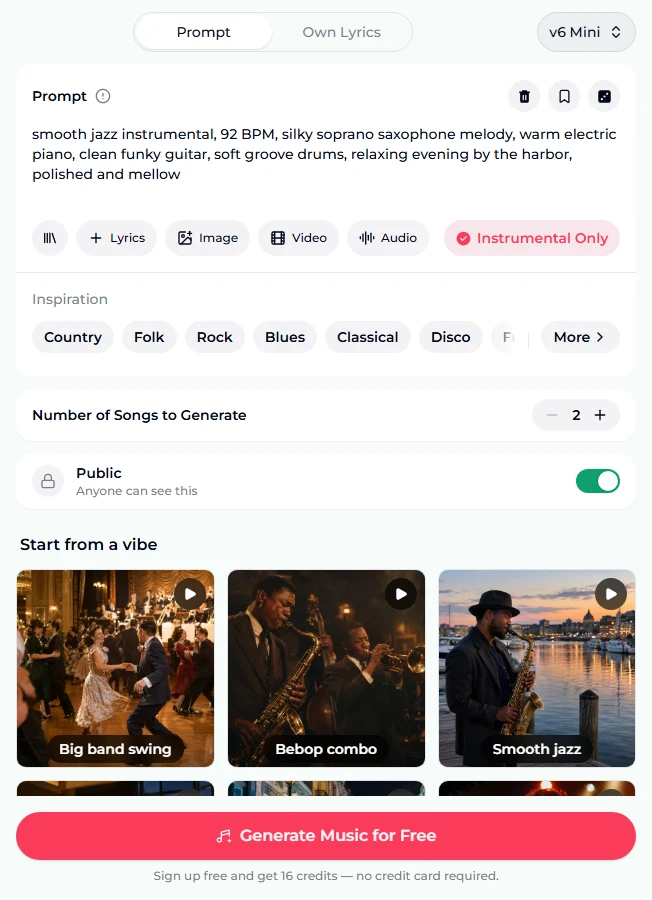
- Look at the rest of the form. Under the prompt are chips for your prompt library, + Lyrics, Image, Video and Audio references, and the Instrumental Only toggle. Below that sit the Inspiration genre chips, the Number of Songs to Generate stepper (it starts at 2, because each run makes two), and the Public switch.
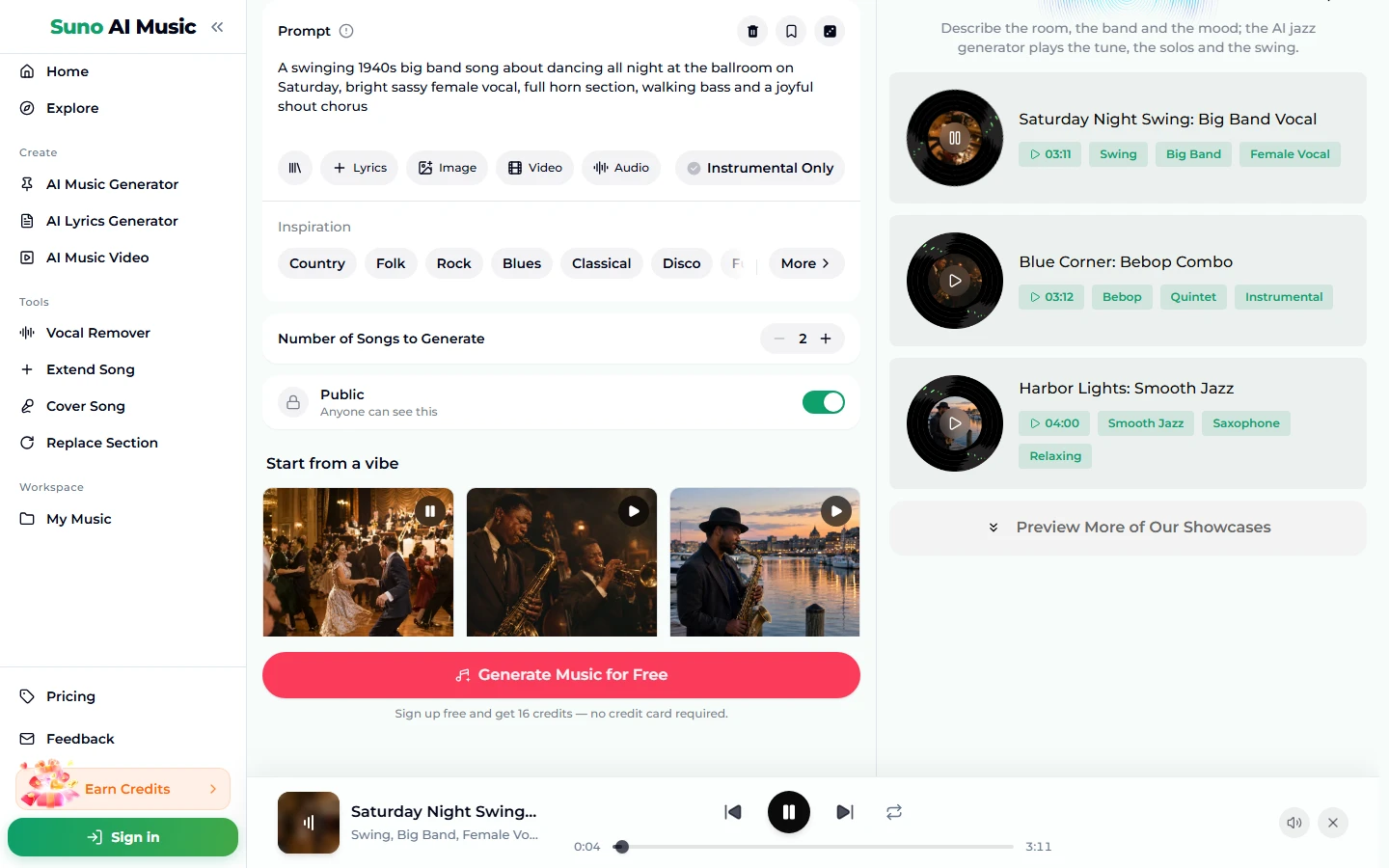
- Tap a vibe to hear what a prompt sounds like. One tap on a "Start from a vibe" tile plays its example song and copies its prompt into the box. Tap Big band swing and the prompt becomes A swinging 1940s big band song about dancing all night at the ballroom on Saturday..., Instrumental Only switches off (this one is sung), and the player bar at the bottom starts Saturday Night Swing: Big Band Vocal.
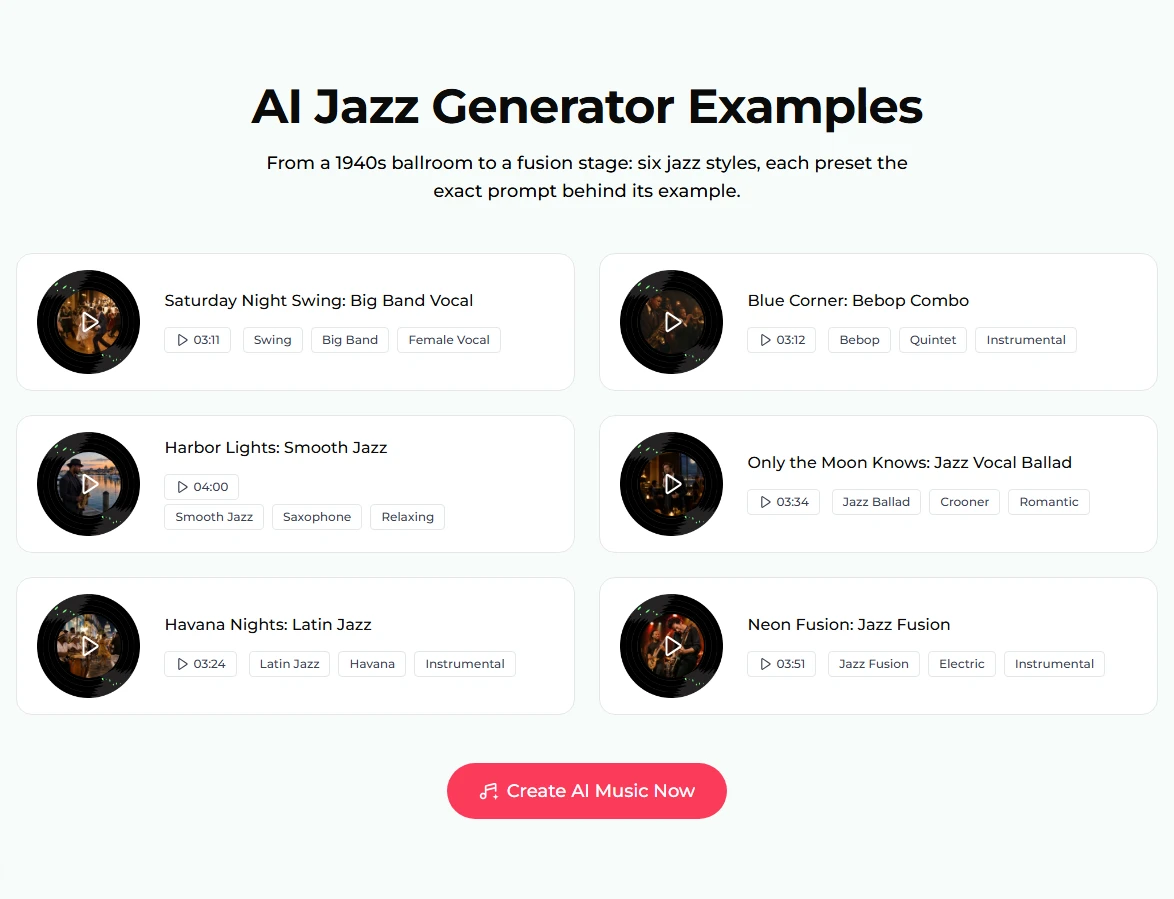
- Browse all six examples. Further down the page, the examples list shows each one with its disc, title, length and tags: Saturday Night Swing (3:11), Blue Corner: Bebop Combo (3:12), Harbor Lights: Smooth Jazz (4:00), Only the Moon Knows: Jazz Vocal Ballad (3:34), Havana Nights: Latin Jazz (3:24) and Neon Fusion: Jazz Fusion (3:51).
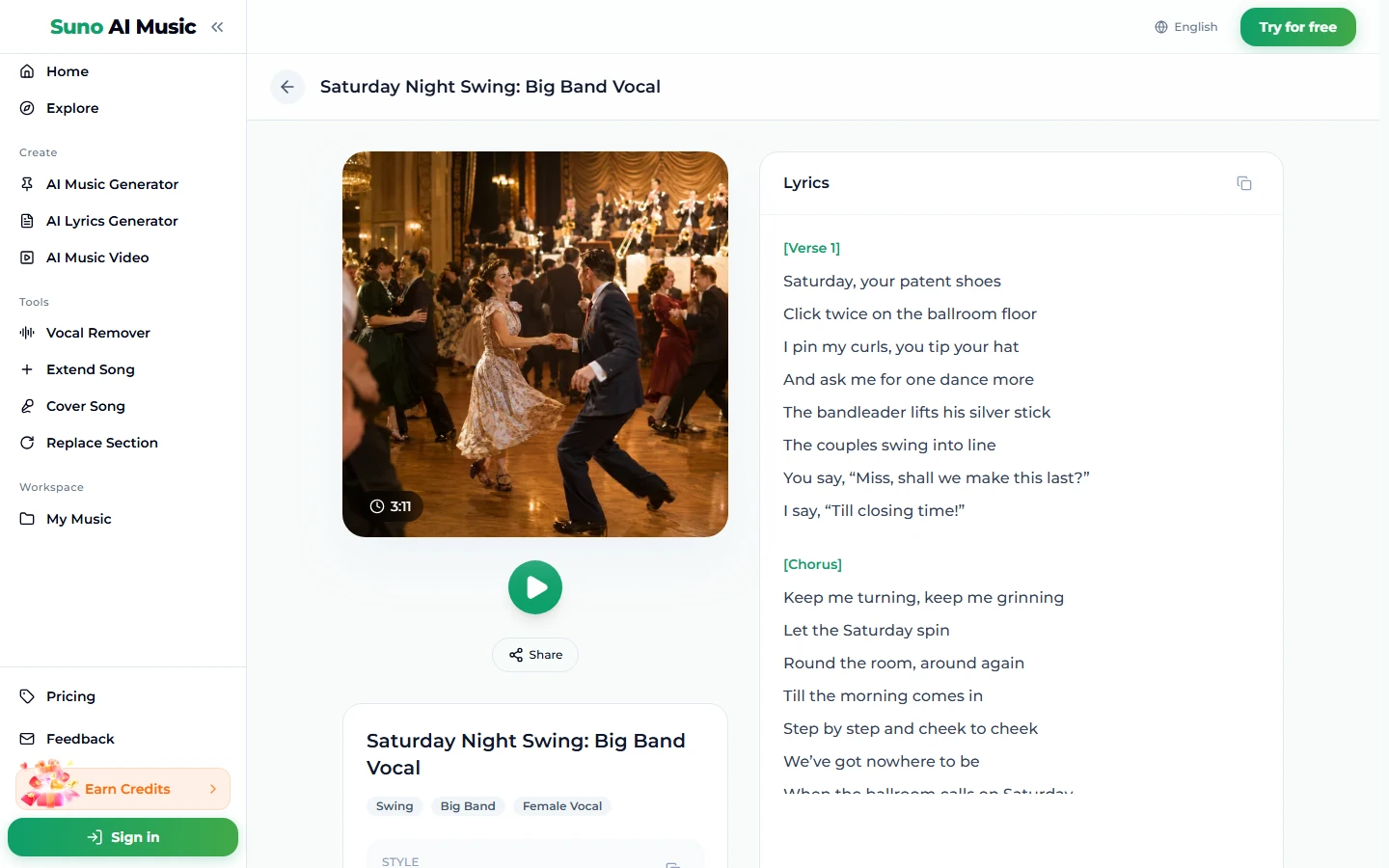
- Open an example's song page if you want the lyrics. Each example has its own page. The big band example shows the ballroom cover, a play button, Share, its tags (Swing, Big Band, Female Vocal) and the full lyrics, which open with "Saturday, your patent shoes / Click twice on the ballroom floor".
- Press Generate Music for Free. Logged out, the note under the button reads "Sign up free and get 16 credits — no credit card required". A run takes about a minute and returns two songs in that style. They will be new songs, not copies of the example: the tile shows you the style, not the result.
Writing a jazz prompt that swings
The six presets all follow the same pattern, and it is worth copying: style and tempo first, then the lead instrument, then the rhythm section, then the scene and mood. A few habits make the difference:
- Say the sub-style. "Jazz" alone gives you something generic. Bebop, smooth jazz, big band swing, latin jazz, jazz fusion and cool jazz each change the band, the tempo and the recording.
- Name one lead. Silky soprano saxophone melody or muted trumpet works better than listing every horn. For a bebop head, alto saxophone and trumpet unison head is the classic sound.
- Describe the rhythm section in two or three words each. Walking upright bass, ride cymbal swing, bright piano comping tells the model how the band plays, not only who is in it.
- Give a number for the tempo. 92 BPM is far more useful than mellow tempo. Suno usually honours it roughly, not to the exact beat.
- Add a room. Smoky 1950s New York club or relaxing evening by the harbor shapes the reverb and the energy.
- For vocals, write a sentence. The two sung presets read like a pitch: A slow romantic jazz ballad about a love kept secret, velvet male crooner vocal... The story gives the AI something to write lyrics about. If you have your own words, use the Own Lyrics tab (lyrics up to 5,000 characters, a style box up to 1,000).
The Prompt box takes up to 500 characters, and every preset here is well under that. For more wording that reliably moves the sound, see our Suno prompts guide.
Six jazz prompts that already work
These are the six vibes on the AI jazz generator, copied exactly. Each one produced the example on its tile on v6.
| Vibe | What it is | Prompt |
|---|---|---|
| Big band swing | Sung 1940s dance number, 3:11 | A swinging 1940s big band song about dancing all night at the ballroom on Saturday, bright sassy female vocal, full horn section, walking bass and a joyful shout chorus |
| Bebop combo | Fast instrumental quintet, 3:12 | bebop jazz quintet instrumental, 220 BPM, fast alto saxophone and trumpet unison head, walking upright bass, ride cymbal swing, bright piano comping, exciting solos, smoky 1950s New York club |
| Smooth jazz | Relaxed instrumental, 4:00 (the preset) | smooth jazz instrumental, 92 BPM, silky soprano saxophone melody, warm electric piano, clean funky guitar, soft groove drums, relaxing evening by the harbor, polished and mellow |
| Crooner ballad | Slow sung love song, 3:34 | A slow romantic jazz ballad about a love kept secret, velvet male crooner vocal, soft brushed drums, upright bass, tender piano and a muted trumpet answering each line |
| Latin jazz | Afro-Cuban instrumental, 3:24 | latin jazz instrumental, 120 BPM, congas and timbales, montuno piano pattern, punchy trumpet and trombone lines, tumbao bass, hot and danceable, lively Havana night |
| Jazz fusion | Electric instrumental, 3:51 | jazz fusion instrumental, 110 BPM, virtuosic electric guitar and synth lead, slap bass, complex funky drum grooves, rhodes chords, odd time sections, energetic and modern |
Two extra recipes of our own, untested, if you want styles the page does not cover:
- cool jazz instrumental, 100 BPM, relaxed muted trumpet melody, soft vibraphone, brushed drums, walking upright bass, late night 1950s West Coast club, understated
- bossa nova instrumental, 130 BPM, nylon string guitar, soft brushed drums, gentle flute melody, warm upright bass, sunny afternoon in Rio, calm
Common jazz mistakes
- Only saying "jazz". The word covers a century of styles. Without a sub-style you tend to get a polite, middle-of-the-road track.
- Asking for swing and a straight groove at once. Swing plus four on the floor or trap hi-hats confuses the feel. Pick one.
- Too many soloists. Sax, trumpet, trombone, guitar, vibes and flute all as leads will crowd each other. One or two leads, plus the rhythm section.
- No tempo on fast styles. Bebop without a number often comes back at a comfortable medium swing. Write 220 BPM if you want the rush.
- Forgetting Instrumental Only. The page opens with it on. Tapping a sung vibe turns it off, so check the toggle before you generate background music.
- Expecting the example song back. The tile gives you the prompt, not the recording. Two new songs come out every run; if both miss in the same way, change one word in the prompt.
- Confusing smooth jazz with lo-fi. Lo-fi has dusty hip hop drums and tape hiss; smooth jazz is clean and polished. If you want the first, the lofi generator is preset for it.
Choosing a model
The model picker sits at the top right of the form. There are three choices:
- v6 Mini ("Fast drafts, high volume") is the free tier and the default when you start. It is fine for finding a style you like.
- v6 ("Most powerful, for any song") needs a paid plan. All six examples on the page were made on v6, so it is the model to use if you want that level of detail in the horns and the swing.
- v6 Wild ("Best for experimental ideas") also needs a paid plan. It suits fusion and odd-meter experiments better than a straight ballad.
Every model costs the same: 10 credits per run, two songs back. Plans and credit packs cover runs after the 16 free credits.
After the track is made
- Make a longer set. Jazz for a dinner or a café needs length. Extend Song continues a track from any point; our guide to extending a song explains where to cut.
- Fix one section. If the solo is great but the ending falls flat, Replace Section regenerates just that part.
- Hear it in another style. Cover Song re-performs a track, for example turning a swing number into a ballad.
- Practise over the band. The vocal remover splits a sung track into two stems, vocals and instrumental, so you can sing or play over the band.
- Put it under pictures. The AI music video tool turns a track into a video.
- Download. Downloads come with a plan; see pricing.
If jazz leads you to neighbouring styles, the AI blues generator, AI funk generator and AI R&B generator use the same form with their own presets, and the piano music maker is set up for solo piano.
FAQ
Can I make jazz music without playing an instrument?
Yes. On the AI jazz generator you describe the band and the mood, and the model composes and performs the whole piece, with the melody, solos and rhythm section.
Can the AI make vocal jazz?
Yes. Switch Instrumental Only off and describe the singer, as the Big band swing and Crooner ballad presets do. The AI writes the lyrics from your description, or you can paste your own on the Own Lyrics tab.
How long is a generated jazz track?
The six examples run from 3:11 to 4:00. For a longer piece, extend a track you like.
How much does it cost?
One run costs 10 credits and returns two songs. New accounts get 16 free credits with no card, enough for a first run on v6 Mini.
Can I use AI jazz commercially, on YouTube or in my café?
Commercial use is included on the Standard plan and above, 2,500+ credit packs, and Team plans. Songs made with free credits, the Starter plan or the Mini credit pack are for personal use only. Details are on the pricing page.
Can I keep my songs private?
Yes, on a paid plan. Turn the Public switch off before you generate; on the free tier songs are public.
Can I give it a reference track?
Yes. The Audio chip takes one track between 6 seconds and 30 minutes, and the song borrows its feel. You can also add up to 5 photos with Image or one video clip with Video. The credit cost is the same with or without a reference.
Final take
The fastest way to learn how to make jazz music with AI is to listen first and write second. Tap each of the six vibes on the AI jazz generator, notice which words produced the swing, the brushes or the montuno piano, then change one of them: the tempo, the lead horn or the room. Two songs per run makes it easy to compare, and a good prompt, once found, keeps producing jazz music that sounds like the same band.