
TL;DR
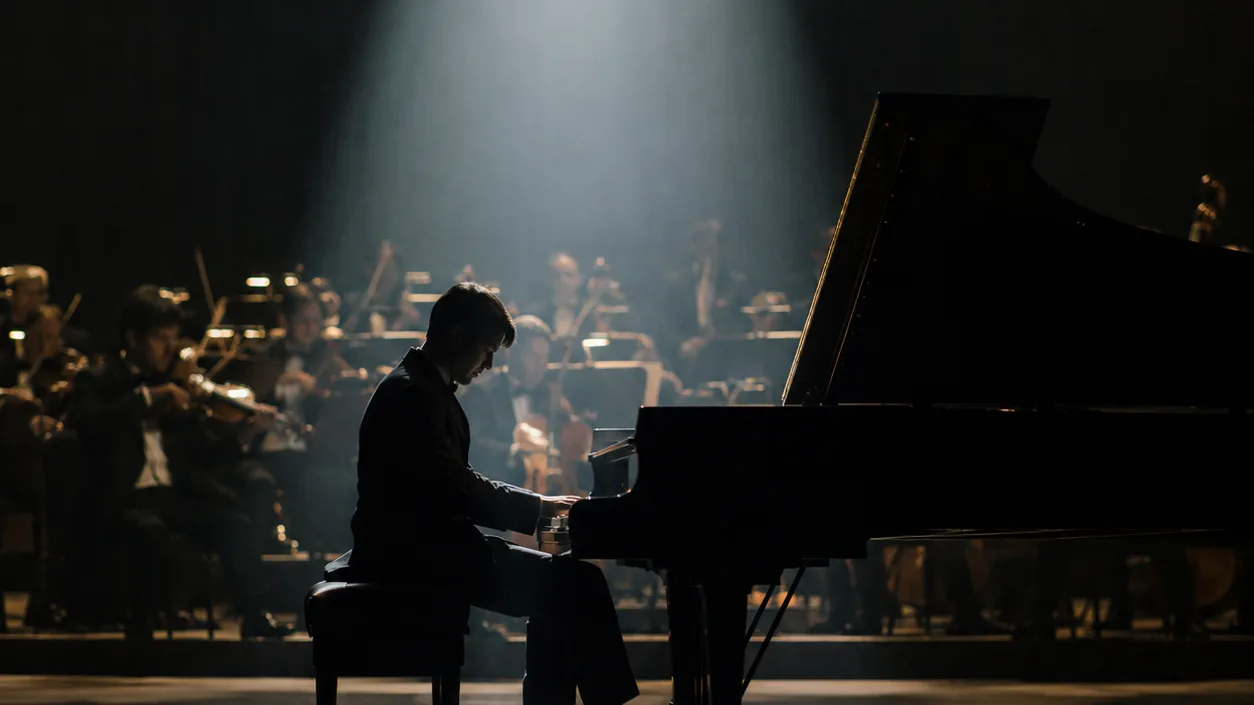
If you want to know how to make piano music without playing a note, the short answer is: describe the style, the tempo and the feeling, and let a generator perform it. On the piano music maker the form opens with a cinematic piano prompt already filled in and Instrumental Only switched on, and six "Start from a vibe" tiles let you hear a finished example before you spend anything. One run costs 10 credits and returns two complete pieces in about a minute; new accounts get 16 free credits.
In this guide
- What makes piano music sound like piano music
- Step by step with the piano music maker
- Writing a piano prompt that works
- Six piano prompts from the page
- Common piano music mistakes
- Choosing a model
- After the piece is made
- FAQ
- Final take
What makes piano music sound like piano music
A piano is one instrument, but "piano music" covers everything from a Chopin-style waltz to a saloon rag. What separates a convincing piece from a stiff one is mostly about the hands and the room. Each of these ingredients is a phrase you can type into the prompt:
- Style and era. Romantic era classical, jazz piano trio, minimalist, ragtime, cinematic. The style decides the harmony, the rhythm and how busy the left hand is. Name it first.
- Tempo. Calm pieces for study sit around 60–75 BPM, a waltz or a ballad around 70–90, ragtime around 100, swing often 110–140. Write the number: 70 BPM.
- Metre. Most pieces are in 4/4. A waltz is in 3/4, and saying 3/4 waltz gives you that lilting ONE-two-three.
- Touch. Expressive rubato (the tempo breathes and stretches), soft felt tone (the muffled, intimate sound of a felt-dampened upright), flowing arpeggios, bouncing left hand stride. These words change how the piece is played, not just what is played.
- Company. Solo piano, piano with strings, a trio with upright bass and brushed drums, or a duet with cello. Name every other instrument you want, and say solo piano if you want none.
- Room. Concert hall recording, chamber music recording, late night club. The room sets the reverb and the character of the recording.
- Shape. Gentle repeating patterns, builds to a powerful climax, lots of space. Piano pieces live on dynamics, so say whether it should stay calm or grow.
Step by step with the piano music maker
-
Open the piano music maker. You land on the Prompt tab. The model picker in the top right reads v6 Mini, the free tier.
-
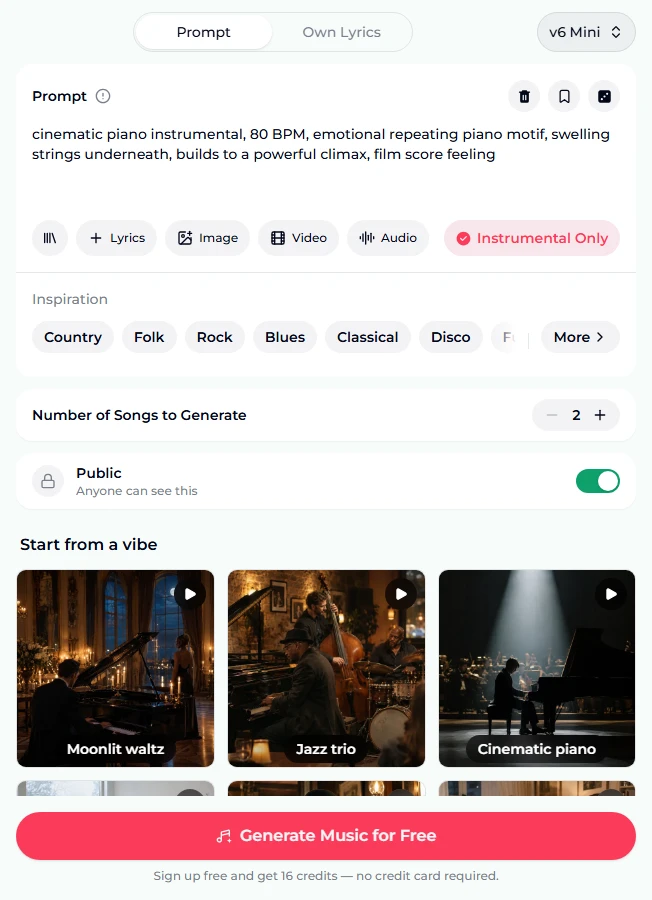
Read the preset. The Prompt box already holds cinematic piano instrumental, 80 BPM, emotional repeating piano motif, swelling strings underneath, builds to a powerful climax, film score feeling, and Instrumental Only is switched on. Under the form sit the Inspiration chips, the Number of Songs to Generate stepper at 2, the Public switch and the first row of vibe tiles.
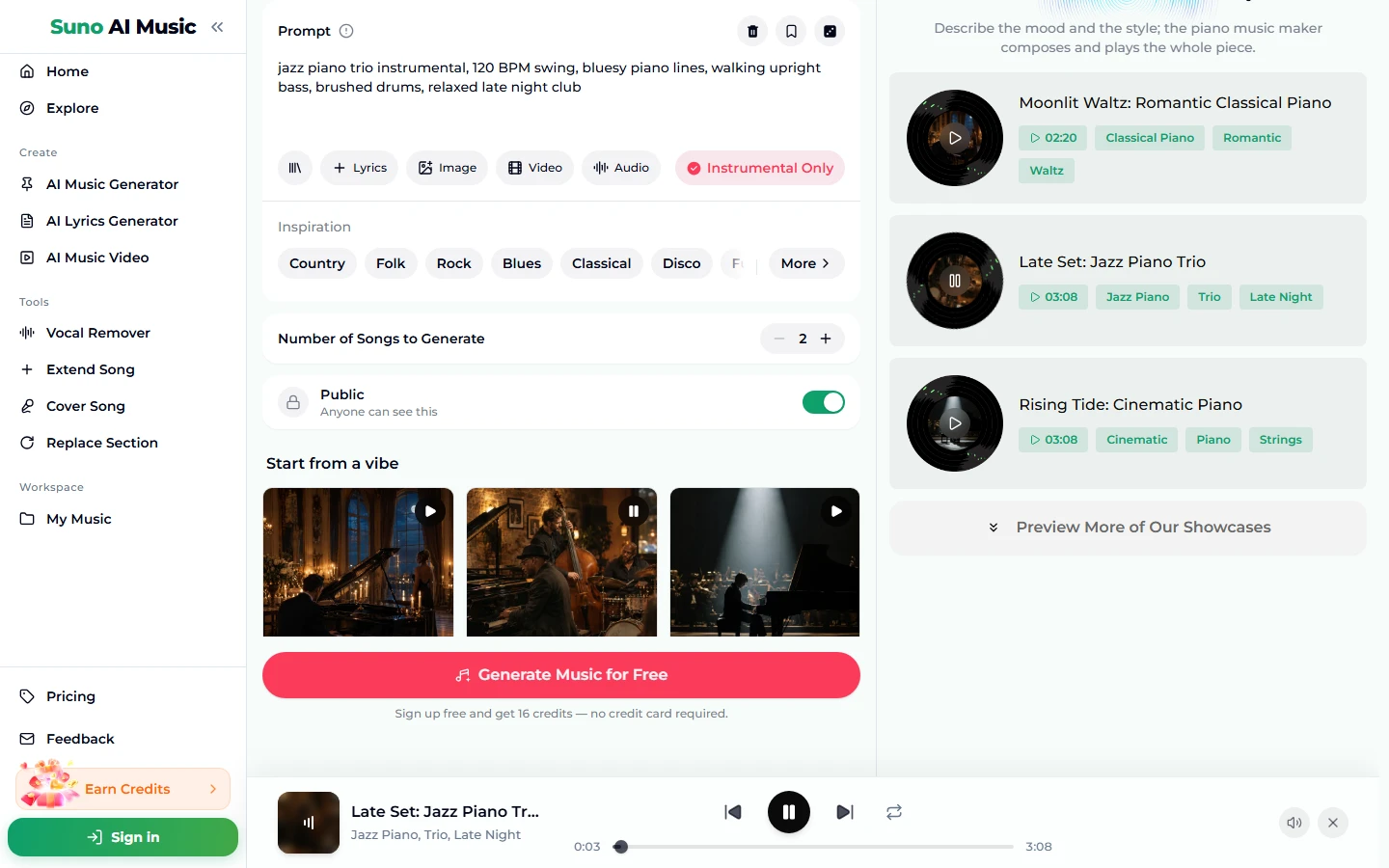
- Tap a vibe to hear it. One tap plays that tile's example song and copies its prompt into the Prompt box. Tapping Jazz trio swaps the text to jazz piano trio instrumental, 120 BPM swing, bluesy piano lines, walking upright bass, brushed drums, relaxed late night club, the tile shows a pause icon, and the player bar at the bottom starts Late Set: Jazz Piano Trio, which runs 3:08.
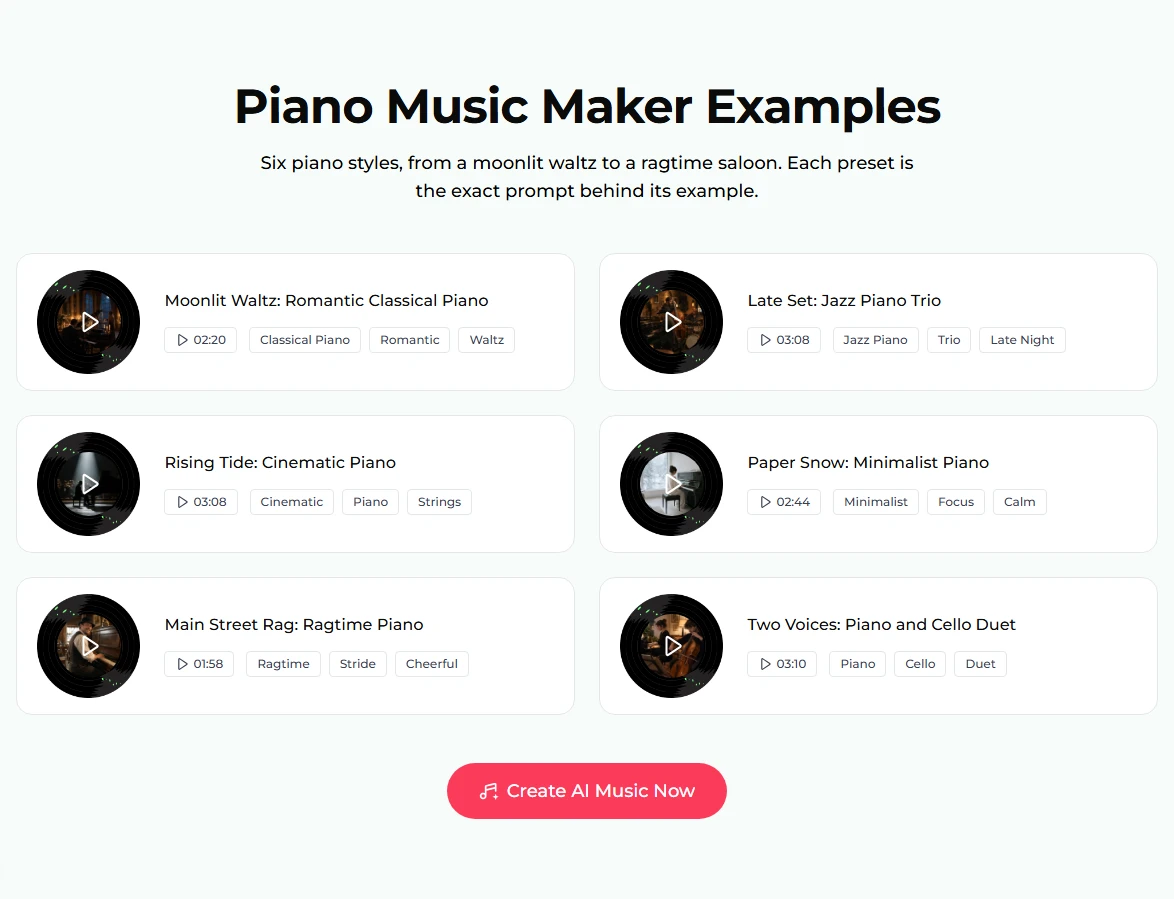
- Browse the other examples. Further down the page, the examples section lists all six pieces as turntable discs with their titles, lengths and tags, from Moonlit Waltz at 2:20 to Two Voices: Piano and Cello Duet at 3:10.
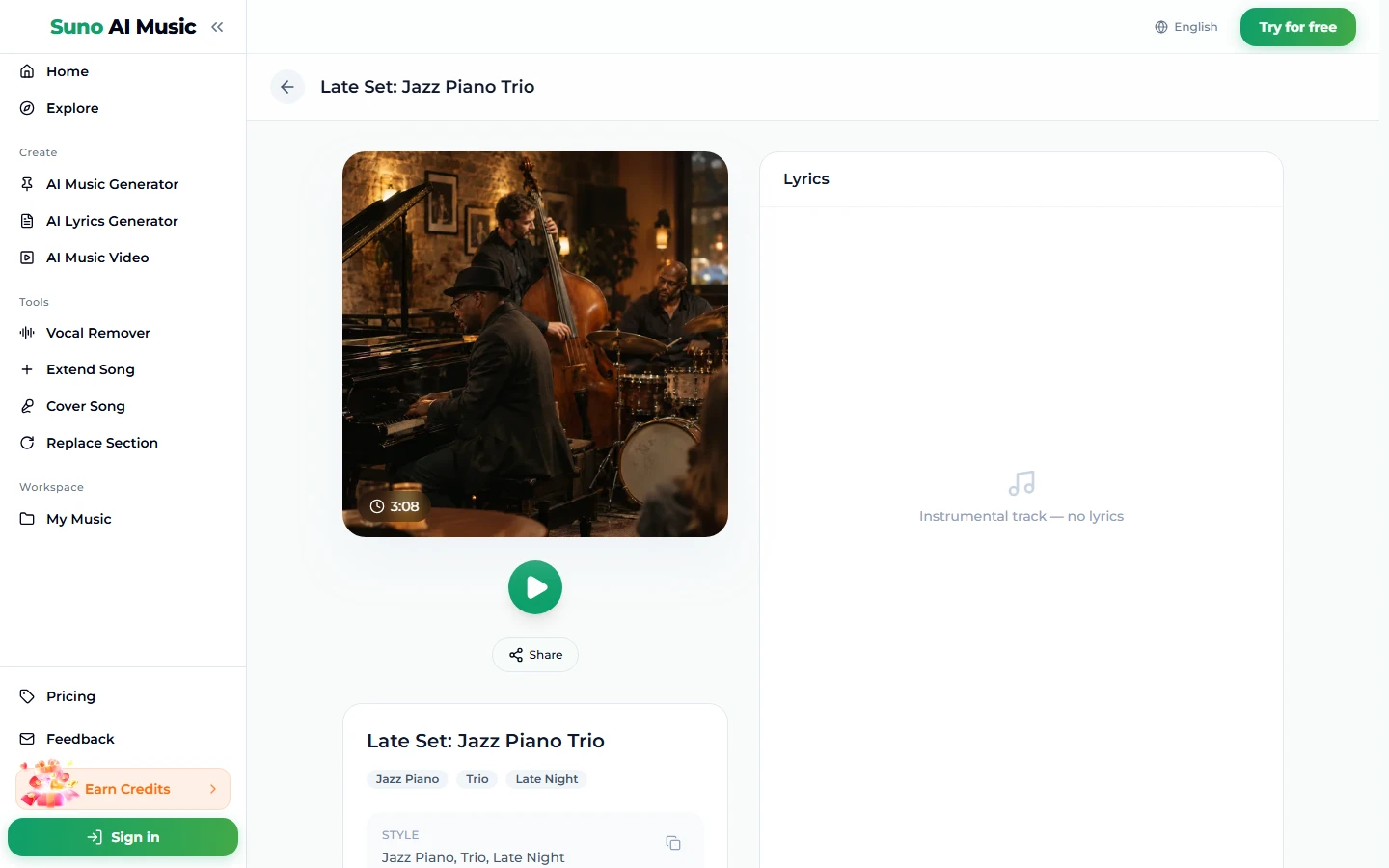
- Open a song page if you want a closer look. Every example has its own page, for instance the jazz trio example, with the cover photo, a play button, Share, the tags, and "Instrumental track — no lyrics" where lyrics would be.
- Edit, then press Generate Music for Free. Change a word or two if you like, then generate. A run takes about a minute and returns two new pieces in that style. They will not be the example you heard; they are fresh performances of the same description.
Writing a piano prompt that works
The Prompt box takes up to 500 characters of plain description. That is plenty. The prompts behind the six examples are all under 200 characters, and they follow the same pattern:
style + instrument setup, tempo, what the hands do, the mood, the room.
Take the minimalist example: minimalist solo piano, 70 BPM, gentle repeating patterns, soft felt tone, lots of space, calm and contemplative, for focus and study. Every phrase does a job. Nothing is decoration.
A few practical rules:
- Lead with the style. The model pays most attention to the first words. Ragtime solo piano first, adjectives after.
- One mood, not five. Tender and nostalgic works. Happy, sad, epic, calm and mysterious gives you mush.
- Describe a scene if you are stuck. A time of day or a place changes the harmony more than theory words do: a rainy afternoon, a winter night by the window.
- Say what you do not want by leaving it out. Asking for no drums can put drums in the model's head. Asking for solo piano is cleaner.
- Tempo and key are suggestions. Write 72 BPM or in D minor, and Suno usually lands roughly there, not exactly.
- Change one thing per run. Two pieces per run make comparison easy, but only if you changed a single variable.
For a composer's flavour, describe the era and the character rather than a name: romantic era nocturne, dreamy and melancholic or impressionist, shimmering, dreamy.
Six piano prompts from the page
These are the six vibes on the piano music maker. Each prompt is copied exactly from the page, and each example song was made on v6 from exactly that prompt. All six are instrumental.
| Vibe | What it is | Prompt |
|---|---|---|
| Moonlit waltz | Romantic classical waltz, example Moonlit Waltz (2:20) | romantic era classical solo piano, 3/4 waltz, expressive rubato, flowing arpeggios, tender and nostalgic, concert hall recording |
| Jazz trio | Piano, upright bass and brushes, example Late Set (3:08) | jazz piano trio instrumental, 120 BPM swing, bluesy piano lines, walking upright bass, brushed drums, relaxed late night club |
| Cinematic piano | Film cue that builds, example Rising Tide (3:08) | cinematic piano instrumental, 80 BPM, emotional repeating piano motif, swelling strings underneath, builds to a powerful climax, film score feeling |
| Minimalist piano | Calm study piece, example Paper Snow (2:44) | minimalist solo piano, 70 BPM, gentle repeating patterns, soft felt tone, lots of space, calm and contemplative, for focus and study |
| Ragtime | Stride and syncopation, example Main Street Rag (1:58) | ragtime solo piano, 100 BPM, bouncing left hand stride, syncopated playful right hand melody, old-time saloon piano, cheerful |
| Piano and cello | Chamber duet, example Two Voices (3:10) | piano and cello duet instrumental, 72 BPM, warm cello melody over flowing piano accompaniment, intimate and heartfelt, chamber music recording |
Two extra recipes of our own, untested, built on the same pattern:
- new age solo piano, 66 BPM, slow open chords, gentle rising melody, soft reverb, peaceful sunrise, for meditation
- pop piano ballad instrumental, 76 BPM, singable right hand melody, steady broken chords, warm and hopeful, intimate studio recording
Common piano music mistakes
- Forgetting Instrumental Only. The piano page switches it on for you, but if you start on another generator page and type a piano prompt, check the toggle. Otherwise you may get a vocal.
- Stacking instruments. Piano, strings, choir, synths, drums, guitar turns a piano piece into a soundtrack where the piano is buried. Pick the piano plus one partner at most.
- Asking for a famous piece. The generator writes original music. Ask for the style of a Chopin nocturne, not the nocturne itself.
- No tempo. "Slow" means different things to different models. 70 BPM is unambiguous.
- Judging from one piece. Every run gives two. If both miss in the same way, change the prompt; if one misses, keep the other.
- Contradictory shape words. Calm, contemplative, builds to a powerful climax pulls in two directions. Decide whether the piece should stay still or grow.
Choosing a model
The picker in the top-right corner of the form offers three models:
- v6 Mini: the free tier, described as "Fast drafts, high volume". Good for trying prompts and hearing which style you like.
- v6: "Most powerful, for any song". The six examples on the page were made on v6, which is the one to use when piano tone and phrasing detail matter.
- v6 Wild: "Best for experimental ideas". Worth a try for unusual combinations, such as prepared piano or piano over ambient textures.
v6 and v6 Wild need a paid plan. Every run costs 10 credits and returns two pieces whichever model you pick, and reference media (Image, Video or Audio) does not change the price. See plans and credit packs.
After the piece is made
- Make it longer. Study and sleep sessions need long pieces. Extend Song continues a piece from the point you pick, and our guide to extending a song explains where to cut.
- Fix one bar. If a passage stumbles, Replace Section regenerates just that part.
- Hear it in another style. Cover Song re-performs your piece in a different arrangement.
- Put it under pictures. The AI music video tool turns the track into a video.
- Learn it or score it. To get the notes into a DAW or notation software, see how to convert an MP3 to MIDI. Our piano chords guide helps if you want to play along.
- Download it. Downloads come with a plan; see pricing.
If piano is your starting point but you want something else, try the AI instrumental generator for other lead instruments, the melody maker for a tune on flute or violin, the AI jazz generator for fuller jazz bands, or the AI ambient generator for sleep soundscapes.
FAQ
Can I make piano music for free?
Yes, to start. New accounts get 16 free credits with no card, and one run costs 10 credits for two pieces on v6 Mini. After that, credits come from a plan or a credit pack.
Can I get solo piano with no other instruments?
Yes. Put solo piano early in the prompt, as the waltz, minimalist and ragtime examples do, and keep Instrumental Only on.
How long are the generated pieces?
The six examples run from 1:58 (ragtime) to 3:10 (piano and cello). Use Extend Song for longer sessions.
Can I use the piano music commercially, on YouTube or at events?
Commercial use is included only on Standard plan and above, 2,500+ credit packs, and Team plans. Free credits, the Starter plan and Mini credit packs are personal use only.
Can I keep a piece private?
Songs are public by default. Turning the Public switch off to keep a song private is a paid-plan option.
Why does my piece sound different from the example?
Tapping a vibe copies the example's prompt, but every run is a new performance. You get the same style, not the same notes.
Can I give it a picture or a recording as a starting point?
Yes. The Image chip takes up to 5 photos and the song picks up their mood; Video takes one clip up to about 4 minutes; Audio takes one track between 6 seconds and 30 minutes and the song borrows its feel. The cost is the same 10 credits.
Final take
How to make piano music with AI comes down to a handful of words: the style, a tempo, what the hands do, one mood and a room. The piano music maker gives you six proven prompts to start from, and hearing each example first takes the guesswork out. Tap the vibe closest to what you want, change one phrase, and generate. The first two pieces cost 10 of your 16 free credits, so it is cheap to find out.