
TL;DR
Commercial songs are the one thing a podcast cannot use: playing a record under your voice needs a sync licence and a master licence, and hosting platforms take shows down for it. The fix is music that is yours. Generate a theme (15–30 seconds, instrumental, with a clear ending), an outro (the theme's calmer twin), two or three stingers (3–5 seconds, for transitions and ad breaks) and a bed (steady, no melody, extended to ten minutes) on the create page — 10 credits per run, two takes each. Mix the bed 18–22 dB under the voice, keep the theme identical every episode, and on the Standard plan and above the commercial licence with its certificate covers a sponsored show. A new account's free credits cover the theme.
In this guide
- Why a podcast needs its own music
- The four pieces every show needs
- Making the theme
- Making the bed
- Stingers and the outro
- Prompt recipes by show type
- Mixing music under a voice
- Licensing for a sponsored show
- FAQ
Why a podcast needs its own music
A song under a podcast is a synchronization — the recording is being combined with other content — and that needs permission from the songwriter's publisher and, separately, from the owner of the recording. Neither is available for the price of a stream, and hosting platforms enforce it: episodes with unlicensed commercial music get muted, flagged or removed, and a repeat can cost the feed. "Podsafe" libraries exist for exactly this reason, and they are what most shows use — with the trade-off that the same forty tracks are under a thousand other podcasts.
Music you generate is different in kind. It has no publisher and no label, it has never been heard on another show, and on a paid plan it comes with a written commercial licence. It is also the only route where "make the theme 10 BPM faster and drop the drums for the ad bed" is a two-minute change rather than a new search.
There is a branding reason too. Listeners recognise a show by its theme within a second; a theme nobody else has is worth more than one from a catalogue.
The four pieces every show needs
| Piece | Length | Job | Type |
|---|---|---|---|
| Theme / intro | 15–30 s | Announce the show; end cleanly so the host can come in | Instrumental, with a defined ending |
| Outro | 20–40 s | Close the episode; carry the call to action | The theme's calmer version, or a fade |
| Stingers | 3–5 s | Mark a segment change, lead into and out of an ad | Short hits, cut from the theme or generated |
| Bed | 5–10 min | Sit under talk without pulling attention | Instrumental, steady, no lead melody |
A fifth, for shows that run ads: an ad bed — a variant of the bed with a slightly different mood so the sponsor read sounds like a segment rather than the show.
Everything below is built from at most three generations: one for the theme (which also yields the stingers and the outro), one or two for beds.
Making the theme
On the create page in Simple mode, set the Vocal / Instrumental switch to Instrumental and describe the theme with its shape in the description — the model follows structure words like "short intro", "builds", "ends on a clean hit" more reliably than most people expect:
A 20-second podcast intro sting: upbeat acoustic guitar, handclaps, bright piano stabs, ends on a clean hit, 115 BPM.
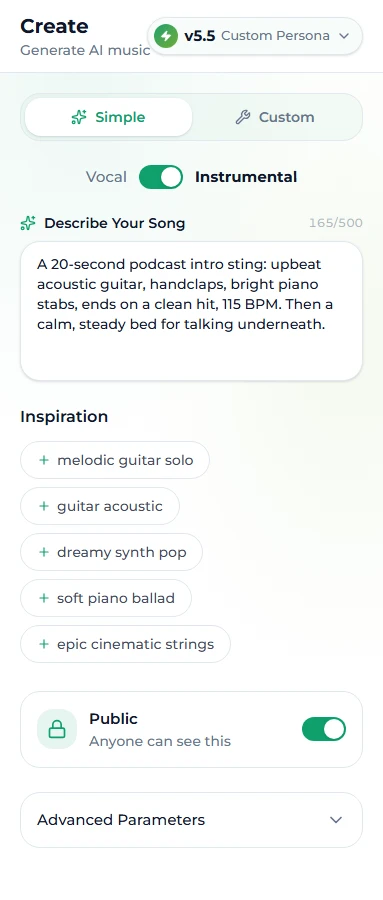
Generate — 10 credits, two takes, a minute or two. You will get full-length tracks, not 20-second clips; that is fine. What you want from them is the first 20–30 seconds with a natural landing point — a hit, a held chord, a bar of silence. Trim to that point in your editor and add a half-second fade so the host's first word lands on air, not on a tail.
If you want a spoken or sung tagline in the theme ("This is The Long Table"), switch to Custom mode, write the tagline as a single [Chorus] line and leave the rest empty — the tags guide explains the brackets. Most shows are better served by an instrumental theme and the host saying the name.
Once you have a theme you like, the rest of the package comes from it:
- Stingers: the theme's clean hit, cut to 3–5 seconds. Two or three variants from different bars of the same take.
- Outro: the theme covered with a calmer description —
same melody, slower, solo piano, gentle— or simply the last 30 seconds of the take with a long fade. - Season variants: cover the theme again in a new style when the show changes; the melody stays recognisable.
Making the bed
The bed is the piece people get wrong, because they make it interesting. A good bed is boring: steady, no lead melody, dynamics that never spike, in a key that does not clash with a speaking voice.
Simple mode, Instrumental on, and say what to leave out:
ambient, calm, soft piano, warm pads, no drums, no lead melody, 70 BPM
Generate, keep the calmer take, then extend it to the length of your longest segment: set the extension point at the end of a phrase and the model continues the same arrangement; three passes take a three-minute bed to nine or ten minutes with no loop seam. The extend guide covers where to cut.
Make one bed per mood the show uses — calm for interviews, warmer for stories, slightly brighter for the ad read — and reuse them across the season. Consistency is the point; a listener should never notice the bed changed.
If you already have a vocal track you love the feel of, the vocal remover hands you its instrumental in one run; the acapella comes with it, useful for a stinger.
Stingers and the outro
Stingers do two jobs: they tell the ear a segment ended, and they let you edit between takes without an audible jump. Keep them from the same take as the theme so they share its sound, cut them on a downbeat, and keep the loudest one for the ad break and the softest for chapter changes.
The outro's job is the call to action. It should be quieter than the theme so the host can talk over it, and it should end rather than fade if you want the last word to land — a cover of the theme with ends on a held chord in the description gives you that.
Prompt recipes by show type
All Simple mode, Instrumental on. Generate the theme line first; the bed line is the same mood with the energy taken out.
| Show type | Theme | Bed |
|---|---|---|
| Interview / conversation | indie folk, warm, acoustic guitar, light percussion, hopeful, ends on a clean hit, 110 BPM | ambient folk, warm, soft acoustic guitar, no drums, no lead melody, 80 BPM |
| True crime / documentary | cinematic, tense, low strings, pulsing synth, sparse piano, ends on a hit, 90 BPM | dark ambient, tense, low drone, soft pulse, no melody, 70 BPM |
| Comedy | funk, playful, clavinet, tight drums, brass stabs, ends on a hit, 120 BPM | lo-fi funk, light, muted guitar, soft drums, no lead, 95 BPM |
| Business / news | corporate, confident, clean electric piano, driving drums, short, ends clean, 115 BPM | minimal, focused, soft electric piano, light pulse, no melody, 85 BPM |
| Wellness / meditation | ambient, serene, soft pads, gentle bells, slow, 60 BPM | ambient, weightless, soft synth pads, no drums, no melody, 55 BPM |
| Tech | synthwave, bright, arpeggiated synths, crisp drums, ends on a hit, 118 BPM | downtempo electronic, calm, soft pads, subtle beat, no lead, 90 BPM |
| Sports | stadium rock, energetic, big drums, power chords, ends on a hit, 130 BPM | rock instrumental, steady, muted guitar, light drums, no lead, 100 BPM |
| Fiction / audio drama | orchestral, mysterious, strings, harp, builds, ends on a swell, 80 BPM | orchestral ambient, soft strings, no melody, slow, 65 BPM |
The prompts guide has the full vocabulary behind these; the any-genre recipes go deeper on each style.
Mixing music under a voice
Numbers that hold for most shows:
- Episode loudness: the podcast standard is around -16 LUFS for stereo, -19 LUFS for mono, with true peaks under -1 dB. Most editors have a loudness normalisation preset for it.
- Bed under voice: music 18–22 dB below the voice. That is quieter than feels right in headphones and correct on a phone.
- Duck it: enable auto-ducking so the bed rises in pauses and drops under speech; set the release long (a second or more) so it does not pump.
- High-pass the bed around 120 Hz so it does not muddy the voice, which lives in the same range as bass and kick.
- The theme is the one thing at full level. Play it at episode loudness, then bring the host in a beat after the hit.
- Same theme, same level, every episode. Save the mix as a template.
Licensing for a sponsored show
A show with sponsors, ads, a paid tier or affiliate links is a commercial use. On Suno AI Music every generated track is copyright-free, and on the Standard plan and above (and the larger credit packs) it carries a commercial licence with a downloadable certificate — no royalties, no attribution, and the licence extends to the extensions, covers and stems you make from the track. The free tier and the Starter plan are for personal use: fine for a hobby show, not for one that earns. Plans are on the pricing page.
Keep the certificate with the show's project files. Hosting platforms require you to hold the rights to the music in your episodes; if a distributor or a rights bot ever asks, the certificate is the answer.
FAQ
Can I use a song I like as my podcast intro?
Not without a sync licence and a master licence from the rights holders, which are rarely available to independent shows. A track you generate has no rights holder but you.
How long should a podcast intro be?
15 to 30 seconds, ending on a clean hit so the host's first line lands on air. Generate a full track and trim to the first natural landing point.
How do I get a ten-minute background bed?
Generate a calm instrumental and extend it in passes, cutting at the end of a phrase each time; three passes reach nine or ten minutes without a loop seam.
Do I need a licence for a podcast with sponsors?
Yes — sponsored, ad-supported or paid shows are commercial use. On Suno AI Music that is the Standard plan and above, with a certificate you can download.
Can I make stingers without generating more music?
Yes. Cut them from the theme's clean hit — 3 to 5 seconds, on a downbeat. They will match the theme because they are the theme.
What loudness should the episode be?
Around -16 LUFS stereo (-19 mono) with true peaks under -1 dB, and the bed 18–22 dB under the voice.
Final take
Three generations cover a season: one theme that yields the stingers and the outro, one or two beds extended to length. Make them instrumental, keep the bed boring, mix it 20 dB under your voice, and keep the certificate with the project. Start with the theme on the create page — the free credits cover it — and the show has a sound of its own by the next episode.