
TL;DR
An AI music model has no "blues mode" or "phonk mode". It has a vocabulary, and every genre is a particular set of words: the sub-genre, a mood, two or three signature instruments, a voice and a tempo. Get the signature words right (slide guitar, cowbell melody, vinyl crackle, bandoneon) and the genre follows. The music maker is the place to practise making AI music in any genre: its six vibe tiles range from a Celtic jig to an anime opening, and each loads a proven prompt. For a specific genre, each of the 20 genre generators linked below opens with that genre's preset. One run is 10 credits for two songs, and new accounts get 16 free credits.
In this guide
- What makes a genre sound like itself
- Step by step with the music maker
- How to write a prompt for any genre
- Six vibes from the music maker
- A generator for every genre
- Common genre mistakes
- Choosing a model
- Moving a song between genres
- FAQ
- Final take
What makes a genre sound like itself
Close your eyes and play three seconds of surf rock: you know it from the twangy, reverb-drenched guitar before any drum hits. That is the principle. A listener recognises a genre by a handful of sounds, and those sounds are what the prompt must name. Five slots cover almost every genre:
- Sub-genre and era. blues is a region; Chicago electric blues shuffle is an address. 60s surf rock, tango nuevo, 90s R&B carry more information than any adjective.
- One mood. joyful, moody, menacing. Two moods that agree are fine; two that fight get averaged into nothing.
- Signature instruments and production. Name the two or three sounds that identify the genre, plus one production word: tremolo picking, spring reverb; slow heavy breakbeat, vinyl crackle; four on the floor, chopped disco strings.
- Voice. haunting smoky female vocal, snotty shouted male vocal, or Instrumental Only for none.
- Tempo. A number where the genre is defined by it: 75 BPM for lo-fi, 124 for house, 174 for drum and bass. Suno usually honours it roughly, not exactly.
Step by step with the music maker
- Open the music maker. It opens on the Prompt tab with a Celtic preset, A lively Celtic folk jig with fiddle, tin whistle, uilleann pipes and bodhran, misty green hills at sunrise, building from a solo fiddle to a full band, and Instrumental Only switched on.
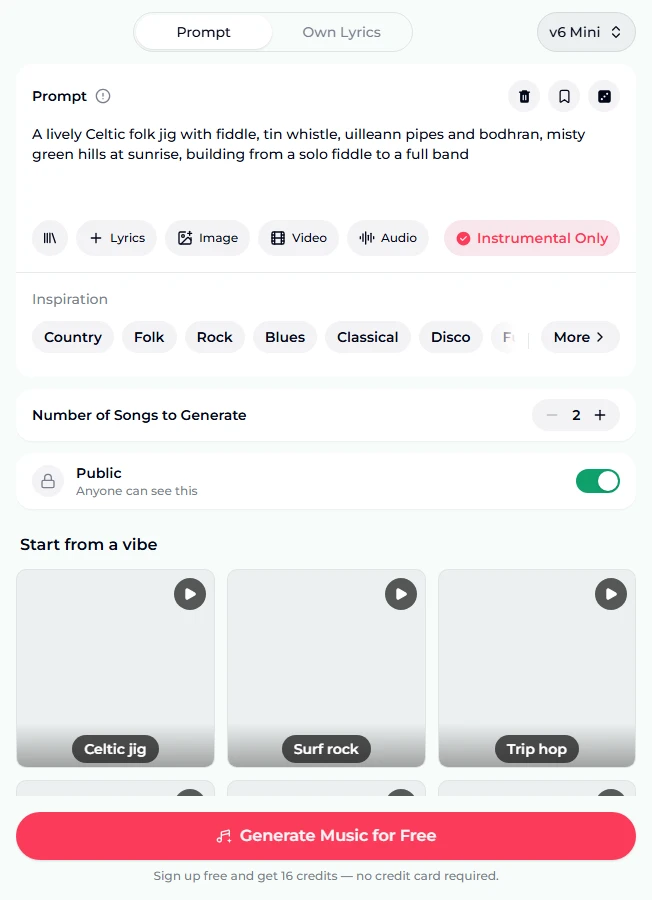
- Note the Inspiration row. Under the Prompt box, the genre chips (Country, Folk, Rock, Blues, Classical, Disco and More) add a genre word with one tap. Below are the Number of Songs to Generate stepper (2 is one run), the Public switch, the vibe tiles and the Generate Music for Free button.
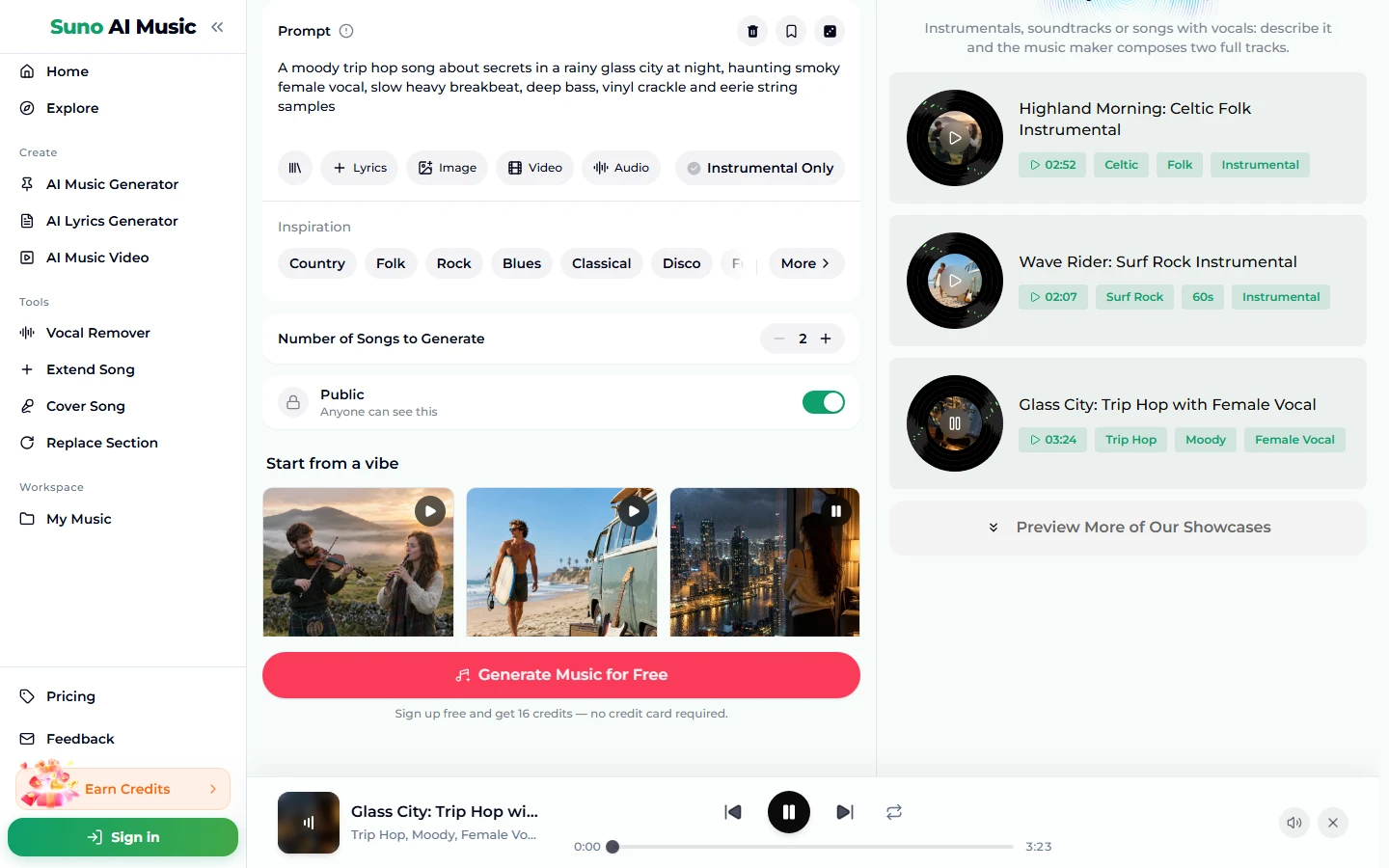
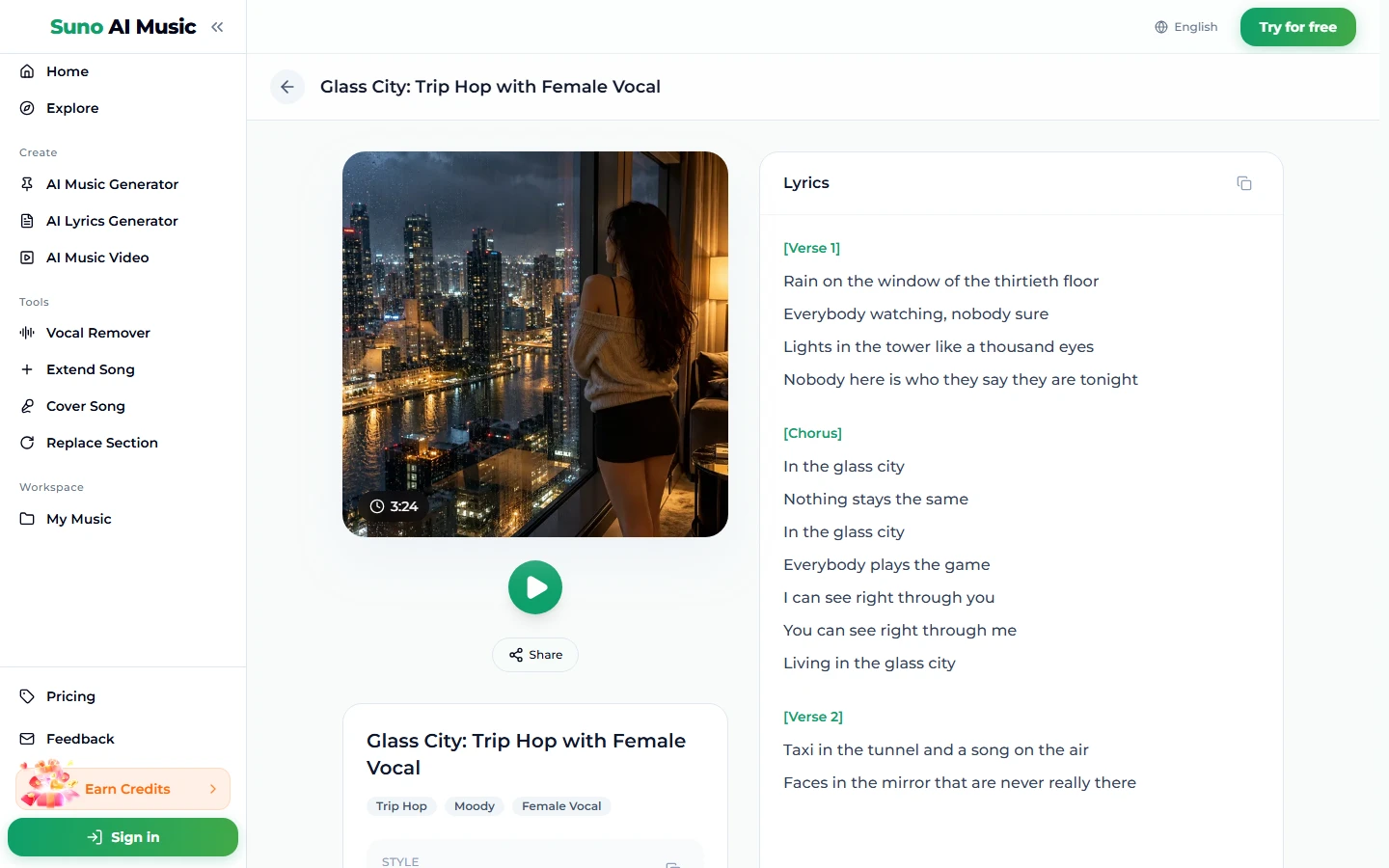
- Tap a vibe. A tile plays its example and copies its prompt into the box, switching Instrumental Only to match. Tapping Trip hop turns the switch off, loads A moody trip hop song about secrets in a rainy glass city at night… and plays Glass City, a 3:24 song.
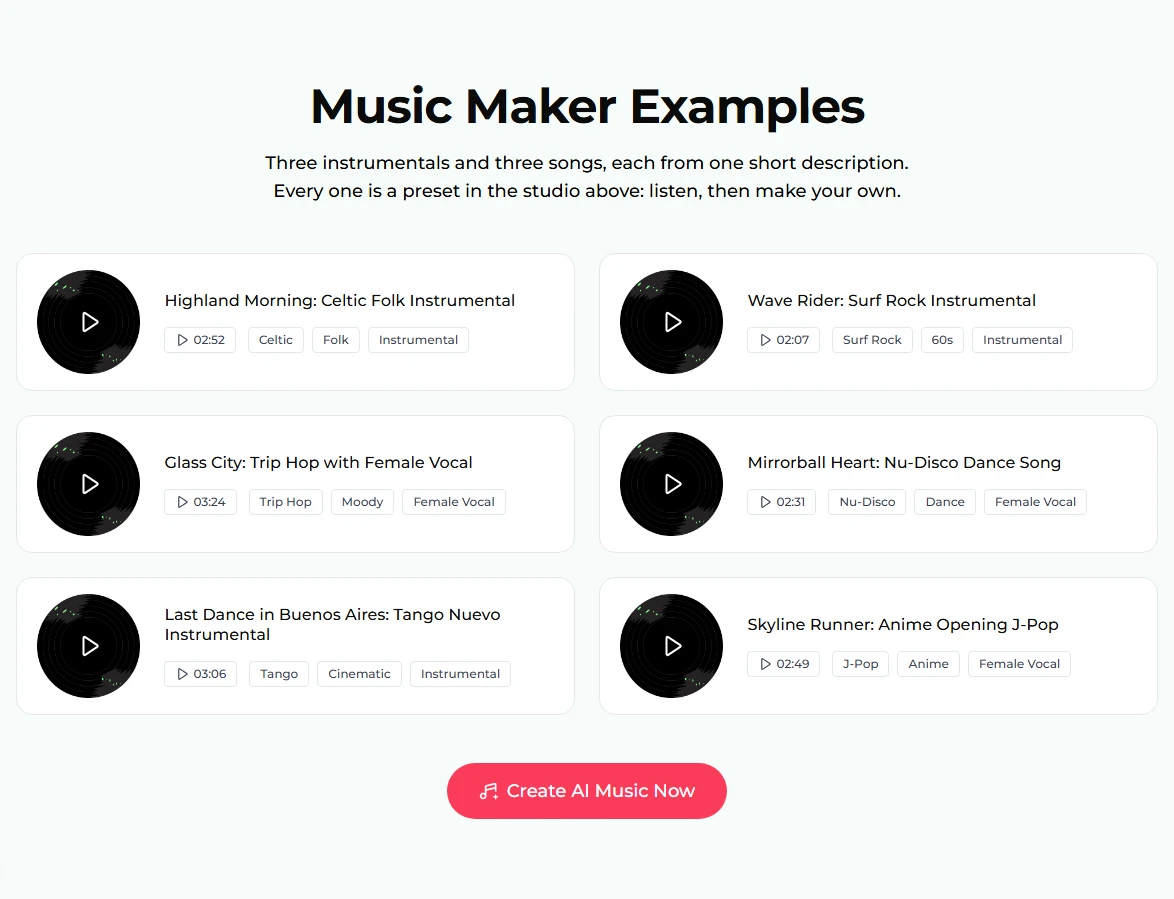
- Hear the range. The Music Maker Examples section lists three instrumentals and three songs. The instrumentals were made on v6 from exactly their tile's prompt. For the three sung ones, we wrote the lyrics and gave v6 a style line in the same direction; the tile's prompt is the one-sentence version, and from it the AI writes lyrics of its own.
- Open an example. The Glass City song page shows the cover, play and Share buttons, the tags and the lyrics, starting "Rain on the window of the thirtieth floor".
- Press Generate. 10 credits, about a minute, two new songs in that genre. They will not be copies of the example.
How to write a prompt for any genre
Look at the six prompts below and you will see two shapes that both work:
- Instrumentals read like a producer's list: genre and era, BPM, lead instrument, rhythm section, a scene, a mix note. 60s surf rock instrumental, 160 BPM, reverb-drenched twangy electric guitar lead, tremolo picking…
- Songs read like a sentence: mood and genre, subject, voice, instruments. A glittering nu-disco dance song about losing yourself on a Friday night dance floor, bright joyful female vocal…
Habits that make genre prompts land:
- Lead with the sub-genre. The model weights early words more.
- Spell out the signature. The cowbell in phonk, the pedal steel in country, the log drum in afrobeats. Leave it out and you get generic pop.
- Add a scene. smoky dance hall at midnight, misty green hills at sunrise. Scenes steer mood and production together.
- Keep it under 500 characters, the Prompt box limit. Eight to fifteen terms is plenty.
- Say "instrumental" in the prompt as well as switching Instrumental Only on, as the page's instrumental prompts do.
The Suno prompts guide has more words that reliably change the sound, and the Suno tags guide covers structure tags for the Own Lyrics tab.
Six vibes from the music maker
The six vibes on the music maker, with each tile's prompt verbatim:
| Vibe | What it is | Prompt |
|---|---|---|
| Celtic jig | Lively folk instrumental, 2:52 example | celtic folk instrumental, 110 BPM, lively fiddle melody, tin whistle, uilleann pipes, bodhran drum, bouzouki and acoustic guitar rhythm, misty green hills at sunrise, joyful jig building to a full band, warm natural acoustic sound |
| Surf rock | 60s twang instrumental, 2:07 example | 60s surf rock instrumental, 160 BPM, reverb-drenched twangy electric guitar lead, tremolo picking, driving surf drums, rolling bass, sunny california beach energy, retro spring reverb sound |
| Trip hop | Dark breakbeat song, 3:24 example | A moody trip hop song about secrets in a rainy glass city at night, haunting smoky female vocal, slow heavy breakbeat, deep bass, vinyl crackle and eerie string samples |
| Nu-disco | Glittering dance song, 2:31 example | A glittering nu-disco dance song about losing yourself on a Friday night dance floor, bright joyful female vocal, four on the floor, funky slap bass, chopped disco strings and funk guitar |
| Tango nuevo | Dramatic bandoneon instrumental, 3:06 example | tango nuevo instrumental, 118 BPM, dramatic bandoneon lead, passionate violin, staccato piano, upright double bass, sharp rhythmic accents, sensual and intense, smoky dance hall at midnight, cinematic and elegant |
| Anime opening | Soaring J-pop theme, 2:49 example | A heroic anime opening theme in fast J-pop style about running over rooftops toward a dream, powerful soaring female vocal, bright guitars, sparkling synths and a dramatic key change |
Two untested recipes of our own for genres without a page:
- Classical (untested): classical string quartet instrumental, adagio, elegant legato violin melody, pizzicato cello, minor key, intimate chamber recording in a small hall
- Reggaeton (untested): A sultry reggaeton song about a summer night in the city, smooth Spanish male vocal, dembow rhythm, deep bass and plucked synth
A generator for every genre
Each page below is the same generator with a preset and six vibe tiles for its genre. The signature words are taken from each page's opening preset:
- AI pop generator: bubblegum to pop rock. bright bouncy female vocal, handclaps, sparkly synths, a big sweet hook.
- AI dance pop generator: four on the floor, bright synth hooks and a big drop; also eurodance and disco pop.
- AI K-pop generator: girl and boy groups, K-ballads. powerful female vocals and a rap break, big dance break, catchy chant hook.
- AI rock generator: 70s classic rock to post-rock. raspy powerful male vocal, crunchy guitar riffs, hammond organ.
- AI punk generator: buzzsaw guitars, pounding simple drums, under two minutes.
- AI metal generator: power, symphonic, djent, doom. fast double bass drums, keyboard fanfares, huge choir chorus.
- AI blues generator: Delta to blues rock. stinging electric guitar licks, amplified harmonica, driving shuffle beat.
- AI jazz generator: big band to fusion. silky soprano saxophone, warm electric piano, soft groove drums.
- AI funk generator: tight horn section stabs, slap bass, choppy wah guitar.
- AI R&B generator: 90s R&B, quiet storm, new jack swing. silky female lead with stacked harmonies, glossy keys.
- AI country generator: country pop to outlaw. acoustic and electric guitars, banjo accents, singalong chorus.
- AI folk generator: Americana, campfire songs. weathered male vocal, acoustic guitar, pedal steel, upright bass.
- AI rap generator: full rap songs. laid-back male flow, whiny synth lead, deep funk bass, talk box hook.
- AI trap generator: booming 808s, rolling hi-hats and dark piano bells.
- Phonk generator: pitched cowbell melody, heavily distorted 808 bass, 150 BPM. Guide: how to make phonk.
- Lofi generator: 75 BPM, dusty boom bap drums with a lazy swing, warm Rhodes, vinyl crackle. Guide: how to make lofi music.
- AI EDM generator: festival progressive, dubstep, trance. euphoric supersaw chords, long build, massive drop.
- AI house generator: 122 BPM, warm rolling bass line, jazzy rhodes chords, shuffled hi-hats.
- AI techno generator: 132 BPM, pounding kick, hypnotic metallic percussion loops.
- AI ambient generator: no drums, slowly evolving warm synth pads, soft tape hiss.
Common genre mistakes
- Stacking genres. jazz, metal, reggaeton is an average, not fusion. Pick one; add a second only as a flavour.
- Naming artists. Unreliable, and a licensing risk. Describe the sound instead.
- The genre word alone. "Blues" is a suggestion; slide guitar, harmonica, shuffle is blues.
- Contradictory moods. calm, aggressive cancels out.
- The wrong switch. A vocal genre with Instrumental Only on, or ambient with it off and a vocal appears.
- Too many words. A paragraph-long prompt gets its first line weighted and the rest blurred.
Choosing a model
The model picker is at the top right. Free accounts generate on v6 Mini ("Fast drafts, high volume"), fine for testing which genre words work. v6 ("Most powerful, for any song") and v6 Wild ("Best for experimental ideas") need a paid plan. v6 is the polished choice and made every example; v6 Wild suits genre blends you want to push. All models cost 10 credits a run for two songs; see plans and credit packs.
Moving a song between genres
Once you have a song you like, you do not have to prompt a new one to hear it in another genre. Cover Song re-performs it in a new style: the synthwave song as a jazz ballad, the country song as reggaeton. It is also the fastest way to learn the vocabulary: cover one song into five genres and you hear exactly which words moved what. Our AI cover guide walks through it.
Other next steps: Extend Song for length (ambient rewards long takes), Replace Section for one weak part, the vocal remover to split a song into vocals and instrumental, and the music video generator. Downloads come with a plan; see pricing.
FAQ
Can AI make music in any genre?
Anything you can describe in sound terms. The method (sub-genre, one mood, signature instruments, a voice, a tempo) works for genres without their own page too.
Why does my blues prompt come back sounding like pop?
The signature sounds were missing. slide guitar, harmonica, shuffle beat plus a gritty vocal is blues; the word alone is a hint.
How do I make an instrumental in a genre?
Switch on Instrumental Only, write "instrumental" in the prompt, and drop the voice slot. The AI instrumental generator opens that way.
Can I change the genre of a song I already made?
Yes, with Cover Song. The melody and lyrics carry over into the new style.
Can I use genre songs commercially, on YouTube or Spotify?
Commercial use, including monetised YouTube and Spotify, is covered only on the Standard plan and above, 2,500+ credit packs, and Team plans. Songs made with free credits, the Starter plan or the Mini credit pack are for personal use only. See pricing.
Which page should I start on?
For a specific genre, its page above. For exploring, or a genre without a page, the music maker or the AI music generator.
Final take
Making AI music in any genre is a matter of naming what a listener would hear: the sub-genre, one mood, the signature instruments, a voice and a tempo. Start on the music maker to hear six very different genres from six short prompts, jump to a genre page when you know what you want, and change one word at a time until it sounds right.