

TL;DR
The quickest way to learn how to make blues music with AI is to tell a story and name a place. On Suno AI Music's AI blues generator the form opens with a Chicago electric blues shuffle already written into the prompt (a Saturday night at a packed club, a gritty male voice, stinging guitar and amplified harmonica), with Instrumental Only off. Six "Start from a vibe" tiles cover Delta blues, Chicago shuffle, slow blues, boogie woogie, blues rock and a harmonica instrumental; one tap plays a real example made on v6 and copies its exact prompt into the box. One run costs 10 credits and returns two songs, and new accounts get 16 free credits.
In this guide
- What makes blues music sound like the blues
- Step by step with the AI blues generator
- Writing a blues prompt that tells a story
- Six blues prompts that already work
- Common blues mistakes
- Choosing a model
- After the song is made
- FAQ
- Final take
What makes blues music sound like the blues
Blues music is simple on paper and hard to fake. A few ingredients do most of the work, and each one is something you can write into a prompt:
- Twelve bars, three chords. Most blues follows the twelve-bar form on the I, IV and V chords. You do not need to write it; traditional blues or twelve-bar blues nudges the model towards it.
- The shuffle. A rolling, swung rhythm (long-short, long-short) that drives Chicago and Texas blues. Driving shuffle beat or slow shuffle in the prompt.
- Bent and slid notes. Blue notes bent on a guitar string, a bottleneck slide, a harmonica that wails. Slide guitar, stinging electric guitar licks, crying electric guitar solo, expressive harmonica lead.
- Call and response. The singer sings a line and the guitar or harp answers it. You can ask for it directly: harmonica answering each line.
- A voice with grit. Weathered male vocal, gritty powerful male vocal, soulful smoky female vocal, raspy powerful male vocal.
- A place. Delta, Chicago and Texas each carry their own sound. Delta means acoustic, slide and foot stomps; Chicago means electric band, amplified harmonica and piano; Texas leans into big guitar tone.
- A tempo that matches the story. Slow blues can sit around 50–70 BPM, a medium shuffle around 90–120, boogie woogie faster still. A number in the prompt helps; Suno follows it roughly.
If you play along on guitar, our guide on how to tune a guitar and our guide to finding the key of a song help you join in.
Step by step with the AI blues generator
- Open the AI blues generator. The Prompt tab is selected, and the box holds the preset: A Chicago electric blues shuffle about a Saturday night at a packed club, gritty powerful male vocal, stinging electric guitar licks, amplified harmonica, piano and a driving shuffle beat. Instrumental Only is off, so the song will be sung. The model picker shows v6 Mini.
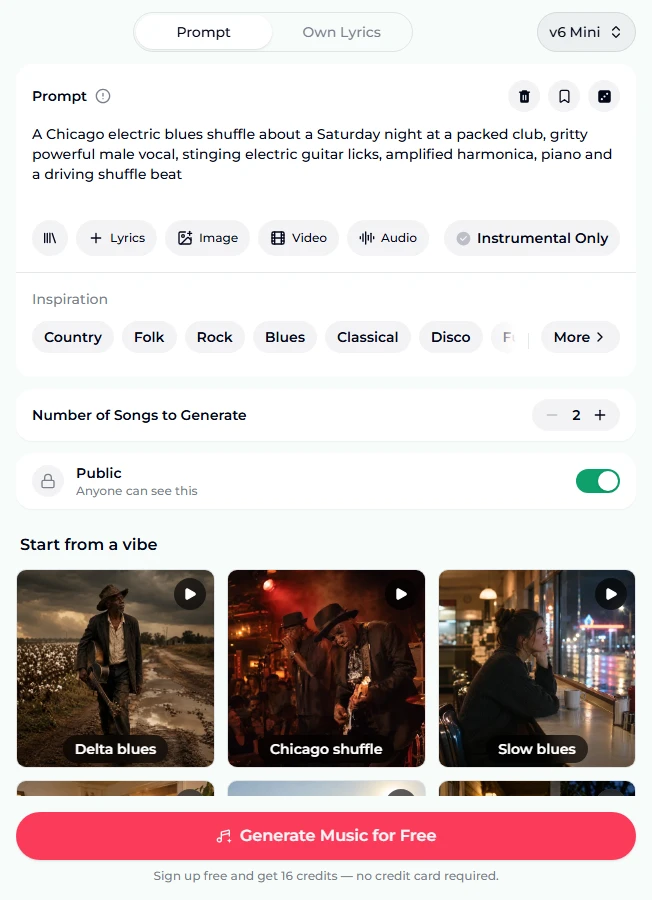
- Know the controls. Under the prompt: your prompt library, + Lyrics, Image, Video, Audio and Instrumental Only. Below: Inspiration genre chips (Blues is one of them) with More, the Number of Songs to Generate stepper starting at 2, and the Public switch.
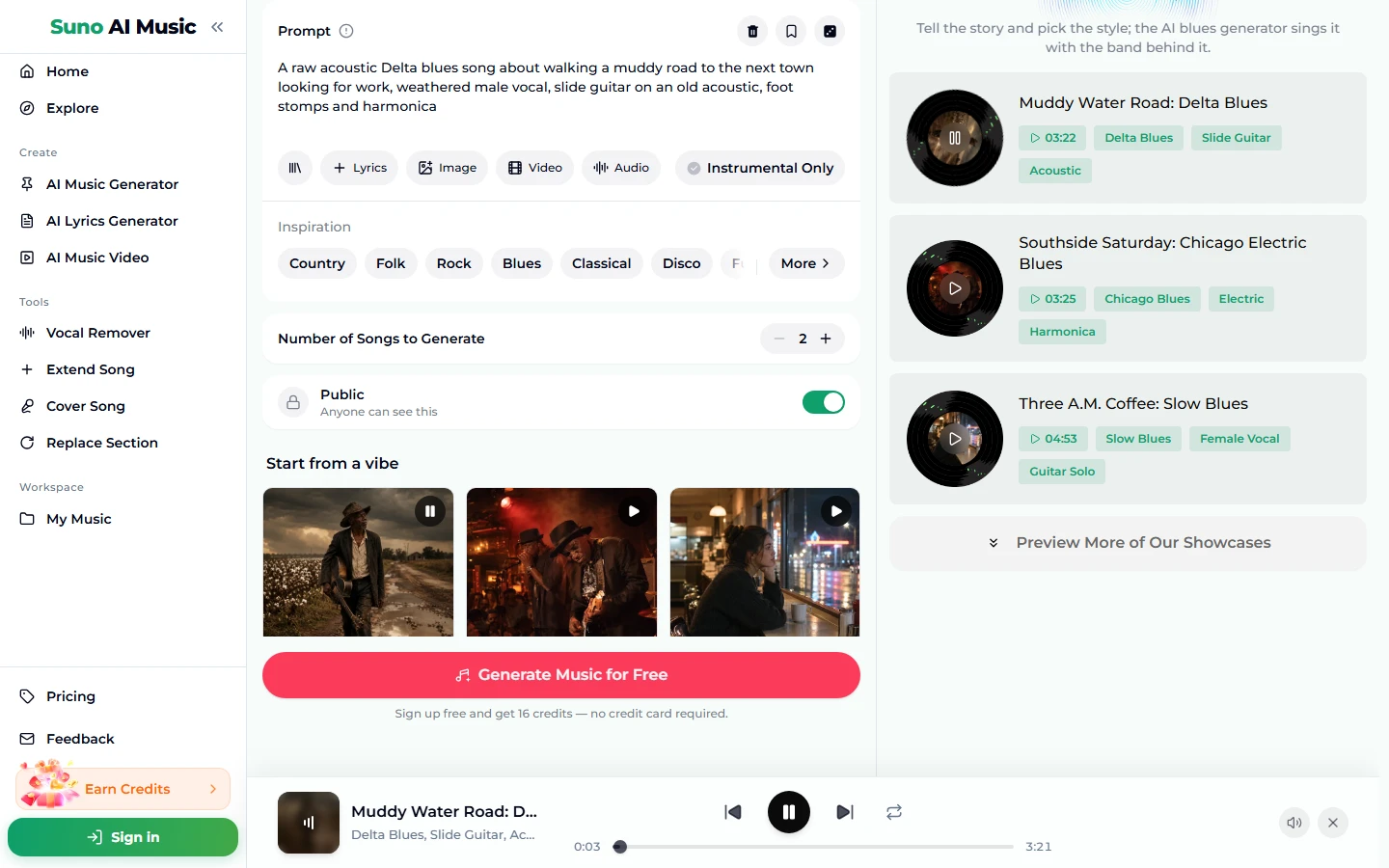
- Tap a vibe. One tap plays the example and copies its prompt. Tap Delta blues and the prompt becomes A raw acoustic Delta blues song about walking a muddy road to the next town looking for work..., and the player bar starts Muddy Water Road: Delta Blues.
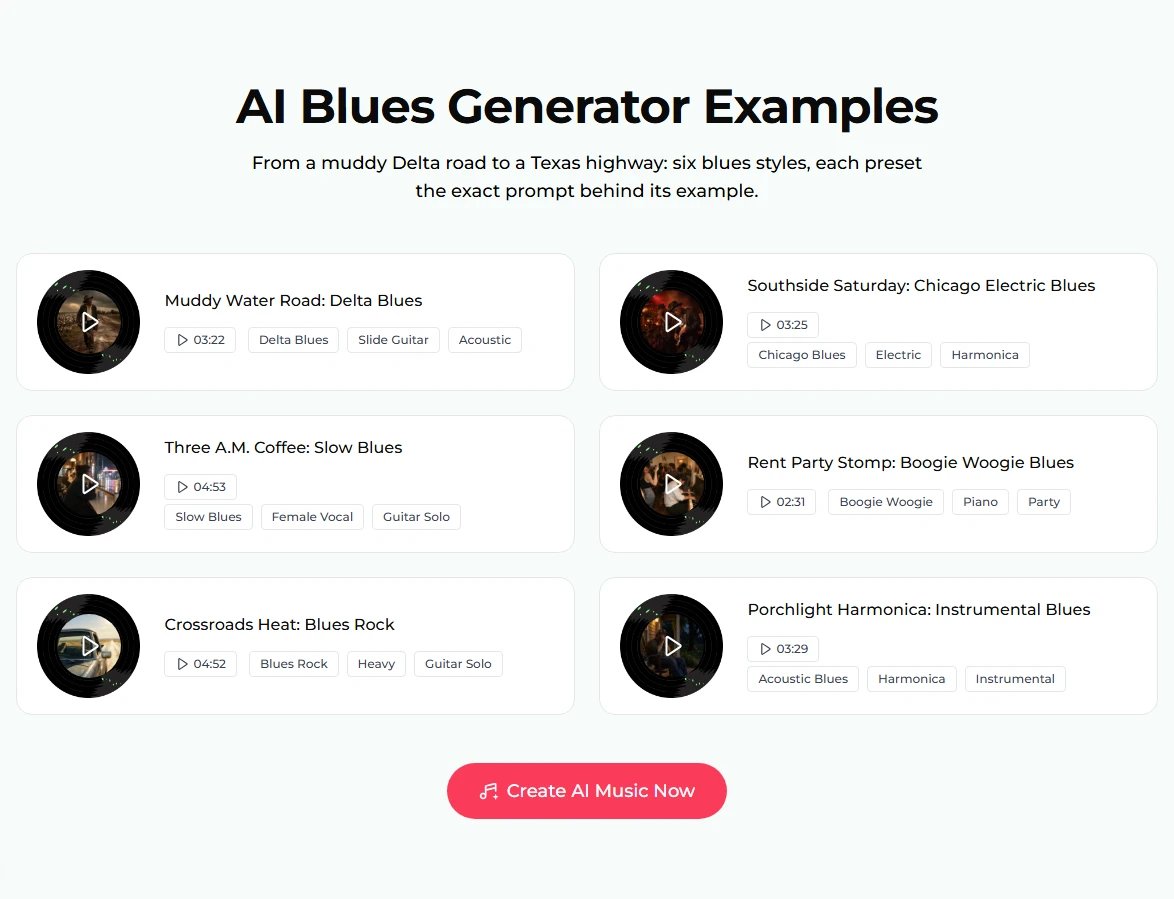
- Compare the six. The examples list shows each with its disc, title, length and tags: Muddy Water Road: Delta Blues (3:22), Southside Saturday: Chicago Electric Blues (3:25), Three A.M. Coffee: Slow Blues (4:53), Rent Party Stomp: Boogie Woogie Blues (2:31), Crossroads Heat: Blues Rock (4:52) and Porchlight Harmonica: Instrumental Blues (3:29).
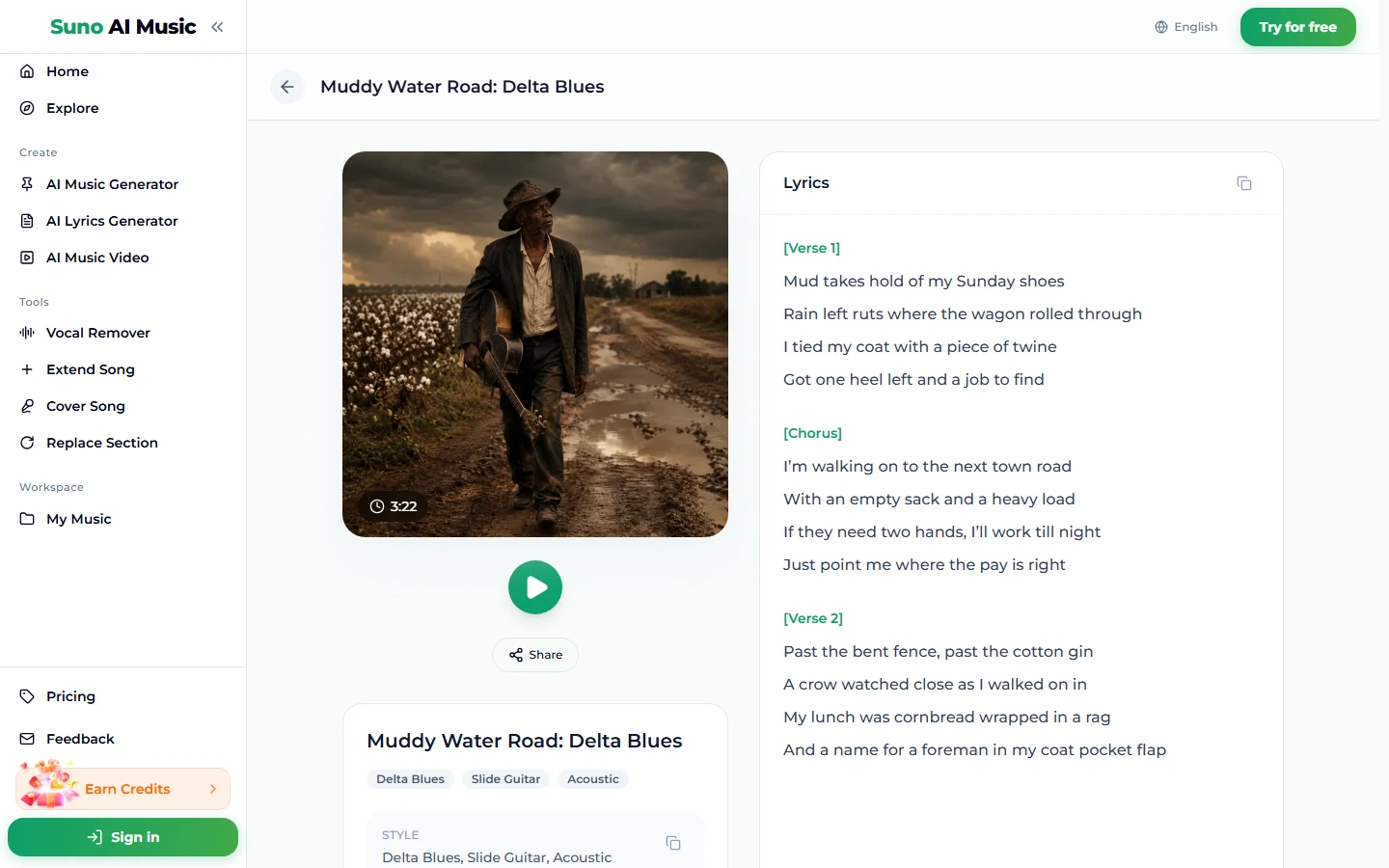
- Read the lyrics. The Delta blues example has its own page with the cover, a play button, Share, the tags and the lyrics. It opens with "Mud takes hold of my Sunday shoes / Rain left ruts where the wagon rolled through", which is the prompt's muddy road turned into concrete images.
- Press Generate Music for Free. Logged out, the note under it reads "Sign up free and get 16 credits — no credit card required". A run takes about a minute and returns two new songs in that style. The tile shows you the style; the songs you get will be your own.
Writing a blues prompt that tells a story
The five sung presets all use one sentence built the same way: style and place, the story, the voice, then the band. The instrumental one swaps the story for a tempo and a scene.
- Put the place first. A raw acoustic Delta blues song, A Chicago electric blues shuffle, A heavy blues rock song about a long hot drive across Texas. The place picks the instruments and the recording.
- Give the trouble a time and a picture. sitting alone in a diner at three in the morning after a breakup does more than a sad song. The blues is specific: an hour, an object, a road.
- Say how the voice sounds. weathered, gritty, smoky, raspy, joyful.
- Name the lead instrument and one or two others. slide guitar on an old acoustic, foot stomps and harmonica; pounding boogie piano, upright bass.
- For instrumentals, give a BPM. The harmonica preset uses 76 BPM and slow shuffle, which keeps it relaxed.
- Use your own verses if you have them. The Own Lyrics tab takes up to 5,000 characters of lyrics, a style box up to 1,000 and a title up to 80. For the classic AAB shape, write a line, repeat it, then answer it.
The Prompt box holds 500 characters. For more reliable phrasing, the Suno prompts guide has a longer list.
Six blues prompts that already work
These are the six vibes on the AI blues generator, exactly as written. Each made the example on its tile on v6.
| Vibe | What it is | Prompt |
|---|---|---|
| Delta blues | Raw acoustic, sung, 3:22 | A raw acoustic Delta blues song about walking a muddy road to the next town looking for work, weathered male vocal, slide guitar on an old acoustic, foot stomps and harmonica |
| Chicago shuffle | Electric band shuffle, 3:25 (the preset) | A Chicago electric blues shuffle about a Saturday night at a packed club, gritty powerful male vocal, stinging electric guitar licks, amplified harmonica, piano and a driving shuffle beat |
| Slow blues | Minor slow burner, 4:53 | A slow minor blues about sitting alone in a diner at three in the morning after a breakup, soulful smoky female vocal, crying electric guitar solo, organ and slow brushed drums |
| Boogie woogie | Piano party, 2:31 | A rollicking boogie woogie blues about a rent party where the whole neighborhood shows up, joyful male vocal, pounding boogie piano, upright bass and a swinging drum beat |
| Blues rock | Heavy riff and solo, 4:52 | A heavy blues rock song about a long hot drive across Texas, raspy powerful male vocal, fat overdriven guitar riff, pounding drums and a fiery guitar solo |
| Harmonica instrumental | Acoustic porch blues, 3:29 | instrumental acoustic blues, 76 BPM, expressive harmonica lead, fingerpicked acoustic guitar, slow shuffle, crickets and a warm southern night on the porch, relaxed and soulful |
Two extra recipes of our own, untested:
- A Texas blues shuffle about a pickup truck that will not start on payday, confident male vocal, big clean electric guitar tone, walking bass, shuffle drums, tongue in cheek
- slow blues guitar instrumental, 60 BPM, twelve-bar blues in A, expressive bent electric guitar lead, warm organ, soft drums, smoky late night bar (switch Instrumental Only on)
Common blues mistakes
- "Sad song" as the whole story. The blues is sad about something specific. Without a scene the lyrics come out as general complaints.
- No place or era. Blues alone can drift into a polite rock ballad. Delta, Chicago, Texas or boogie woogie give it a home.
- Too many soloists. Guitar, harmonica, sax, organ and piano all soloing crowds a twelve-bar form. One lead, one answer.
- Clean, even rhythm. If a take sounds stiff, add shuffle or swinging drum beat.
- Forgetting the toggle. The page opens with Instrumental Only off. For a backing track to play over, switch it on or tap the Harmonica instrumental vibe.
- Expecting the example back. The tile hands you its prompt, not its recording. Every run returns two new songs; if both miss in the same way, change one word.
Choosing a model
The picker at the top right has three models:
- v6 Mini ("Fast drafts, high volume") is the free tier. Good for trying stories and styles.
- v6 ("Most powerful, for any song") needs a paid plan. All six examples were made on v6, and it gives the most detail in the guitar tone and the voice.
- v6 Wild ("Best for experimental ideas") also needs a paid plan, for strange crossovers more than a classic shuffle.
Every model costs the same, 10 credits per run for two songs. After the 16 free credits, see plans and credit packs.
After the song is made
- Stretch the solo. Extend Song continues a song from any point, handy for a longer guitar break. Our guide to extending a song explains where to cut.
- Rewrite one verse. Replace Section regenerates only the part you mark.
- Change the style. Cover Song re-performs a song, for example turning a Delta blues into a Chicago band version.
- Play along. The vocal remover splits a song into two stems, vocals and instrumental, so you have a backing band to practise over.
- Add pictures. The music video generator puts the song under a video.
- Download. Downloads come with a plan; see pricing.
Blues sits next to several other styles on the site: the AI jazz generator, AI rock generator, AI country generator and AI folk generator all use the same form with their own presets.
FAQ
Can I make blues music without playing guitar?
Yes. On the AI blues generator you describe the story, the voice and the band, and the model writes, sings and plays the whole song.
Does it write lyrics in the traditional blues style?
It writes from your description, and asking for traditional blues pushes it towards the classic shape. If you want strict AAB verses, write them yourself on the Own Lyrics tab.
Can I make an instrumental blues backing track?
Yes. Switch Instrumental Only on, or tap the Harmonica instrumental vibe, and give a tempo and a key in the prompt, for example twelve-bar blues in E, 90 BPM. Suno follows them roughly.
How much does a song cost?
One run is 10 credits and returns two songs. New accounts get 16 free credits with no card.
Can I use AI blues commercially, on YouTube or Spotify?
Commercial use is included on the Standard plan and above, 2,500+ credit packs, and Team plans. Songs made with free credits, the Starter plan or the Mini credit pack are for personal use only. See pricing.
Can I get the guitar on its own?
No. The vocal remover gives two stems, vocals and instrumental; it does not separate guitar, harmonica or drums.
Can I use a recording as a reference?
Yes. Audio takes one track between 6 seconds and 30 minutes and the song borrows its feel. Image takes up to 5 photos and Video one clip. The cost is the same with or without a reference.
Final take
How to make blues music with AI comes down to three things the genre has always been about: a place, a trouble and a voice. Play the six vibes on the AI blues generator, notice how Delta, Chicago and three in the morning change the whole record, then write your own trouble into the same sentence. Two songs per run gives you a choice every time.